

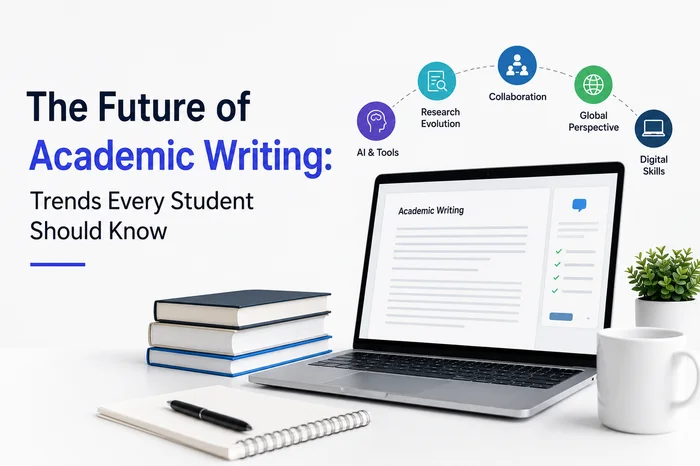
Have you ever heard that academic writing is changing faster than ever before? Well, it’s actually true. Academic writing is indeed changing, and its future trends are something that every student should know.
Just a few years ago, you had to spend hours searching for books, checking references, and formatting papers by hand. Right? But now, smart tools can help you not only organise ideas and check grammar but also suggest better sentence structures instantly.
However, teachers still want to see your own ideas, creative thinking, and problem-solving skills. The future of academic writing is about using technology wisely while keeping your work honest, meaningful, and original.
What Is the Future of Academic Writing?
Before anything else, we’ll talk about the future trends of academic writing that every student should know.
Well, you must also know that the future of academic writing is rapidly shifting toward not only AI-assisted workflows and interactive multimedia but also decentralised open-access publishing.
And rather than replacing human intellect, AI will handle foundational tasks. These tasks include formatting, data mining, and structural editing. This will allow scholars to focus more heavily on critical analysis and original thought.
The following are the key trends that are actually shaping the future of academic writing:
● Responsible AI Integration and Ethical Disclosure
You must also know that artificial intelligence is becoming a common study companion for students. Students now use AI tools not only to organise ideas and improve grammar but also to summarise information and check sentence flow.
This is actually because these tools save time and help reduce simple mistakes.
However, you must keep in mind that using AI comes with responsibility. Schools and universities are creating rules that explain when and how AI can be used. In fact, peers may even be asked to mention if AI helped with editing or brainstorming.
Well, professors are not trying to stop students from using technology. Instead, it is to make sure that everyone remains honest and transparent about their work.
However, many students also seek support from Assignment Master in NZ to understand difficult topics in a better way.
● Emphasis on Original Human Insights
On top of that, it’s true that AI is becoming more powerful every day. But as AI becomes more powerful, original thinking is becoming even more valuable.
Teachers will place greater importance not only on personal opinions and unique arguments but also on critical thinking and real-life examples in the future.
On top of that, you must also agree that AI can collect information, but it cannot replace your personal experiences or creative ideas. Right?
You must remember that students who learn to ask thoughtful questions, solve problems creatively, and think independently will have a clear advantage in academic writing.
● Visual and Multimodal Elements
However, academic writing is no longer limited to plain text. Yes, you read that right! And future assignments may include infographics, interactive charts, videos, audio recordings, digital presentations, and visual storytelling.
These elements make information easier to understand and more engaging for readers.
But does this mean that writing will disappear? Not at all! Instead, writing will work together with visuals to improve communication.
And learning how to combine words with images and multimedia will become an important academic skill in the future.
● Real-Time Peer Review
When you submit your assignments, you have to wait for days or even weeks for feedback. Right? Many learners also seek guidance from the best essay writing service in Auckland to better understand research methods, proper citation practices, and academic standards while producing original work.
But guess what? That process is changing. Yes, it’s true!
Modern online platforms now allow not only classmates and teachers but also researchers to review work almost instantly. This real-time feedback helps students fix mistakes earlier and improve their writing before final submission.
This also helps students see different viewpoints, making their arguments stronger and more balanced.
● Increased Focus on Plain English and Reader Empathy
One of the biggest changes in academic writing is the move toward simpler language.
In the past, many students believed that using difficult vocabulary made their writing look smarter. But it’s not true. Actually, it never was!
However, educators are now increasingly valuing clear communication over complicated wording.
You must remember that plain English simply means explaining ideas so almost anyone can understand them.
But what does reader empathy even mean? Well, in simple words, reader empathy means thinking about your audience while writing. Instead of trying to impress readers with complex words, successful writers focus on helping readers understand the message easily.
This trend makes academic writing more inclusive because people from different backgrounds can understand research without unnecessary confusion.
Students who write clearly often receive better feedback because their ideas are easier to follow.
Frequently Asked Questions
Will AI completely replace academic writing?
Ans. No. AI will not replace academic writing. But it’s drastically transforming the process. Rather than replacing it, AI will basically support students by handling routine tasks. But original human thinking, analysis, and creativity will remain essential.
Is it okay to use AI for assignments?
Ans. The use of AI for assignments is usually acceptable only as a study aid, research assistant, or brainstorming tool. However, submitting AI-generated text or passing off AI work as your own violates most institutional academic integrity policies and is considered plagiarism.
How can students prepare for future academic writing?
Ans. Students can prepare for future academic writing not only by building a consistent writing routine and mastering research and citation mechanics but also by refining an editing process.
Wrapping Up!
Many students may not realise this, but the future of academic writing is quite innovative and full of opportunities. On top of that, artificial intelligence, multimedia content, real-time collaboration, and open-access research are changing how students learn and communicate.
However, you must remember that these advancements do not reduce the importance of human creativity. Instead, they highlight it.
In addition to this, students who embrace technology while protecting not only their originality and honesty but also critical thinking will be the ones who succeed. You just have to keep in mind that these AI tools are just for your assistance and that they must not replace you.
As education continues to evolve, remember that great writing has never been about using the most advanced tools. It has always been about sharing meaningful ideas in a way that informs, inspires, and helps others understand the world better.





















Leave a Reply