QuickBooks Payroll is designed to simplify employee payments, tax calculations, deductions, payroll reports, and other payroll-related tasks. When payroll stops working, however, businesses may have difficulty creating paychecks, calculating taxes, downloading payroll updates, or completing payroll processing.
The phrase how to fix QuickBooks Payroll not working can describe several different problems. In one situation, payroll may fail for a single employee. In another, the entire payroll process may stop responding. Some users may see an error message, while others may notice that taxes or deductions are not calculating correctly.
The best troubleshooting approach is to identify exactly what has stopped working and then check the related settings. This guide explains practical ways to diagnose and resolve common QuickBooks Payroll problems.
What Does “QuickBooks Payroll Not Working” Mean?
QuickBooks Payroll not working does not always indicate one specific error. The problem can affect different payroll functions.
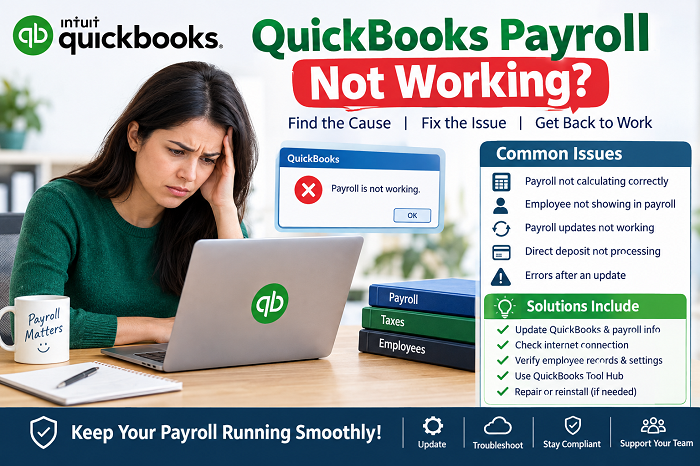
Common symptoms include:
- Payroll does not calculate correctly.
- Payroll taxes are missing or incorrect.
- Employee paychecks cannot be created.
- Payroll updates fail.
- Employee information does not appear correctly.
- QuickBooks freezes during payroll processing.
- Payroll-related windows do not open.
- Direct deposit processing does not complete.
- Payroll information does not refresh.
- An error message appears while processing payroll.
- Payroll works for some employees but not others.
Identifying the exact symptom is the first step toward finding an appropriate solution.
Why Is QuickBooks Payroll Not Working?
Several issues can interfere with payroll processing. Some are simple configuration problems, while others may involve the QuickBooks application or company file.
1. Payroll Service Status
QuickBooks Payroll features depend on the payroll service connected to the company file. If the service status is not correct, some payroll functions may not work normally.
Check the payroll service information and confirm that it is active and associated with the correct company.
2. Outdated QuickBooks Software
An outdated QuickBooks installation can cause compatibility issues with payroll services and other application components.
If you use QuickBooks Desktop, check for available updates and install the appropriate supported update before continuing with more advanced troubleshooting.
3. Outdated Payroll Updates
Payroll information should be kept current. If a payroll update has not been downloaded, payroll calculations or tax-related functions may not behave as expected.
Check for available payroll updates and allow the process to finish before testing payroll again.
4. Incorrect Employee Information
Employee records contain information that directly affects payroll.
A problem with the employee’s:
- Pay rate
- Pay type
- Tax information
- State
- Local tax details
- Deductions
- Benefits
- Payroll schedule
may cause unexpected payroll results.
5. Incorrect Payroll Items
Payroll items determine how wages, taxes, deductions, and other amounts are handled.
If a payroll item is inactive or incorrectly configured, QuickBooks may fail to calculate the associated amount correctly.
6. Internet Connection Problems
Some payroll functions require communication with online services. A weak or interrupted connection can prevent payroll updates and certain online operations from completing.
7. Company-File Problems
In some cases, problems within the company file can affect payroll functionality.
If several unrelated payroll features are failing, company data may need to be checked using the appropriate QuickBooks utilities.
How to Fix QuickBooks Payroll Not Working
The following troubleshooting process starts with basic checks and gradually moves toward more advanced solutions.
Step 1: Restart QuickBooks
Close QuickBooks completely and reopen it.
A temporary application issue can sometimes prevent payroll functions from responding correctly.
After reopening the company file, try the same payroll operation again.
If the problem continues, restart the computer and test payroll once more.
Step 2: Check the Payroll Subscription
Verify that the payroll service associated with your company file is active.
Review the payroll service information and make sure you are working in the correct company file.
If the payroll service is not active or the information does not match the company, resolve that issue before modifying employee payroll settings.
Step 3: Update QuickBooks
If you are using QuickBooks Desktop, check for available software updates.
An updated application can help address certain program and compatibility problems.
After installing an update:
- Close QuickBooks.
- Restart the computer if necessary.
- Open the company file again.
- Test payroll.
Do not interrupt an update while it is being installed.
Step 4: Download the Latest Payroll Update
Open the payroll update option available in your QuickBooks version and check for a current update.
Once the update has completed, return to the Payroll Center and try the affected operation again.
If the update fails, note the exact error message before attempting advanced troubleshooting.
Step 5: Check the Employee Record
If payroll is not working for only one employee, carefully review that employee’s information.
Check:
- Employee status
- Pay type
- Pay rate
- Hours
- Federal tax information
- State tax information
- Local tax information
- Deductions
- Benefits
- Payroll schedule
Compare the affected employee with another employee whose payroll is calculating correctly.
This comparison can reveal a configuration difference without requiring changes to the entire payroll system.
Step 6: Verify Pay Rates and Hours
Incorrect hours or pay rates can make it appear that payroll is not working.
For hourly employees, verify regular and overtime hours.
For salaried employees, verify the salary amount and payroll frequency.
Also check bonuses, commissions, or other earnings that are included in the paycheck.
Step 7: Review Payroll Items
Payroll items control the way earnings, deductions, taxes, and other amounts are calculated and recorded.
Review the payroll items associated with the affected employee.
Look for:
- Inactive payroll items
- Incorrect rates
- Incorrect tax tracking
- Duplicate items
- Missing deductions
- Incorrect employee assignments
If a payroll item was recently changed, determine whether the payroll problem started after that change.
Step 8: Check Payroll Dates
Payroll dates can affect how QuickBooks handles a paycheck.
Verify:
- Pay period start date
- Pay period end date
- Paycheck date
- Payroll schedule
- Employee pay frequency
Make sure the dates correspond to the intended payroll period.
An incorrect paycheck date or payroll schedule can produce unexpected results.
Step 9: Check the Internet Connection
If payroll updates or online payroll functions are not working, check the internet connection.
Try opening several trusted websites to confirm that the connection is stable.
Then restart QuickBooks and try the payroll operation again.
If the connection repeatedly drops, resolve the network issue before continuing with payroll troubleshooting.
Step 10: Run QuickBooks Payroll Troubleshooting Tools
QuickBooks Desktop provides troubleshooting utilities for certain application and installation-related problems.
Depending on the specific problem and QuickBooks version, available tools may help identify or repair program components.
Use the appropriate utility for the problem rather than running multiple repair tools without a clear reason.
Before performing major repairs, maintain a current company-file backup.
Step 11: Verify Company Data
If payroll problems are accompanied by unusual company-file behavior, check the company data using the appropriate QuickBooks Desktop data utilities.
The Verify Data utility can identify certain data problems. If an issue is detected, follow the recommended repair process for your QuickBooks version.
Always create a backup before performing a significant data-repair operation.
Step 12: Review Deductions and Benefits
If gross pay calculates correctly but the final paycheck is wrong, review deductions and benefits.
Common examples include:
- Retirement contributions
- Insurance
- Garnishments
- Loan repayments
- Other employee deductions
Make sure each item is active, assigned correctly, and configured according to the intended payroll setup.
Step 13: Check Payroll Tax Information
If payroll taxes are not calculating, review the employee’s tax setup and payroll information.
Check federal, state, and local tax settings where applicable.
Also verify that payroll information is current.
Do not enter a manual tax amount simply because QuickBooks did not calculate it. First determine why the calculation is missing.
Step 14: Check Date and Time Settings
Incorrect computer date or time settings can sometimes interfere with application or online-service communication.
Check the Windows date, time, and time-zone settings.
After correcting an obvious system-time problem, restart QuickBooks and test payroll again.
Step 15: Review Firewall and Security Settings
Security software can sometimes interfere with QuickBooks communication.
If payroll updates or online services are failing while other QuickBooks functions work normally, review your firewall or security software settings.
Do not permanently disable security protection just to test payroll.
Instead, review application permissions and use trusted configuration instructions for your QuickBooks version and security software.
Step 16: Try Single-User Mode
If the company file is being accessed by several users, multi-user activity may complicate troubleshooting.
If appropriate for your environment, temporarily test the payroll operation in single-user mode.
Make sure other users have finished their work before switching modes.
If payroll works in single-user mode but not in multi-user mode, investigate the network and company-file environment.
Step 17: Test Whether One or Multiple Employees Are Affected
This is an important diagnostic step.
If only one employee is affected, focus on that employee’s record, payroll items, tax setup, and deductions.
If every employee is affected, investigate broader issues such as:
- Payroll service status
- Payroll updates
- QuickBooks software
- Internet connectivity
- Company-file data
- Application configuration
This can help prevent unnecessary changes to individual employee records.
QuickBooks Payroll Not Calculating
A common symptom is that payroll opens successfully but calculations are missing or incorrect.
If this happens, review the employee’s pay rate, hours, payroll items, tax information, deductions, and payroll schedule.
Also check whether a payroll update is available.
If the issue affects multiple employees, look for a common payroll configuration or service issue.
QuickBooks Payroll Taxes Not Calculating
When payroll wages calculate but taxes do not, review the employee’s tax setup and payroll information.
Check the applicable:
- Federal tax information
- State tax setup
- Local tax setup
- Taxable earnings
- Payroll items
- Payroll update status
Payroll tax calculations can depend on multiple factors, so avoid changing several settings at the same time.
QuickBooks Payroll Update Not Working
If payroll updates fail, begin with the internet connection and QuickBooks version.
Then:
- Restart QuickBooks.
- Confirm the network connection.
- Check for QuickBooks updates.
- Check payroll service status.
- Attempt the payroll update again.
- Record any error code or message.
If the same update error continues, the exact message can provide useful information for further troubleshooting.
QuickBooks Payroll Not Working After an Update
If payroll stopped working immediately after a QuickBooks or payroll update, document the issue before making additional changes.
Check whether:
- The update completed successfully.
- Payroll service information is correct.
- Payroll updates are current.
- Employee records remain intact.
- The issue affects one employee or several.
- A specific error message appears.
Avoid deleting payroll transactions simply because the problem started after an update.
QuickBooks Payroll Not Working in Multi-User Mode
Multi-user environments require additional attention because several users may access the company file.
If payroll works in single-user mode but fails in multi-user mode, review the network configuration and company-file access settings.
Make sure the company file is stored in an appropriate location and that users have the required permissions.
QuickBooks Payroll Not Working for One Employee
When only one employee is affected, compare that employee’s information with another employee whose payroll works normally.
Focus on differences in:
- Pay rate
- Pay type
- Tax settings
- State
- Local tax information
- Deductions
- Benefits
- Payroll items
- Pay schedule
This can help isolate an employee-specific configuration problem.
QuickBooks Payroll Not Working for All Employees
When every employee is affected, do not start changing individual employee records.
Instead, investigate system-wide causes.
Check:
- Payroll subscription
- Payroll service status
- Payroll updates
- QuickBooks updates
- Internet connectivity
- Company-file data
- Security settings
- Multi-user configuration
If several payroll functions fail simultaneously, broader application or service troubleshooting may be appropriate.
What Not to Do During Payroll Troubleshooting
Payroll records should be handled carefully.
Avoid:
- Randomly changing employee tax settings.
- Manually entering tax amounts without understanding the cause.
- Deleting historical payroll transactions unnecessarily.
- Creating duplicate payroll items.
- Repeatedly recreating failed paychecks.
- Deactivating payroll services without a specific reason.
- Running data-repair tools without a backup.
- Installing unofficial software or payroll files.
- Ignoring recurring error messages.
A troubleshooting change that appears to solve one problem can create another if the underlying cause is not understood.
How to Prevent QuickBooks Payroll Problems
Regular maintenance can reduce payroll interruptions.
Keep Software Updated
Install supported QuickBooks updates and keep payroll information current.
Review Employee Records
Update pay rates, deductions, benefits, tax information, and other employee details when changes occur.
Check Payroll Before the Deadline
Perform a preliminary review before the final payroll run. This provides time to investigate unexpected results.
Maintain Backups
Keep appropriate company-file backups, especially before making major changes or running repair utilities.
Document Changes
Record significant changes to payroll items, employee settings, schedules, or other payroll configuration.
Avoid Unnecessary Configuration Changes
Do not modify tax or payroll settings just to make an error disappear. Identify the cause first.
QuickBooks Payroll Troubleshooting Checklist
Use this checklist when payroll is not working:
- Restart QuickBooks.
- Restart the computer.
- Check payroll service status.
- Update QuickBooks Desktop if applicable.
- Download the latest payroll update.
- Review employee information.
- Verify pay rates and hours.
- Check payroll items.
- Review deductions and benefits.
- Verify payroll dates.
- Check the internet connection.
- Review security and firewall settings.
- Test single-user mode when appropriate.
- Check company-file data.
- Record the exact error message if the issue continues.
When to Seek Additional QuickBooks Assistance
If the problem continues after basic troubleshooting, gather detailed information before seeking additional assistance.
Useful details include:
- QuickBooks product and version
- Payroll service type
- Exact error message
- Error code, if available
- Affected employee or employees
- Payroll date
- When the problem began
- Recent updates or configuration changes
- Troubleshooting steps already completed
This information can help identify whether the issue involves the employee record, payroll service, application, company file, or another component.
Frequently Asked Questions
How do I fix QuickBooks Payroll not working?
Start by checking the payroll service, QuickBooks version, payroll updates, employee information, payroll items, dates, and internet connection. If the problem continues, use appropriate QuickBooks troubleshooting tools and company-file checks.
Why is QuickBooks Payroll not calculating?
Possible causes include outdated payroll information, incorrect employee setup, payroll-item problems, incorrect dates, or company-file issues.
Why are payroll taxes not calculating?
Review the employee’s tax information, payroll items, taxable earnings, and payroll update status. The exact cause depends on the employee and payroll configuration.
Why does payroll work for one employee but not another?
The employees may have different pay rates, tax information, deductions, benefits, payroll items, or schedules. Comparing the records can help identify the difference.
Can an outdated payroll update cause problems?
Yes. Payroll functions can depend on current payroll information, so checking for available payroll updates is an important troubleshooting step.
Can internet problems stop QuickBooks Payroll?
Certain payroll functions require online communication, so connectivity problems can interfere with updates and other service-related tasks.
Should I manually change payroll tax amounts?
Do not make manual changes simply because a calculation is missing. First determine why QuickBooks is not producing the expected calculation.
What should I do if QuickBooks Payroll still does not work?
Document the exact error, affected employees, payroll date, QuickBooks version, payroll service, and troubleshooting steps already attempted. This information can help with further investigation.
Final Thoughts
When QuickBooks Payroll is not working, the most useful approach is to identify the exact symptom and determine its scope. Start with basic checks such as restarting QuickBooks, verifying the payroll service, installing available updates, and reviewing employee information.
If the problem involves calculations, focus on pay rates, hours, payroll items, taxes, deductions, and payroll dates. If multiple employees are affected, investigate system-wide factors such as payroll updates, connectivity, company-file data, and application configuration.
Most importantly, avoid making unnecessary changes to payroll records. Keep backups, document important changes, and work through the troubleshooting process one step at a time. This helps protect payroll information while making it easier to identify the underlying cause.