

The broadcast industry is at a turning point. Stations that once ran entirely on hardware racks, linear schedules, and manual workflows are now facing a fundamental question: adapt or fall behind. Broadcasting Operations have never been more complex — or more full of opportunity — than they are right now.
Streaming platforms are pulling audiences away from traditional channels. Advertiser expectations have shifted. And the pressure to distribute content across more platforms with leaner teams is mounting every day. Digital transformation isn’t a future talking point for media organizations. For many, it’s already an operational reality they’re navigating in real time.
What Digital Transformation Actually Means for Broadcasting Operations
“Digital transformation” gets used loosely, but in the context of broadcast media, it means something specific: replacing or augmenting legacy, hardware-dependent systems with flexible, software-driven infrastructure that can scale, adapt, and integrate across platforms.
For most stations, this shift doesn’t happen overnight. It starts with one pain point — maybe it’s the inefficiency of manual Broadcasting Scheduling, or the cost of maintaining aging playout hardware. From there, it expands into a broader rethinking of how Broadcasting Operations are structured from the ground up.
The organizations making this transition successfully aren’t the ones chasing every new technology. They’re the ones making deliberate choices about which tools solve real problems and fit their existing workflows.
The Move Away from Legacy Hardware to Cloud-Based Infrastructure
For decades, broadcast infrastructure meant physical equipment — servers, routers, playout systems — housed in dedicated facilities and maintained by on-site engineers. That model worked when content lived on one or two channels and audiences were predictable.
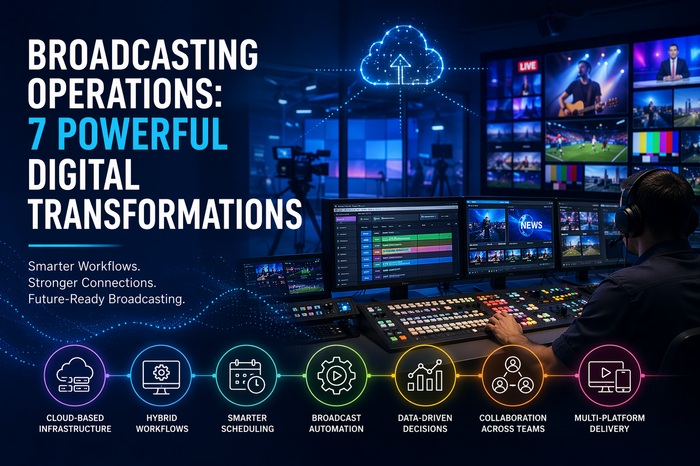
That’s no longer the environment most broadcasters operate in. Cloud-based Broadcast Solutions have changed the equation by moving core functions — storage, processing, playout, and distribution — off physical hardware and into flexible, remotely accessible infrastructure. The result is lower capital expenditure, faster deployment, and the ability to scale capacity up or down based on demand.
For Radio & TV Broadcasting organizations with multiple stations or regional operations, cloud infrastructure also enables centralized management across locations. A team in one city can monitor and support Broadcasting Operations happening across an entire network — without a technician needing to be physically present at every site.
How Hybrid Broadcast Software Bridges the Gap
Not every station is ready — or able — to go fully cloud-native overnight. Legacy equipment still works. Existing workflows still function. And for many operations, a full infrastructure overhaul carries more risk than the organization can absorb at once.
This is where Hybrid Broadcast Software plays a critical role. Rather than forcing a choice between old and new, hybrid solutions allow broadcasters to integrate cloud-based capabilities with existing on-premise systems. Content can move between environments based on need, cost, and workflow logic — without disrupting what’s already working.
Hybrid Broadcast Software is particularly valuable for stations in transition. It allows teams to build confidence in new systems while maintaining the reliability of proven infrastructure. Over time, the balance can shift further toward cloud-based tools as the organization’s comfort and capability grow.
Smarter Scheduling and the Role of Broadcasting Management Software
One of the areas where digital transformation delivers the most immediate, measurable value is scheduling. Traditional Broadcasting Scheduling was labor-intensive — built around spreadsheets, manual entries, and constant coordination between traffic, programming, and production teams.
Modern Broadcasting Management Software automates much of this process. It integrates scheduling with traffic systems, rights management, and content libraries, reducing the manual touchpoints that create errors and delays. When a change needs to be made — a last-minute programming swap, a breaking news segment, an advertiser update — the system can adapt in real time rather than requiring a manual cascade of updates across departments.
For stations running Broadcasting Operations across multiple platforms simultaneously, this kind of automation isn’t just a convenience. It’s what makes multi-platform distribution manageable at all.
Choosing the Right Broadcasting Solutions for Your Operation
With so many tools and platforms entering the market, choosing the right Broadcasting Solutions requires more than a feature checklist. It requires an honest assessment of where your operation is today, where it needs to go, and what gaps are creating the most friction right now.
The strongest Broadcasting Software platforms on the market share a few common qualities: they integrate cleanly with existing systems, they offer scalable pricing that fits organizations of different sizes, and they’re backed by vendors who understand the specific demands of Broadcasting Operations — not just software in general.
Support matters as much as functionality. Broadcast environments don’t have business hours. When something goes wrong during a live transmission, the team behind your tools needs to be reachable and responsive.
It’s also worth thinking beyond the immediate purchase. The right Broadcasting Solutions partner isn’t just selling a product — they’re helping you build an infrastructure that can absorb the next wave of change, whatever form it takes. A well-chosen solution should also provide flexibility for integration with future technologies, ensure long-term cost efficiency, and enable teams to streamline workflows without extensive retraining or operational disruption.
The Road Ahead for Broadcast Media
The pace of change in broadcast media shows no signs of slowing. IP-based workflows, AI-assisted content management, and real-time audience analytics are already moving from experimental to standard. Broadcasting Operations teams that build flexible, software-driven foundations now will be far better positioned to adopt these capabilities as they mature.
Digital transformation in broadcasting isn’t about replacing what works. It’s about removing what holds you back — the manual processes, the siloed systems, the infrastructure that can’t flex when the industry does.
The broadcasters leading the way aren’t the biggest or the best-funded. They’re the ones making smart, deliberate technology decisions today that compound into competitive advantages tomorrow.
If your current operation feels more reactive than strategic, it may be time to take a closer look at what modern Broadcasting Operations tools can actually do for your team.
The broadcasters leading the way aren’t the biggest or the best-funded. They’re the ones making smart, deliberate technology decisions today that compound into competitive advantages tomorrow. Organizations that embrace innovation gradually, invest in staff training, and prioritize scalable digital ecosystems will find it easier to adapt to evolving viewer behavior, new monetization models, and the growing demand for multi-platform content delivery.




















Leave a Reply