

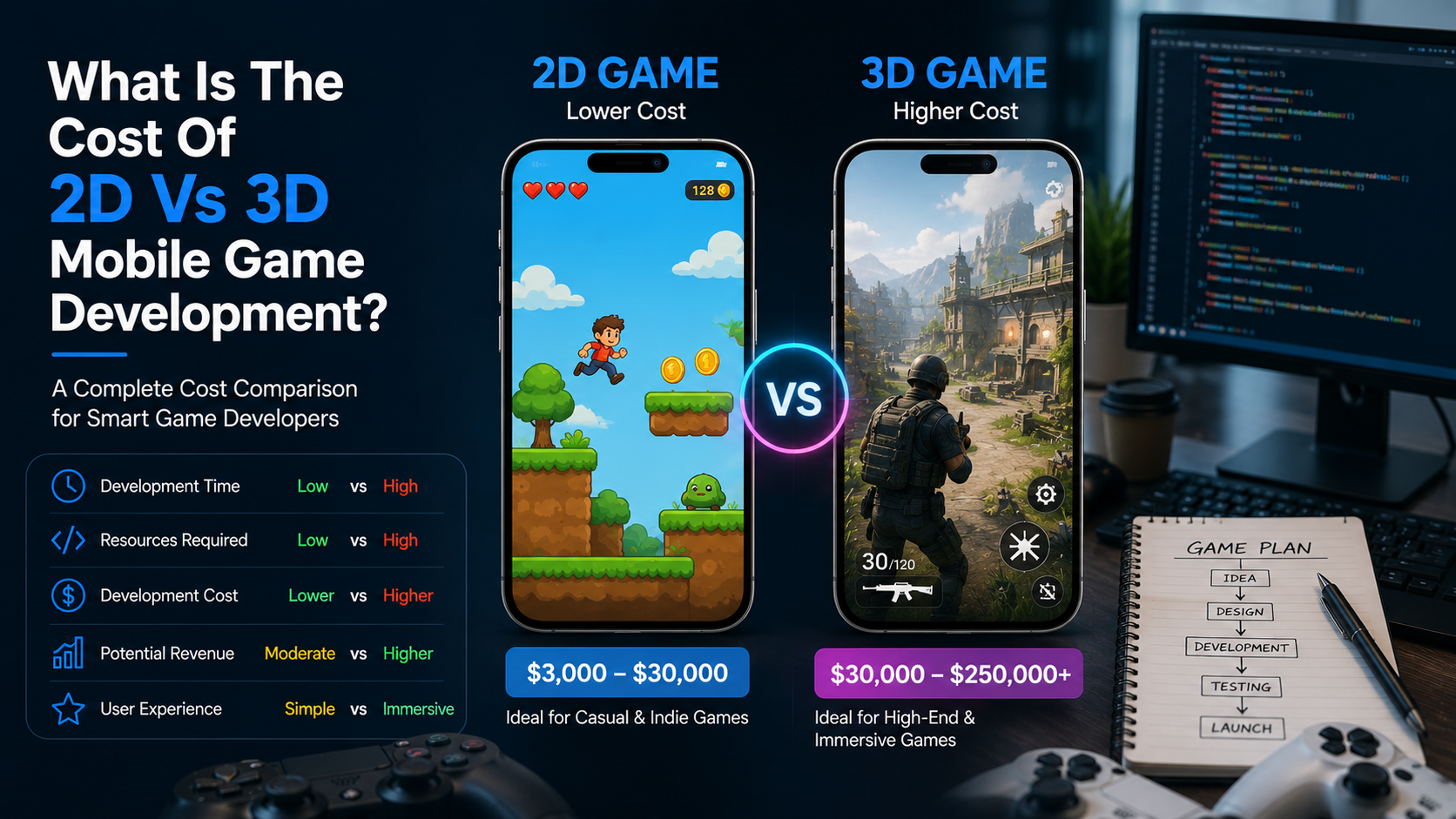
People often assume the biggest difference between 2D and 3D games is visual style. In reality, the bigger difference usually shows up in production complexity and budget.
A simple-looking 3D game can cost significantly more than a polished 2D game, even when both seem similar to players on the surface. That surprises a lot of first-time founders and indie studios.
The reason is that game development costs are shaped by much more than gameplay mechanics. Art pipelines, animation systems, optimization work, testing requirements, and team structure all change depending on whether a game is built in 2D or 3D.
This is why many businesses consult a mobile game development company before deciding which direction to take. Choosing the wrong scope early can quietly stretch timelines and budgets far beyond the original estimate.
And honestly, not every game idea needs a full 3D production.
Sometimes, 2D is the smarter choice creatively and financially.
Understanding The Difference Between 2D And 3D Games
Before talking about budgets, it helps to define what changes technically between the two.
2D games operate on flat environments using sprites, frame-based animations, and simpler rendering systems.
3D games use:
- models
- textures
- lighting systems
- camera controls
- environmental depth
- physics simulations
That extra dimension affects nearly every stage of development.
Games like Among Us succeed with relatively simple visual structures, while titles like Genshin Impact require significantly larger production ecosystems.
Both are successful. Their development requirements are completely different.
Why 3D Games Usually Cost More?
The cost difference mostly comes down to production layers.
A 2D character may require:
- concept art
- sprite creation
- frame animation
A 3D character often requires:
- sculpting
- retopology
- rigging
- texturing
- animation
- lighting adjustments
- rendering optimization
That pipeline naturally takes more time and more specialized talent.
3D environments also demand heavier optimization because mobile hardware limitations become more noticeable with complex rendering systems.
2D Mobile Game Development Costs
2D games are generally cheaper to produce, especially for indie teams or startups.
What Makes 2D Development More Affordable?
Several factors reduce production overhead:
- Smaller art teams
- Simpler animation workflows
- Lower hardware requirements
- Faster testing cycles
- Easier optimization
Games like Candy Crush Saga prove that massive revenue does not require advanced 3D graphics.
The simplicity of 2D also speeds up iteration. Teams can test mechanics faster without waiting for large rendering pipelines.
Common Cost Range For 2D Games
The budget depends heavily on complexity.
1. Simple 2D Games
Examples:
- puzzle games
- hypercasual games
- arcade-style games
Usually involves:
- basic mechanics
- limited animations
- minimal backend systems
2. Mid-Level 2D Games
Examples:
- platformers
- multiplayer indie games
- strategy games
These require:
- custom UI systems
- progression systems
- online connectivity
- more detailed art pipelines
3. Advanced 2D Games
Some 2D games become surprisingly expensive when they include:
- multiplayer infrastructure
- procedural systems
- advanced combat mechanics
- large content libraries
At that point, the gameplay systems matter more than the art dimension itself.
3D Mobile Game Development Costs
3D development introduces significantly more technical complexity.
Even basic 3D games require:
- model creation
- lighting systems
- environmental optimization
- camera systems
- physics calculations
That means larger teams and longer production timelines.
Why 3D Development Becomes Expensive
A major reason is asset production.
Creating one polished 3D environment can take weeks, depending on the detail level.
Then comes optimization.
Mobile devices vary massively in performance capability. A game running smoothly on flagship phones may struggle badly on older hardware.
Optimization work in 3D development often becomes one of the most time-consuming stages.
Common Cost Range For 3D Games
1. Simple 3D Games
Examples:
- endless runners
- stylized arcade games
- low-poly games
These are relatively manageable if the scope stays controlled.
2. Mid-Level 3D Games
Examples:
- racing games
- third-person shooters
- action adventure games
These require:
- detailed animations
- AI systems
- advanced environments
- multiplayer support in some cases
3. AAA-Style Mobile Games
Games approaching console-quality visuals become dramatically more expensive.
Titles like PUBG Mobile require:
- large engineering teams
- LiveOps infrastructure
- networking systems
- high-end rendering optimization
At this level, budgets rise fast.
Art Style Impacts Cost More Than People Expect
This part gets overlooked constantly.
A realistic 3D art direction costs much more than stylized visuals because realism requires:
- higher texture quality
- more detailed animations
- advanced lighting
- complex environmental assets
Stylized games often reduce production complexity while still looking visually appealing.
Games like Minecraft prove that artistic direction can matter more than graphical realism.
Development Team Structure Changes Too
2D teams are usually smaller.
A basic 2D mobile game may only need:
- a few developers
- one artist
- a UI designer
- a tester
3D games often require:
- 3D modelers
- animators
- technical artists
- lighting specialists
- optimization engineers
This naturally increases payroll costs.
Engine Choice Also Affects Budget
Most mobile games rely on engines like:
- Unity
- Unreal Engine
Unity is heavily used in both 2D and mobile-focused 3D development because it handles cross-platform deployment efficiently.
Unreal Engine tends to shine more in visually ambitious 3D projects, though it may require more powerful production pipelines.
The engine itself is rarely the biggest expense. The team expertise required to use it effectively is what impacts cost.
Multiplayer Features Increase Costs In Both 2D And 3D
Once multiplayer enters the project, budgets rise regardless of art style.
Networking systems require:
- server infrastructure
- synchronization systems
- matchmaking
- anti-cheat measures
- backend maintenance
This is where overall mobile game development cost often expands beyond initial estimates because post-launch infrastructure becomes part of the budget too.
Which Is Better Financially: 2D Or 3D?
There’s no universal answer.
2D games are usually:
- cheaper
- faster to develop
- easier to optimize
3D games are usually:
- visually immersive
- more marketable in certain genres
- technically demanding
The better choice depends on:
- target audience
- gameplay style
- monetization strategy
- production budget
A polished 2D game with strong retention can outperform an expensive 3D project financially.
That happens more often than people think.
Hidden Costs Most Teams Forget
Early estimates often ignore:
- post-launch updates
- bug fixing
- optimization patches
- content expansions
- App Store Compliance Update
- LiveOps management
Those costs continue long after release.
Especially for multiplayer or live-service games.
Final Thoughts
The cost difference between 2D and 3D mobile game development goes far beyond visuals.
2D development usually offers faster production, smaller teams, and lower technical overhead. 3D development introduces deeper immersion but also significantly higher complexity in art production, optimization, and engineering.
What matters most is not choosing the “better” format. It’s choosing the format that realistically fits the game you’re trying to build.
Because in mobile gaming, scope mistakes are often more expensive than technical mistakes.



























Leave a Reply