

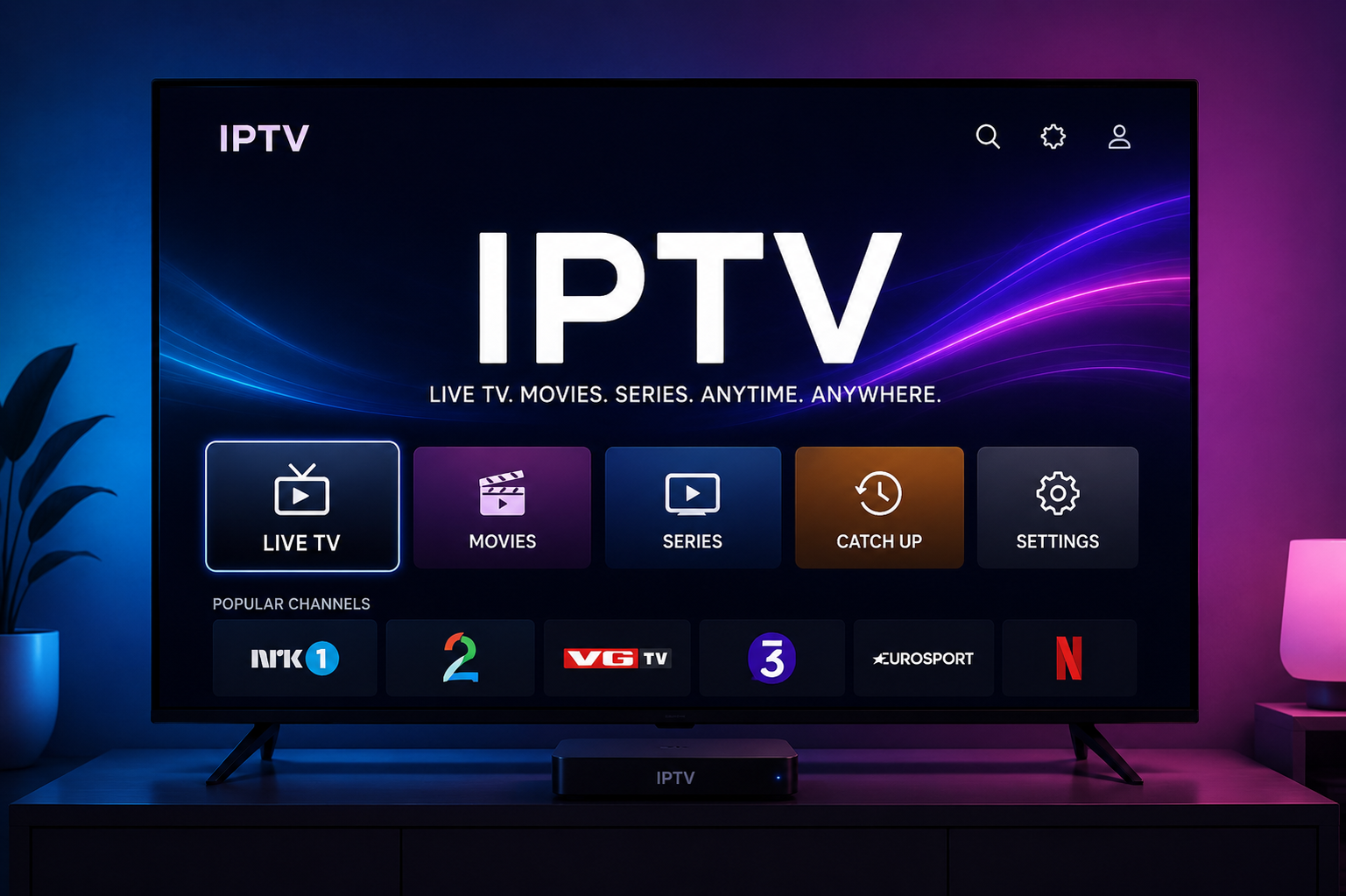
IPTV Free Trial Norway
An IPTV free trial Norway gives us an opportunity to evaluate a service before deciding whether it is suitable for everyday viewing. While a longer trial provides more information, even a carefully planned five-minute test can reveal several important details.
The key is to use those five minutes wisely.
Instead of randomly opening one channel and deciding that everything is good, we can test the areas that matter most: channel loading, picture quality, buffering, audio, navigation, channel switching, and device performance.
A short test cannot prove everything about a service, but it can quickly identify obvious strengths and weaknesses.
Why a Five-Minute Test Is Useful
Most viewers do not want to spend hours troubleshooting a service just to discover that it does not work properly on their device.
A focused five-minute test gives us an initial screening process.
Within a few minutes, we can determine whether:
- The application opens correctly
- Channels load without excessive delay
- Picture quality is acceptable
- Audio stays synchronized
- Channel switching is responsive
- Buffering appears immediately
- The application remains stable
- Our preferred device handles playback properly
If a service struggles with basic functions during the first few minutes, that is a reason to investigate further before spending money.
Minute 1: Check the Application and Login
The first minute should focus on basic setup.
We can open the IPTV application and check whether the service is easy to access.
Look at:
- Login process
- Application startup
- Menu loading
- Channel list
- Categories
- Search function
- Program guide, if available
The application should respond reasonably quickly.
If menus repeatedly freeze or basic sections fail to load, we should take note.
A smooth interface is important because we will interact with it every time we watch television.
Minute 2: Test Your Most Important Channel
During the second minute, we should choose one of our most important channels.
Rather than selecting a random channel, we should choose something we genuinely expect to watch regularly.
Check whether the channel:
- Starts quickly
- Displays a stable picture
- Provides clear audio
- Maintains synchronization
- Experiences buffering
This gives us a more meaningful result than testing content we are unlikely to watch.
Minute 3: Switch Between Several Channels
The third minute can be used to test channel switching.
Move between several channels from different categories and observe how quickly they begin playing.
We can test:
- A preferred Norwegian channel
- A news channel
- An entertainment channel
- A sports channel
- Another channel from a different category
We should look for noticeable differences in loading time and playback quality.
Fast and predictable channel switching can make IPTV much more convenient for everyday use.
Minute 4: Check Picture and Audio Quality
During the fourth minute, we should pay closer attention to the actual viewing quality.
Look at the picture for:
- Pixelation
- Blurry scenes
- Frozen frames
- Compression artifacts
- Sudden quality changes
At the same time, listen for:
- Audio delays
- Sound interruptions
- Distorted audio
- Unusual volume changes
A stream can load successfully but still provide an uncomfortable viewing experience.
Minute 5: Stress-Test the Basic Experience
The final minute can be used to perform a quick overall check.
Switch between channels again, open the menu, return to playback, and check whether the application continues responding normally.
If possible, test the service while other normal household internet activities are happening.
We should observe whether:
- Playback remains stable
- Menus respond normally
- Channels continue loading
- Buffering appears
- The device becomes slow
- Picture quality changes
This final step provides a quick overview of the service’s basic behavior.
Do Not Judge IPTV Only by Speed
A fast internet connection is helpful, but internet speed is not the only factor affecting IPTV performance.
Our experience can also depend on:
- Wi-Fi signal strength
- Router performance
- Network congestion
- Device hardware
- Application quality
- Stream quality
- Provider infrastructure
If buffering occurs, we should avoid immediately blaming either the IPTV provider or our internet connection.
Instead, we can compare the results with other streaming services on the same device and network.
Test Your Actual Viewing Device
A five-minute test is most useful when performed on the device we plan to use regularly.
If our main screen is a Smart TV, we should test IPTV on that television.
If we intend to use a streaming box or another supported device, we should test that hardware instead.
A service can perform differently across devices because of differences in hardware, software, applications, and network connections.
The goal is to evaluate our actual setup, not someone else’s.
Check Your Preferred Channels
A large channel list can look impressive, but it is not necessarily useful.
We should identify the channels that matter most to us before starting the test.
For example, our priority might be:
- Norwegian programming
- News
- Sports
- Movies
- Entertainment
- International channels
During the IPTV Norway trial, we should check these channels first.
If the channels we actually want are unavailable or unreliable, a huge overall channel count will not solve the problem.
Look for Immediate Buffering
Buffering during the first few minutes deserves attention, especially if it happens repeatedly.
However, one brief interruption does not automatically mean the entire service is unreliable.
We should ask:
Did buffering happen once or several times?
Did it affect one channel or several?
Was our internet connection being heavily used?
Did other streaming services experience the same problem?
These questions help us understand what may be happening.
Check Channel Loading Time
Loading time can have a major impact on the viewing experience.
When we select a channel, we want playback to begin without an unnecessarily long wait.
During the five-minute test, we can switch between several channels and compare their startup behavior.
If one channel takes longer than another, that does not necessarily indicate a major problem. However, if many channels repeatedly take a long time to load, we should investigate further.
Explore the Program Guide
If the IPTV service includes an electronic program guide, we should open it during the test.
We can check whether:
- The guide loads quickly
- Program information is available
- Channels are organized clearly
- Navigation is simple
- The information appears useful
A good program guide can make a large channel selection easier to manage.
Test Search and Favorites
Search and favorites are particularly useful when a service offers a large number of channels.
If these features are available, we can quickly test them.
Try searching for a preferred channel and then add it to favorites if the application supports that function.
The process should be reasonably straightforward.
These small features can have a significant impact on everyday convenience.
Try the Test During Peak Hours
A five-minute test can be performed at different times to make it more useful.
If possible, we can repeat the test during a normal evening viewing period.
Busy hours may provide additional information about performance when more people are using internet services.
We can compare:
| Testing Time | Purpose |
|---|---|
| Morning | Basic performance |
| Afternoon | Normal daytime conditions |
| Evening | Typical viewing period |
| Weekend | Different household conditions |
The same five-minute process can therefore become a useful comparison tool.
Use the Test as a Screening Tool
The five-minute test should not replace a longer trial.
Instead, it should act as a first screening process.
If the service performs well, we can continue testing it for a longer period.
If serious problems appear immediately, we can investigate those issues before investing more time or money.
This approach makes the trial more efficient.
What a Good Five-Minute Test Can Reveal
A focused test can reveal several important characteristics.
1. Basic Application Performance
We can see whether the application opens, responds, and navigates properly.
2. Channel Accessibility
We can determine whether important channels are available and load correctly.
3. Initial Streaming Quality
We can assess picture and audio quality.
4. Channel Switching
We can see whether moving between channels is reasonably smooth.
5. Immediate Buffering
Repeated early buffering can indicate that further investigation is needed.
6. Device Compatibility
We can confirm whether our preferred device handles the service properly.
What the Five-Minute Test Cannot Reveal
It is equally important to understand the limitations of a short test.
Five minutes cannot reliably tell us how the service will perform over several weeks.
It may not reveal:
- Long-session stability
- Weekend performance
- Consistent peak-hour behavior
- Occasional outages
- Customer support quality
- Long-term application reliability
- Changes in channel availability
For these reasons, a successful five-minute test should be considered a good first impression, not final proof.
Extend the Test After the First Five Minutes
If the initial test goes well, we can continue watching.
A longer session allows us to evaluate whether the early performance continues.
We can watch for:
- Recurring buffering
- Picture-quality changes
- Audio synchronization
- Application freezes
- Channel interruptions
- Device overheating or slowdowns
Longer testing provides a much more complete picture.
Compare IPTV With Other Streaming Services
A useful way to investigate streaming problems is to compare IPTV with another streaming service using the same device and internet connection.
If several services experience similar problems, our local connection may be contributing to the issue.
If other services perform normally while IPTV repeatedly struggles, we should investigate the IPTV service or specific streams more closely.
This comparison prevents us from making assumptions based on a single test.
IPTV Subscription Norway
After completing the initial test and, ideally, a longer trial, we can decide whether an IPTV subscription Norway is worth considering.
We should evaluate the complete experience instead of focusing on one successful five-minute session.
| Factor | What to Check |
|---|---|
| Channels | Are preferred channels available? |
| Quality | Is the picture clear and consistent? |
| Stability | Does playback remain reliable? |
| Buffering | Are interruptions limited? |
| Application | Is navigation easy? |
| Devices | Does it work on our main device? |
| Support | Is help available when needed? |
| Pricing | Is the cost clearly explained? |
| Terms | Are renewal and cancellation clear? |
| Content rights | Is the content properly authorized? |
This gives us a more balanced basis for making a subscription decision.
Review Subscription Terms Before Paying
Technical performance is only part of the evaluation.
Before choosing a longer subscription, we should understand the provider’s terms.
We should check:
- Trial duration
- Regular subscription price
- Renewal conditions
- Cancellation process
- Refund policy
- Supported devices
- Payment requirements
Clear terms help us understand exactly what we are signing up for.
Check Content Authorization
We should also consider whether the provider has the necessary rights to distribute the channels and content it offers.
A large channel list does not automatically mean that every channel is legally authorized for distribution.
Before committing to a paid plan, we should look for credible information about the provider and its content rights.
This is an important part of choosing an IPTV service responsibly.
Five-Minute IPTV Checklist
We can save this checklist for our next trial:
- Open the IPTV application
- Complete the login process
- Test one important channel
- Test several additional channels
- Check channel loading speed
- Monitor buffering
- Check picture quality
- Check audio synchronization
- Test channel switching
- Open the program guide
- Test search
- Test favorites
- Check application responsiveness
- Test during a normal viewing period
- Continue with a longer session if results are positive
- Review subscription terms
- Consider content authorization
Final Thoughts
An IPTV free trial Norway does not require hours of testing before we can form an initial opinion. A carefully structured five-minute test can quickly reveal whether the application, channels, picture quality, audio, navigation, and basic streaming performance meet our expectations.
However, the five-minute test should be treated as a starting point rather than a complete evaluation.
If the service performs well, we can continue with longer viewing sessions and peak-hour testing. If serious problems appear immediately, we can investigate the cause before considering an IPTV subscription Norway.
The smartest approach is to use the first five minutes to identify obvious issues, then use the rest of the trial to confirm stability, quality, compatibility, value, and everyday usability.
When using an IPTV Free Trial Norway, we can quickly test whether an IPTV service meets our everyday streaming needs before choosing an IPTV subscription Norway. An IPTV Free Trial Norway allows us to check channel availability, picture quality, buffering, loading speed, audio synchronization, and device compatibility under real-world conditions. When using an IPTV Free Trial Norway, we can quickly test whether an IPTV service meets our everyday streaming needs before choosing an IPTV subscription Norway. An IPTV Free Trial Norway allows us to check channel availability, picture quality, buffering, loading speed, audio synchronization, and device compatibility under real-world conditions.






















Leave a Reply