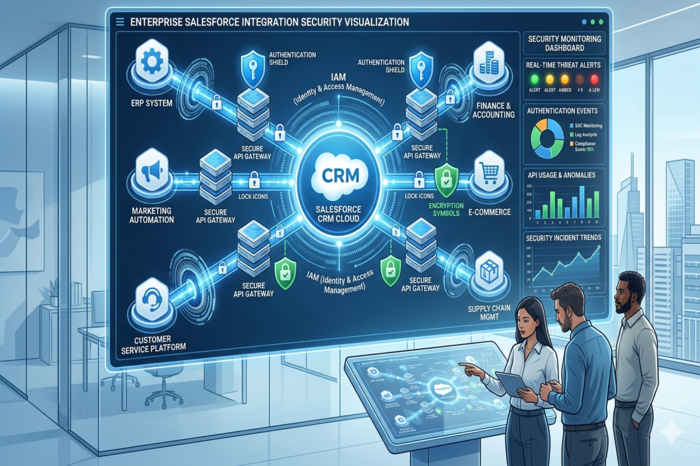
In today’s digital-first business environment, organizations rely heavily on Salesforce to manage customer data, automate workflows, and drive operational efficiency. However, Salesforce rarely functions as a standalone platform. It integrates with multiple external systems such as ERP solutions, marketing tools, analytics platforms, and collaboration applications. As these integrations expand, ensuring robust security and access control becomes a top priority.
Salesforce integrations enable seamless data exchange across systems. While this connectivity improves efficiency, it also introduces security risks. Unauthorized access, data breaches, and compliance violations can occur if proper controls are not in place. Therefore, organizations must implement comprehensive security frameworks that protect data while maintaining usability.
For example, construction and project management companies often rely on Procore Salesforce Integration to synchronize project data, financial details, and customer information. This integration enhances operational visibility and collaboration. However, it also requires strict access control mechanisms to ensure that sensitive project data is only accessible to authorized users. Without proper safeguards, such integrations can expose critical business information to risks.
As organizations continue to expand their digital ecosystems, implementing strong security and access control models in Salesforce integrations becomes essential. A well-designed approach ensures data protection, regulatory compliance, and operational reliability.
Understanding Salesforce Integration Security
Salesforce integration security refers to the measures used to protect data and systems during integration processes. It ensures that data exchanged between Salesforce and external systems remains secure and accessible only to authorized users.
Security in Salesforce integrations involves multiple layers. These include authentication, authorization, encryption, and monitoring. Each layer plays a critical role in protecting data.
Organizations must adopt a holistic approach to security. This ensures that all integration points are protected.
Why Security and Access Control Matter
Security and access control are critical for maintaining trust and compliance.
Data Protection
Sensitive customer and business data must be protected from unauthorized access. Security measures prevent data breaches.
Regulatory Compliance
Organizations must comply with regulations such as GDPR and HIPAA. Proper controls ensure compliance.
Risk Mitigation
Security frameworks reduce the risk of cyberattacks and data loss.
Operational Continuity
Secure systems ensure uninterrupted business operations. They prevent disruptions caused by security incidents.
Core Components of Integration Security
A robust security model includes several key components.
Authentication
Authentication verifies the identity of users and systems. Common methods include OAuth, API keys, and certificates.
Authorization
Authorization determines what users can access. Role-based access control (RBAC) is commonly used.
Encryption
Encryption protects data during transmission and storage. It ensures that data cannot be intercepted.
API Security
APIs are critical integration points. Securing APIs prevents unauthorized access and misuse.
Monitoring and Auditing
Monitoring tools track system activity. Auditing ensures compliance and identifies potential threats.
Access Control Models in Salesforce
Access control models define how users interact with data.
Role-Based Access Control (RBAC)
RBAC assigns permissions based on user roles. It simplifies access management.
Attribute-Based Access Control (ABAC)
ABAC uses attributes such as user location and device. It provides more granular control.
Least Privilege Principle
Users should have only the access they need. This reduces security risks.
Identity and Access Management (IAM)
IAM systems manage user identities and permissions. They ensure secure access across systems.
Integration Security Patterns
Different security patterns are used in Salesforce integrations.
API Gateway Security
API gateways manage and secure API traffic. They enforce authentication and rate limiting.
Token-Based Security
Tokens are used for secure authentication. OAuth tokens are widely used in Salesforce integrations.
Secure Middleware
Middleware platforms provide an additional security layer. They manage data flow and enforce policies.
Zero Trust Architecture
Zero trust models assume no implicit trust. Every request is verified before access is granted.
Challenges in Integration Security
Organizations face several challenges when securing integrations.
Complex Ecosystems
Multiple systems increase complexity. Managing security across these systems is difficult.
Evolving Threats
Cyber threats are constantly evolving. Organizations must stay updated.
Data Privacy Concerns
Handling sensitive data requires strict controls. Privacy regulations add complexity.
Integration Dependencies
Dependencies between systems can create vulnerabilities. A breach in one system can affect others.
Best Practices for Securing Salesforce Integrations
Organizations can improve security by following best practices.
Implement Strong Authentication
Use multi-factor authentication (MFA) and OAuth. These methods enhance security.
Enforce Least Privilege
Limit access to necessary data. This reduces risk.
Use Encryption
Encrypt data in transit and at rest. This protects sensitive information.
Monitor Continuously
Monitoring tools detect anomalies. They enable quick response to threats.
Regular Security Audits
Audits identify vulnerabilities. Organizations can address issues proactively.
Role of Compliance in Security Models
Compliance plays a critical role in integration security.
Data Protection Regulations
Organizations must follow regulations such as GDPR. This ensures data privacy.
Industry Standards
Standards such as ISO and SOC provide security guidelines.
Audit Trails
Audit logs track user activity. They support compliance and accountability.
Role of Automation and AI
Automation and AI enhance security capabilities.
Automated Threat Detection
AI detects anomalies in real time. It identifies potential threats.
Automated Access Management
Automation simplifies user access control. It ensures consistency.
Predictive Security
AI predicts potential vulnerabilities. Organizations can prevent issues.
Future Trends in Integration Security
Integration security continues to evolve.
Zero Trust Adoption
Zero trust models will become standard. They provide stronger security.
AI-Driven Security
AI will play a larger role in threat detection. It will improve response times.
Cloud Security Enhancements
Cloud platforms will offer advanced security features. They will support scalable environments.
Identity-Centric Security
Identity will become the primary security focus. Organizations will invest in IAM solutions.
Building a Secure Integration Framework
Organizations must design secure integration frameworks.
Define Security Policies
Clear policies ensure consistent security practices.
Use Secure Integration Tools
Choose tools with built-in security features.
Train Employees
Employees must understand security practices. Training reduces human error.
Continuously Improve
Security is an ongoing process. Organizations must adapt to new threats.
Conclusion
Salesforce integration security and access control models are essential for protecting enterprise data and systems. As organizations integrate multiple platforms, security becomes increasingly complex.
However, security requires continuous effort. Organizations must update strategies, adopt new technologies, and stay ahead of evolving threats.
In a rapidly changing digital landscape, robust security frameworks are critical for success. Businesses that invest in secure Salesforce integrations will achieve greater reliability, trust, and long-term growth