

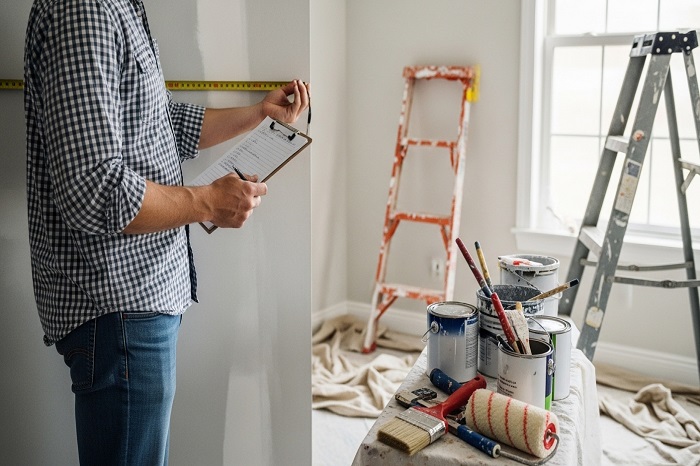
Estimating interior painting jobs accurately is essential for maintaining profitability, winning bids, and delivering projects on budget. The estimating process is important whether you are a professional contractor or an independent painter, to avoid making costly errors and satisfy the clients. It might seem that interior painting is not a complex task, yet each project is unique in terms of the size of a room, the state of its surface, the height of the ceiling, the quality of paint, the number of layers, and preparation demands.
Labor and material costs may soon get out of control without an exact estimate. Many contractors rely on estimating services USA to double-check calculations and stay competitive in busy markets.
Step 1: Conduct a Detailed Site Inspection
Go to the property before drawing up any figures. On-site analysis enables you to examine facts on the ground and not make assumptions.
During inspection, check for:
- Wall cracks and nail holes
- Water stains or damage
- Peeling or bubbling paint
- Mold or mildew
- Grease buildup (kitchens)
- Damaged drywall
- Trim condition
- Ceiling height
The amount of time spent on preparation is directly dependent on surface condition. The higher the number of repairs required, the higher the labor cost is. The inspection stage should not be overlooked because this is the basis of a correct estimate.
Step 2: Measure the Paintable Area
Accurate measurements are essential in painting estimating to avoid underbidding or overestimating a project. A precise takeoff ensures that every surface walls, ceilings, trims, and finishes is measured correctly, allowing estimators to calculate the exact quantity of materials and labor required. This level of accuracy not only protects your profit margins but also helps contractors submit competitive, reliable bids. In professional estimating services, detailed takeoffs form the foundation of every estimate, ensuring nothing is missed and every cost is justified.
Measuring Walls
- Measured the length of each wall.
- Divide by the height of the ceiling.
- Add all wall areas together.
Formula:
Wall Area = Perimeter × Height
Example:
- Room size: 14 ft × 16 ft
- Ceiling height: 9 ft
- Perimeter = 14 + 16 + 14 + 16 = 60 ft
- Wall area = 60 × 9 = 540 sq. ft.
Subtract Openings (Optional)
Minus doors and large windows where needed.
Example:
- Door: 21 sq. ft.
- Two windows: 30 sq. ft.
- Total deduction: 51 sq. ft.
- Adjusted wall area = 489 sq. ft.
Measure Ceilings
Ceiling area = Length × Width
14 × 16 = 224 sq. ft.
Measure Trim and Doors
Trim is usually calculated by the linear foot, whereas doors are charged on an individual basis.
Calculate the total square feet to be painted.
Step 3: Decision of Surface Preparation
The issue of preparation also has a major effect on labor hours.
Common prep tasks include:
- Filling holes and cracks
- Sanding surfaces
- Caulking gaps
- Cleaning grease or stains
- Removing wallpaper
- Priming bare drywall
In case of any elaborate repair on walls, increase labor time. In new houses, coating of the new house with finish is usually required to be primed first, and then the finish is applied.
Step 4: Determine Quantity of Paint
The approximate covering of most interior paints:
350–400 square feet per gallon
Example Calculation
- Total wall area: 2,000 sq. ft.
- Two finishes needed: 4,000 sq. ft. coverage.
- 4,000 ÷ 350 = 11.4 gallons
- Round up to 12 gallons.
Always give a round-up to consider wastage and touch-ups.
Include Primer (If Required)
If primer is needed:
- Divide both squares by the same square.
- The rate of primer coverage resembles that of paint.
Step 5: Determine Material Costs
Along with paint, all supplies:
- Primer
- Caulk
- Spackling compound
- Sandpaper
- Painter’s tape
- Drop cloths
- Plastic sheets
- Brushes and rollers
- Paint trays
Prospective Material Cost Breakdown
- Paint: 12 gallons × $45 = $540
- Primer: 6 gallons × $30 = $180
- Supplies: $120
- Total materials = $840
Prices of materials are dependent on quality. Premium paints are expensive but can save on the number of coats to be applied.
Step 6: Estimate Labor Costs
Perhaps the highest percentage of interior painting work is labor.
Painter Productivity Rates
The professional painters usually finish:
- 150–250 sq. ft. per hour (walls)
- 100–200 sq. ft. per hour (ceilings)
- Training and detailing are more time-consuming.
Example Labor Calculation
- Total area: 4,000 sq. ft.
- Mean work rate: 200 sq. ft. an hour.
- 4,000 ÷ 200 = 20 hours
Add preparation time:
- Repairs: 6 hours
- Masking and setup: 4 hours
- Total labor hours = 30 hours
If hourly rate = $50:
30 × $50 = $1,500
Set rates based on location, size of crew, and experience.
Step 7: Room Complexity
Interior painting is not a job equal. Add to your estimate in case the project involves:
- High ceilings
- Ceilings that are vaulted or cathedral.
- Stairwells
- Crown molding
- Built-in cabinets
- Accent walls
- Multiple color changes
Difficult spaces takea longer time, demand ladders, and accuracy, and add to the labor expenses.
Step 8: Add Overhead Costs
In the case of professional contractors, overhead has to be added in order to be profitable.
Costs of overheads may comprise:
- Business insurance
- Licensing
- Office rent
- Vehicle maintenance and fuel.
- Equipment wear and tear
- Administrative expenses
The overhead is ordinarily around 10 to 20% of the overall project expenditure.
Example
- Materials: $840
- Labor: $1,500
- Subtotal: $2,340
- 15% overhead = $351
- New total = $2,691
Step 9: Include Profit Margin
After overhead, add profit.
The goals of most painting contractors are:
- 10%–25% profit margin
- Using 15% profit:
- $2,691 × 15% = $404
Total estimate = $3,095
Step 10: Add Contingency
There is a possibility of unforeseen problems with the project, which include:
- Hidden damage
- Additional coats required
- Customer-requested changes
- Issues of surface absorption.
- Add 5–10% contingency.
Example:
$3,095 × 10% = $309
Final estimated cost = $3,404
Step 11: Compute Price /sf
A lot of painters charge for interior work in terms of square feet.
Formula:
Total cost /Total square footage.
Example:
- $3,404 ÷ 2,000 sq. ft. = $1.70 per sq. ft.
Interior painting is usually:
Depending on complexity and location, it will cost $1.50- 4.00 per sq. ft.
Step 12: Prepare Professional Proposal
A precise and professional estimate will enhance your likelihood of landing a job.
Include:
- Scope of work
- Surfaces to be painted
- Preparation details
- Number of coats
- Paint brand and finish
- Timeline
- Payment terms
- Warranty information
Well-documented information eliminates confusion and conflicts.
Conclusion
To estimate interior painting, it is not enough to match the number of square feet with a predetermined rate. A professional estimate is carefully inspected, measured, calculations of the material that is used and realistic labor projections. The final price depends on surface preparation, number of coats, quality of paint used, and complexity of the room, among others.
With a systematic method, correct measurements, estimation of the number of paint required, labor hours estimated, overhead, profit, and contingency, one will come up with reliable and competitive bids.
FAQs
What Is Your Interior Painting Price?
The most common way of computing price is by summing up total square footage, estimating material and labor costs, and including overhead, profit, and contingency.
How Much Does It Cost To Have Interior Painting Done?
The labor is typically charged between 40 and 70 per hour and varies depending on the location and experience.
























Leave a Reply