

Key Takeaways
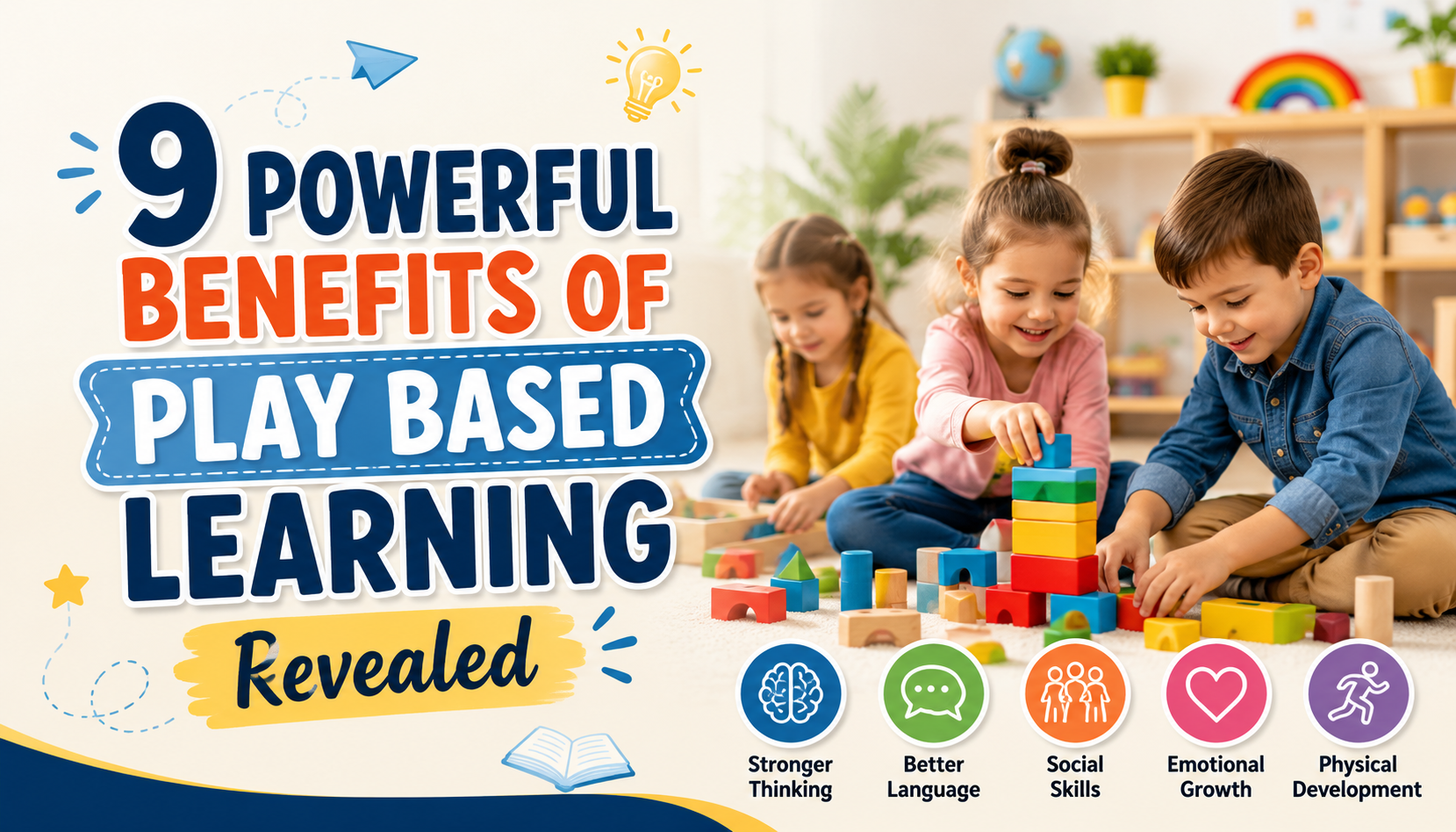
- Play based learning helps young children grow in thinking, language, movement, feelings, and social skills.
- Children learn better when lessons feel active, safe, joyful, and connected to real life.
- Teachers and families can guide play without controlling every choice.
- Books, stories, pretend play, blocks, music, art, and outdoor games can all support early learning.
- Play helps children build confidence, problem-solving skills, focus, and independence.
- A strong preschool learning plan can mix free play, guided play, stories, and simple routines.
Introduction
Young children learn with their whole body.
They touch, move, ask, build, pretend, laugh, and try again.
That is why the benefits of play based learning matter so much in preschool and early childhood education.
Play is not a break from learning.
It is one of the most natural ways children learn about words, numbers, people, feelings, stories, and the world around them.
This blog explains how play based learning supports children in clear and practical ways.
It also shows how parents, teachers, and caregivers can use play, Preschool Stories, books, routines, and simple activities to help children grow.
What play based learning means for young children
Play based learning is a way of teaching that uses play as the main path to learning.
It allows children to explore ideas through hands-on activities instead of only sitting, listening, or repeating facts.
A child may learn about shapes by building with blocks.
Another child may learn new words while pretending to run a grocery store.
A group may learn sharing, patience, and problem-solving while building a pretend town together.
These moments may look simple, but the brain is doing deep work.
Children are planning, testing ideas, remembering steps, using language, solving problems, and learning how to work with others.
In early childhood education, play is often linked with strong brain growth.
This is because young children learn best when they feel safe, active, and interested.
A worksheet can teach one small skill.
However, a rich play experience can support many skills at the same time.
For example, a child playing with toy animals may sort them by size, create a story, count them, name their colors, and act out feelings.
That one activity can support math, language, imagination, memory, and social understanding.
This is why many teachers see play as serious learning.
It gives children a chance to learn by doing.
It also helps them connect new ideas with real life.
A child who pretends to cook may understand family routines better.
A child who plays doctor may learn care, kindness, and body words.
A child who builds a bridge may learn balance, cause and effect, and patience.
Play based learning can be child-led, teacher-guided, or a mix of both.
Child-led play means the child chooses the activity and direction.
Teacher-guided play means an adult gently adds questions, tools, or ideas to deepen learning.
Both forms are useful.
A strong preschool classroom often includes free play, guided play, story time, music, movement, art, outdoor time, and group discussion.
The adult does not need to control every moment.
In fact, too much control can make play feel like a task.
Instead, the adult can watch, listen, and join with care.
A teacher may ask, “What will happen if the tower gets taller?”
A parent may say, “The bear looks sad. What could help?”
These small questions help children think more deeply.
They also build language and confidence.
The best play based learning feels joyful, but it still has purpose.
It gives children chances to practice real skills in a natural way.
This is important because preschool children are still learning how to focus, talk, share, wait, move safely, and understand feelings.
Play gives them a safe space to practice these skills again and again.
How play supports the whole child
Play does not help only one part of a child.
It supports the whole child.
This includes the mind, body, emotions, language, and relationships.
When children play, they use their senses.
They touch sand, hear music, smell paint, see colors, and move their bodies.
These experiences help the brain build strong connections.
Children also learn how things work.
They discover that water can pour, blocks can fall, clay can change shape, and wheels can roll.
These small discoveries support early science thinking.
Play also helps children learn words.
During pretend play, children use language to explain roles, rules, plans, and feelings.
One child may say, “He is the pilot.”
Another may say, “The plane is late.”
Another may add, “The baby needs a ticket.”
This kind of talk builds vocabulary and story skills.
It also prepares children for reading and writing later.
Preschool Stories and a good preschool book can make this learning even stronger.
After hearing a story, children may act it out with puppets.
They may draw a scene from the book.
They may pretend to be the characters.
This helps them remember the story and understand emotions.
A best book for preschoolers often includes simple words, clear pictures, rhythm, and strong feelings.
These features make it easier for children to connect stories with play.
A preschool adventure book author may use a journey, a problem, and a happy solution to help children think.
When children act out these adventures, they practice problem-solving, courage, teamwork, and imagination.
Play also supports physical growth.
Running, jumping, climbing, dancing, drawing, cutting, and stacking all build motor skills.
Large body movements help children gain strength and balance.
Small hand movements help children prepare for writing.
For example, using play dough strengthens fingers.
Picking up small blocks improves hand control.
Painting with a brush builds wrist movement.
These playful actions prepare the body for school tasks without making children feel pressured.
Emotional growth is another major part of play.
Children often use play to express feelings they cannot fully explain.
A child may act out a storm after feeling scared.
Another may pretend a doll is angry.
Another may build a safe house for toy animals.
These actions help children process feelings.
They also give adults a window into what children may be thinking.
Play can also teach self-control.
A child playing a game may need to wait for a turn.
A child in pretend play may need to follow a role.
A child building with others may need to handle frustration when the tower falls.
These moments teach patience, flexibility, and calm behavior.
Social skills grow through play as well.
Children learn to share materials, listen to ideas, solve conflicts, and include others.
They learn that people may think differently.
They learn how to speak kindly.
They also learn how to repair small problems.
For example, if two children want the same truck, a teacher can guide them to take turns or create a plan.
This helps children learn fairness.
It also teaches them that problems can be solved with words.
Benefits of play based learning in early education
The benefits of play based learning are wide because play touches many parts of development at once.
It helps children think, speak, move, feel, create, and connect.
One key benefit is stronger cognitive development.
Cognitive development means growth in thinking, memory, attention, and problem-solving.
When children build a tower, they learn balance and planning.
When they match shapes, they learn patterns.
When they pretend to run a shop, they learn counting, sorting, and communication.
These skills are important for later school success.
Play also helps children enhance cognitive development through play because it gives them freedom to test ideas.
A child can try one way, fail, and try another.
This teaches flexible thinking.
It also teaches that mistakes are part of learning.
That lesson is powerful.
Children who are not afraid to try often become more confident learners.
Another benefit is better language growth.
Children talk a lot during play.
They name objects, explain plans, ask questions, and tell stories.
This helps them build vocabulary and sentence skills.
Pretend play is especially helpful.
A child pretending to be a teacher, parent, doctor, builder, or explorer uses new words linked to that role.
Books for Early Childhood Education can support this process.
After reading a story, a teacher may set up a play area connected to the book.
For example, after a story about a garden, children may pretend to plant seeds.
They may use words like soil, roots, water, grow, and harvest.
This makes new language easier to remember.
Play also supports early math.
Children count blocks, compare sizes, sort colors, make patterns, and measure pretend food.
They may not know they are doing math, but they are building the base for it.
A child who fills cups with water learns about more and less.
A child who lines up cars learns about order.
A child who shares snacks learns simple division.
In addition, play supports early science.
Children ask questions naturally.
They wonder why ice melts, why shadows move, why leaves fall, and why magnets stick.
Play gives them room to explore these questions.
An adult can add simple language and guidance.
For example, a teacher may say, “The ice is melting because it is getting warm.”
This turns play into discovery.
Social development is another strong benefit.
Children learn how to be part of a group.
They learn to take turns, follow simple rules, listen, and cooperate.
These skills matter in preschool, kindergarten, and life.
A child who learns to work with others during play may find group learning easier later.
Emotional development also grows through play.
Children face small challenges in a safe way.
A puzzle may be hard.
A tower may fall.
A friend may choose a different idea.
These moments help children practice managing feelings.
With adult support, children learn to breathe, try again, ask for help, or choose another plan.
Play can also build confidence.
When children complete a puzzle, create a painting, build a road, or tell a story, they feel proud.
This pride supports a healthy self-image.
It tells the child, “Learning is something that can be done.”
That belief can shape future school experiences.
Why play helps children remember more
Children remember more when learning feels meaningful.
Play creates meaning.
It connects ideas with action, feeling, movement, and choice.
A child who only hears the word “triangle” may forget it.
However, a child who builds a triangle roof for a toy house may remember it more easily.
The shape becomes part of a real experience.
Memory improves when children use more than one sense.
Play often includes seeing, touching, hearing, moving, and speaking.
This gives the brain many paths to remember the same idea.
For example, a child learning about rain may listen to a story, sing a rain song, paint clouds, jump in puddles, and pretend to hold an umbrella.
Each activity strengthens the idea in a different way.
This is why playful learning can be more powerful than drill-based learning for preschool children.
Young children are not built to sit still for long periods.
They need movement and interaction.
Play gives them both.
Focus also grows through play.
A child may spend a long time building a block city because the task feels interesting.
This deep attention is valuable.
It helps children practice staying with an idea.
Over time, this can support better focus in other learning tasks.
Play also helps children understand cause and effect.
When a child pushes a car, it moves.
When a child stacks too many blocks, the tower falls.
When a child mixes colors, a new color appears.
These moments teach logic.
They also teach children to make predictions.
A teacher can deepen this learning by asking simple questions.
For example:
- “What might happen next?”
- “Why did it fall?”
- “How can the bridge get stronger?”
- “What else could be tried?”
Questions like these help children think without making the activity feel like a test.
They support reasoning and problem-solving.
Story-based play is especially helpful for memory.
Preschool Stories often include characters, problems, settings, and solutions.
When children act out a story, they remember the order of events.
They also learn how stories work.
This supports early literacy.
A best preschool book can also help children understand emotions and choices.
For example, a story about sharing may lead to pretend play about friendship.
A story about moving to a new class may connect with Preschool Graduation Ceremony Ideas.
Children may act out saying goodbye, receiving certificates, singing songs, or walking across a small stage.
This helps them understand change in a gentle way.
In this way, play connects books, emotions, routines, and real events.
It makes big ideas easier for young children to understand.
Play also supports creativity.
A box can become a house, a boat, a cave, or a rocket.
This flexible thinking is important.
Creative children learn that one object or idea can have many uses.
That skill supports problem-solving later.
A child who can imagine many uses for a box may also imagine many ways to solve a problem.
How adults can guide play without taking over
Adults play an important role in play based learning.
However, the role is not to control every move.
The best support often comes from watching carefully, joining gently, and adding small ideas at the right time.
A teacher may notice that children are building a road.
Instead of telling them what to do, the teacher may add signs, toy people, or a map.
This gives the play more depth.
A parent may notice a child pretending to cook.
The parent may ask, “Who is coming to dinner?”
This simple question can turn the activity into a story.
The child may add guests, menus, feelings, and problems.
That is guided play.
It respects the child’s ideas while helping learning grow.
Adults can also model language.
If a child says, “Big truck go,” the adult may answer, “Yes, the big truck is going over the bridge.”
This gives the child a stronger sentence without correcting harshly.
Adults can also introduce new words.
During block play, words like tall, short, wide, balance, stack, edge, and stable can be used.
During art, words like smooth, rough, bright, mix, shade, and pattern can be added.
During outdoor play, words like climb, crawl, jump, faster, slower, near, and far can be used.
These words become easier to learn because they connect with action.
Adults can also support social learning.
When conflict happens, adults can guide children calmly.
They can help children name feelings and find fair solutions.
For example, a teacher may say, “Both children want the red car. One plan is taking turns. Another plan is finding another car for the road.”
This teaches problem-solving instead of punishment.
It also shows children that feelings can be handled with words.
A strong play environment matters too.
Children need safe materials, open space, and enough time.
Rushed play often stays shallow.
Longer play allows children to build stories, solve problems, and return to ideas.
A good preschool classroom may include areas for blocks, books, art, dramatic play, puzzles, music, science, and quiet rest.
At home, play based learning does not require expensive toys.
Simple items can work well.
Boxes, scarves, spoons, cups, paper, crayons, leaves, stones, pillows, and recycled materials can inspire rich play.
A child can build, sort, count, pretend, draw, and explore with everyday objects.
This is helpful for families because learning can happen during daily life.
Cooking, cleaning, shopping, walking, and bedtime can all become learning moments.
For example, a child can count apples at the store.
A child can sort socks by color.
A child can listen to a bedtime story and retell the favorite part.
A child can pretend a blanket is a tent.
These moments are simple, but they matter.
Practical play ideas for preschool learning
There are many easy ways to support learning through play.
One strong idea is block play.
Blocks help children learn balance, size, shape, planning, and teamwork.
A child can build a house, school, road, bridge, or zoo.
An adult can add small questions to deepen thinking.
For example, “How can the tower stay up?” or “Where will the door go?”
Pretend play is another powerful choice.
Children can pretend to run a store, clinic, library, restaurant, airport, or classroom.
This kind of play builds language, social skills, memory, and imagination.
It also helps children understand real-world roles.
A pretend store can teach counting, turn-taking, polite words, and sorting.
Art play is also valuable.
Painting, drawing, cutting, gluing, and shaping clay help children express ideas.
Art supports fine motor skills and creativity.
It also gives children a way to show feelings.
The final product does not need to be perfect.
The process matters more.
Music and movement can support memory, rhythm, listening, and body control.
Children can sing counting songs, clap patterns, dance like animals, or move fast and slow.
These activities help children follow directions while staying active.
Outdoor play is equally important.
Running, climbing, digging, collecting leaves, watching bugs, and playing with water all support learning.
Nature gives children real things to observe.
It also supports calm attention and healthy movement.
Story play can connect literacy with imagination.
After reading a preschool book, children can act out the story.
They can use puppets, drawings, blocks, or costumes.
This helps them understand characters, order, and feelings.
A best preschool adventure book may invite children to imagine a trip, solve a problem, or help a friend.
This builds confidence and early reading interest.
Families interested in an author’s work may also explore an Ashli Karaman author biography or Ashli Karaman book author biography to learn how story themes support early childhood learning.
Author Ashli Karaman and a preschool adventure book author page can also create helpful internal links for readers searching for trusted children’s books.
Books, stories, and play can work together.
For example, LESSONS FROM A PRESCHOOL may connect with themes such as kindness, curiosity, classroom routines, and growth.
A book for preschool can become more meaningful when children can talk about it, draw it, and act it out.
This is why the best parenting book or best book for preschoolers is often one that supports both reading and real-life conversation.
Play can also support school events.
Preschool Graduation Ceremony Ideas may include songs, memory boards, simple speeches, certificates, and child-friendly stories.
Children can practice these moments through pretend play.
This helps them feel less nervous and more prepared.
Play based learning can also help teachers notice each child’s needs.
During play, adults can see how children talk, move, solve problems, handle feelings, and interact with others.
This kind of observation is useful.
It helps teachers plan better lessons.
It also helps families understand how a child is growing.
Building a strong play based learning routine
A strong play based learning routine includes balance.
Children need freedom, but they also need structure.
They need choice, but they also need safety.
They need active play, quiet play, social play, and alone time.
A good routine may begin with a welcome activity.
Children may choose puzzles, books, blocks, or drawing.
This helps them settle into the day.
Then, the class may move into circle time with songs, weather talk, or a short story.
After that, children may have center time.
Centers can include dramatic play, blocks, art, books, science, math games, and sensory play.
During this time, teachers can observe and guide.
Outdoor play can come next.
Children need time to run, climb, balance, and explore nature.
Then, a calm story or rest period can help the body slow down.
The day may end with a closing song or reflection.
Children may talk about what they built, learned, or enjoyed.
This simple reflection helps them remember and explain their learning.
At home, routines can also support playful learning.
Morning routines can include naming clothes, counting steps, or singing a song.
Meal times can include sorting foods, talking about colors, or sharing stories.
Bath time can include water play, floating and sinking, and simple science words.
Bedtime can include reading, retelling, and quiet pretend play.
These daily moments do not need to feel like school.
They can feel warm and natural.
The goal is not to force lessons into every second.
The goal is to notice learning chances and support them gently.
A strong routine also includes repetition.
Children learn through doing things again.
They may want to hear the same story many times.
They may build the same tower again and again.
They may repeat the same pretend game.
This is not a problem.
Repetition helps children master ideas.
Each time, they may add something new.
The adult can support growth by adding small changes.
For example, if a child always builds a house, the adult may add toy people and ask who lives there.
If a child always plays restaurant, the adult may add paper menus.
If a child always reads the same book, the adult may ask what happens first, next, and last.
These small changes keep learning fresh.
Common mistakes to avoid
One common mistake is treating play as unimportant.
Some adults may think real learning only happens through worksheets, flashcards, or direct teaching.
However, young children often learn more deeply through active experiences.
Play gives them a chance to use ideas, not just hear them.
Another mistake is over-directing play.
When adults tell children exactly what to build, say, draw, or imagine, the play loses power.
Children need room to make choices.
Choice builds independence and motivation.
A better approach is to offer materials, ask questions, and let children lead when possible.
A third mistake is focusing too much on the final product.
In art, the painting does not need to look perfect.
In blocks, the tower does not need to stay up forever.
In pretend play, the story does not need to make adult sense.
The learning happens during the process.
Children are thinking, testing, choosing, and adjusting.
A fourth mistake is giving too many toys at once.
Too many choices can make children feel scattered.
A smaller number of open-ended materials can lead to deeper play.
Open-ended materials are items that can be used in many ways.
Examples include blocks, boxes, cloth, clay, paper, stones, shells, and loose parts.
A fifth mistake is not giving enough time.
Deep play often takes time to begin.
Children may need several minutes just to choose roles or plan a structure.
When play is interrupted too quickly, the learning may stay surface-level.
A sixth mistake is forgetting quiet children.
Some children play loudly and socially.
Others watch first, play alone, or use fewer words.
Quiet play can still be rich.
Adults should observe before assuming a child is not learning.
A child quietly lining up animals may be sorting, counting, planning, or creating a story in the mind.
A seventh mistake is ignoring culture and family life.
Children bring home experiences into play.
They may pretend to cook familiar foods, celebrate family events, speak home languages, or act out routines.
These experiences should be respected.
They help children feel seen and safe.
Play based learning works best when it honors the child’s real world.
Safety is also important.
Children need materials that match their age and development.
Small parts may not be safe for very young children.
Outdoor areas need clear rules.
Art materials should be child-friendly.
Safe play allows children to explore with confidence.
Assessment should also fit the play model.
Teachers can observe children during play and take notes.
They can look for language, problem-solving, motor skills, social growth, and emotional control.
This gives a fuller picture than a worksheet alone.
Families can do the same at home.
They can notice what the child enjoys, what feels hard, and what skills are growing.
FAQs
What are the main benefits of play based learning
The main benefits of play based learning include stronger thinking skills, better language, improved social skills, healthier emotional growth, and stronger motor development.
Children learn by exploring real objects, trying ideas, and solving small problems.
This makes learning active and meaningful.
For example, a child building with blocks may learn balance, counting, planning, and patience.
A child acting out Preschool Stories may learn new words, feelings, and story order.
A child playing outside may build strength, coordination, and curiosity about nature.
Play also helps children feel confident.
They learn that they can make choices, fix mistakes, and try again.
This confidence is important for later school learning.
Is play based learning better than worksheets
For preschool children, play based learning is often more natural and useful than too many worksheets.
Worksheets may help with a small skill, such as tracing or matching.
However, they do not always support deep thinking, movement, language, or social growth.
Play can support many skills at once.
For example, a pretend grocery store can include counting, speaking, listening, sharing, sorting, and problem-solving.
That kind of learning is rich.
This does not mean all paper activities are bad.
A simple drawing, matching game, or name-writing activity can be useful.
However, young children should not spend most of the day sitting with worksheets.
They need active, hands-on learning.
How can parents use play based learning at home
Parents can use play based learning at home through simple daily activities.
They can read a preschool book and invite the child to act out the story.
They can count toys during cleanup.
They can sort laundry by color.
They can build with boxes, cook together, sing songs, or play pretend shop.
The home does not need expensive learning tools.
Everyday objects can support strong learning.
Cups, spoons, blankets, paper, crayons, and safe recycled items can become powerful play materials.
The adult’s role is to talk, listen, ask simple questions, and give the child time.
This helps learning feel warm and natural.
What books support play based learning
Books that support play based learning often have clear pictures, simple language, strong characters, and problems children can understand.
The best preschool book may invite children to pretend, ask questions, move, draw, or retell the story.
Books for Early Childhood Education can also help teachers plan activities.
A story about animals can lead to sorting games.
A story about friendship can lead to role play.
A story about a journey can lead to maps, blocks, and pretend travel.
A preschool adventure book author may create stories that help children imagine, solve problems, and build courage.
Families may also look for the best book for preschoolers by checking age level, emotional safety, story quality, and connection to real life.
Conclusion
Play is one of the strongest tools in early childhood learning.
It helps children think, speak, move, feel, imagine, and connect with others.
The benefits of play based learning are clear because play matches the way young children naturally grow.
Children are not passive learners.
They are explorers.
They learn by touching, asking, moving, pretending, testing, and trying again.
When adults understand this, they can create better learning moments.
A teacher can turn blocks into a lesson about balance and teamwork.
A parent can turn bedtime reading into story play.
A caregiver can turn outdoor time into science discovery.
A simple box can become a rocket, a house, a cave, or a store.
These playful moments build real skills.
Play based learning also makes education feel joyful.
This matters because children who enjoy learning are more likely to stay curious.
They are more willing to try.
They are more open to mistakes.
They are more confident when facing new tasks.
Strong early learning does not need to feel rushed or heavy.
It can feel warm, active, and meaningful.
The best preschool classrooms and homes often include stories, songs, movement, art, nature, pretend play, and caring adult guidance.
They also include enough time for children to explore deeply.
Supporting keywords such as Preschool Stories, Books for Early Childhood Education, preschool book, book for preschool, and best preschool adventure book all connect with this larger idea.
Books and play work well together because stories give children ideas to act out, discuss, and remember.
Topics such as Preschool Graduation Ceremony Ideas can also connect to play because children use pretend practice to understand important life events.
In addition, resources linked to Author Ashli Karaman, an Ashli Karaman author biography, or a preschool adventure book author page can help families find story-based learning ideas that support early growth.
The key is balance.
Children need freedom and guidance.
They need movement and quiet.
They need stories and hands-on discovery.
They need adults who care enough to watch, listen, and support without taking over.
When play is respected, children gain more than fun.
They gain language, focus, problem-solving, kindness, creativity, and confidence.
They also build a strong foundation for school and life.
For families, teachers, and caregivers, the message is simple.
Play should not be pushed aside.
It should be planned, protected, and valued.
A child who plays with purpose is also learning with purpose.
That is why play based learning remains one of the most powerful ways to support young children during the preschool years.















Leave a Reply