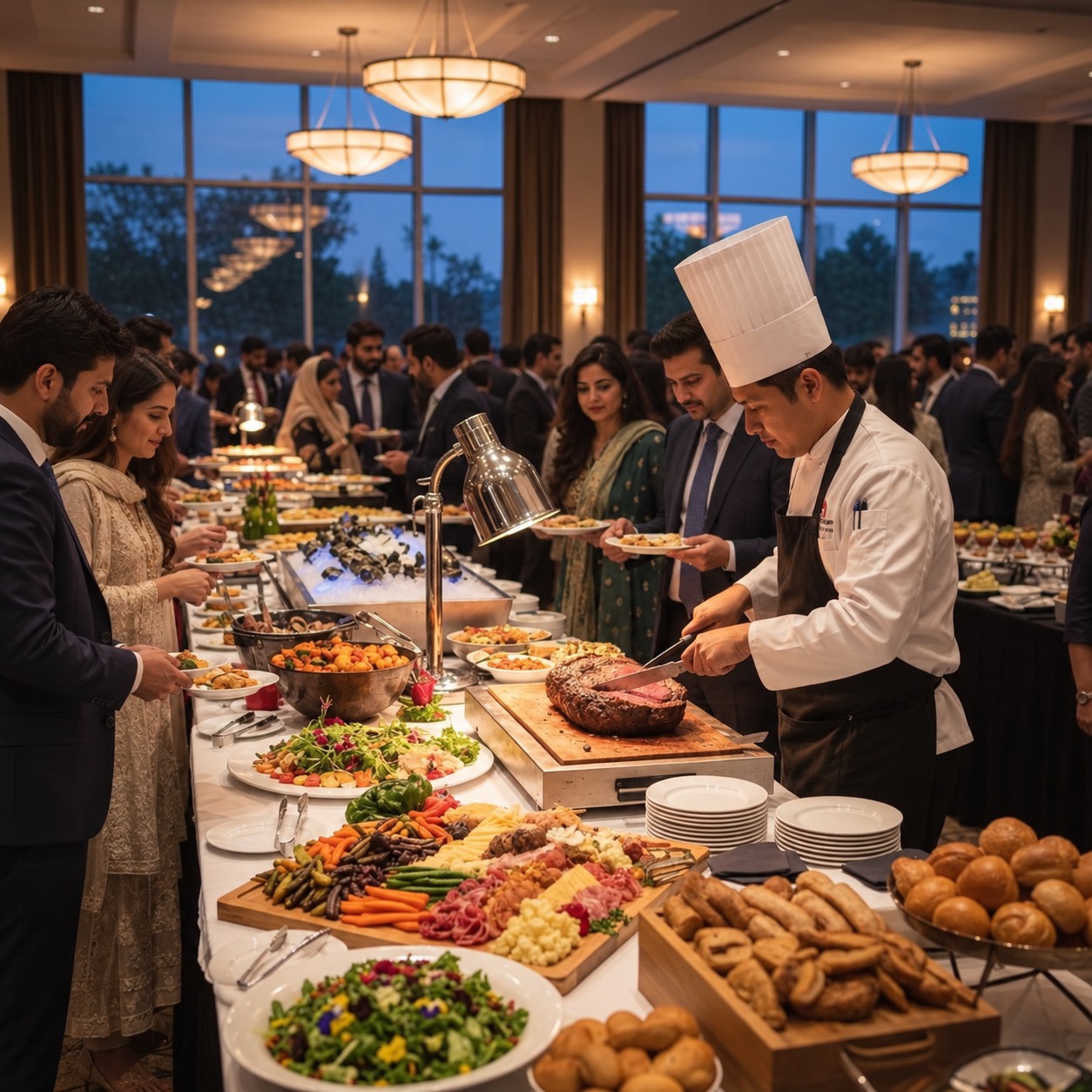
A restaurant kitchen and a wedding catering operation solve completely different problems, even when the same chef is behind both. A restaurant serves a rolling stream of small orders across a full evening. A Karachi wedding caterer has to produce a fixed, enormous volume of food, sometimes six hundred to a thousand plates, and have every dish hot, fresh, and correctly portioned within roughly a two-hour serving window, often outdoors, often in July or August humidity that punishes anything meant to be served warm. Families searching for the best catering services in Karachi are usually comparing menus and prices, when the real differentiator is almost always operational: can this kitchen actually execute at this scale without the biryani arriving lukewarm at table forty while table two is still eating?
Why Karachi’s Climate Changes What Good Catering Actually Looks Like
Heat and humidity are not a minor footnote for outdoor Karachi functions; they dictate real decisions about menu design and equipment. Chafing dishes lose heat faster in humid air than most families assume, and a caterer without enough sterno fuel or electric warming trays for the actual guest count will have visibly cooling food by the second serving round. Karachi’s periodic load shedding compounds this further, since electric warmers are useless the moment power drops unless the caterer has arranged backup generator capacity specifically for the food service area, not just for the stage lighting.
Rice-based dishes, biryani, pulao, and kabuli, hold heat and texture reasonably well through a long serving window, which is part of why they dominate Karachi wedding menus. Fried items and anything with a crisp exterior, on the other hand, degrade quickly in humid conditions, turning soggy within twenty or thirty minutes if not fried in smaller, continuous batches rather than one large batch held under a warmer. A caterer with real Karachi wedding experience plans the frying schedule around the actual guest arrival pattern, since the baraat’s entrance timing and the walima’s dinner service rarely line up neatly with a printed schedule.
Live counters have become a defining feature of larger Karachi weddings precisely because they sidestep this heat problem; food is cooked to order in front of guests rather than held for an extended period. A live BBQ or chaat counter genuinely improves both food quality and guest experience compared to a static buffet, but it also requires more staff, more equipment, and tighter coordination with the venue’s electrical and gas access, details that separate an experienced catering team from one attempting live counters for the first time at someone else’s wedding.
What to Check Before Booking the Best Catering Services in Karachi
Menu tasting is the obvious first step, but it reveals less than families assume if it happens in a controlled kitchen setting rather than replicating actual event conditions. It is worth asking directly whether the caterer can demonstrate how a dish holds up after sitting in a chafing dish for forty-five minutes, since that is closer to the real serving experience than food tasted straight off the stove.
Food safety and hygiene certification matter more than most families think to ask about, particularly for a guest count in the hundreds where a single contamination issue affects an enormous number of people at once. Asking about staff training, cold chain handling for perishable ingredients transported to the venue, and how long prepared food sits before service are reasonable, specific questions that a genuinely professional Karachi catering operation should answer without hesitation.
It also helps to ask how the kitchen scales for guest count changes that arrive close to the event date, since Karachi weddings routinely see final headcounts shift after invitations have already gone out. A caterer with a clear, pre-agreed process for adjusting quantities on short notice, rather than a vague assurance that it will be handled, is signaling real operational maturity rather than optimism. Portion planning also deserves a direct conversation, since underestimating per-guest quantities is one of the most common and most visible failures at Karachi weddings, showing up as empty serving dishes an hour before the event is scheduled to end while guests are still arriving to eat.
Families should also confirm staffing ratios for service, since a kitchen capable of cooking for eight hundred guests is not automatically equipped to serve them efficiently without long queues forming at the buffet. A caterer who can specify roughly how many serving staff they bring per hundred guests and how that staff is distributed across multiple serving stations rather than one central line is generally the more experienced operation. This single detail, easy to overlook during a menu-focused consultation, is often what determines whether dinner service feels smooth or chaotic once the actual guest count arrives all at once.
Menu Diversity and What Karachi Guests Actually Expect
Karachi’s wedding menus have grown considerably more varied over the past several years, and a caterer stuck offering only traditional desi options is increasingly at a disadvantage against one comfortably running desi, Chinese, continental, and BBQ stations side by side within the same function. Guest lists at larger Karachi weddings often span multiple generations and, increasingly, guests with different dietary preferences, and a menu that only accounts for one style of cuisine tends to leave a noticeable portion of the guest list picking at plain rice and salad while everyone else eats comfortably.
This diversity also needs to be genuine rather than token. A single Chinese dish added to an otherwise entirely desi spread rarely satisfies guests who specifically wanted that option, and a caterer who treats non-traditional cuisines as a full, properly executed station, with its own dedicated cooking staff and appropriate equipment, delivers a noticeably better experience than one spreading the same core kitchen team too thin across unfamiliar cuisines they rarely prepare.
Dietary accommodation deserves specific attention as well, since Karachi’s guest lists increasingly include people managing specific dietary needs, whether medical, religious, or personal preference. A caterer who can confidently produce a properly labeled vegetarian station or accommodate a request for reduced oil or spice without it being an afterthought thrown together at the last minute reflects a kitchen that has actually planned for this rather than one encountering the request for the first time on the day of the function. Families with guests who have specific dietary restrictions benefit from raising this directly during the initial menu consultation, well before the final headcount and menu are locked in, so the caterer has genuine time to plan a proper station rather than a rushed substitution assembled from whatever ingredients happen to be on hand that evening.