

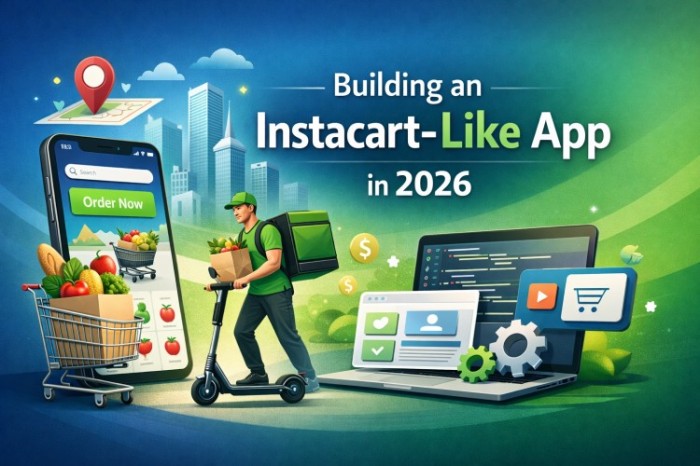
The online grocery delivery market has experienced rapid growth in recent years, driven by increasing demand for convenience, time-efficient services, and seamless digital shopping experiences. Recent industry estimates suggest the global online grocery market is projected to surpass $800 billion by 2028, expanding at a CAGR of over 20%. This growth presents a strong opportunity for entrepreneurs and businesses to launch competitive grocery delivery platforms.
Whether you’re a startup entering the on-demand grocery space or an established retailer expanding your digital presence, building an Instacart-like app can help you reach a growing customer base. In this complete guide, we’ll cover everything you need to know about developing an Instacart-like app in 2026, including key benefits, essential features, technical requirements, development costs, and effective strategies for a fast and successful launch.
What Is an Instacart Clone App?
An Instacart clone app is a ready-made or custom-developed online grocery delivery solution designed to mirror the core functionality of platforms like Instacart. It connects grocery stores, delivery partners, and customers within a unified ecosystem, enabling users to browse products, place orders, process payments, and receive doorstep deliveries through a mobile app.
While inspired by Instacart’s proven model, clone apps can be fully customized to reflect your brand, adapt to regional business requirements, and align with specific operational workflows. Whether you’re serving local retailers or launching a large-scale marketplace, an Instacart clone app provides a faster entry into the online grocery market without building everything from the ground up.
Benefits of Developing an Instacart Clone App
Launching a grocery delivery app based on the Instacart model offers several advantages in today’s digital-first economy. Below are the key benefits driving its popularity among entrepreneurs:
- Faster Time to Market
Instacart clone apps include pre-integrated modules such as product catalogs, shopping carts, payment processing, and order tracking, allowing you to launch your platform in a matter of weeks instead of months. - Lower Development Costs
Using a pre-built framework significantly reduces expenses related to custom development, quality assurance, and infrastructure setup, freeing up budget for marketing and business growth. - Proven and Reliable Business Model
Instacart’s success has established on-demand grocery delivery as a trusted and scalable model. Adopting this approach allows you to tap into an already mature and expanding consumer demand. - High Scalability and Customization
These apps are designed for flexibility, enabling you to add local languages, support various store formats, expand product categories, and implement monetization strategies such as subscriptions or promoted listings. - Simplified Partner Onboarding
Dedicated dashboards for vendors, shoppers, and delivery partners streamline onboarding and management, making it easier to expand operations across multiple locations or regions.
Essential Features Every Instacart-Like App Should Have
With your business model in place, the next step is to identify the core and advanced features that will make your grocery delivery app stand out in 2026.
Core Features for 2026
A seamless experience is essential for all users—customers, delivery partners, and stores alike:
Customer App
- User registration and profile management
- Product browsing with advanced search and filters
- Shopping cart and smooth checkout process
- Multiple secure payment options
- Real-time order tracking and delivery updates
- Order history and easy reordering
- Push notifications for offers and updates
Delivery Partner App
- Job alerts for new deliveries
- Detailed order and route information
- Delivery status updates
- Earnings and performance dashboard
Store/Partner App
- Order management and tracking
- Inventory updates and stock management
- Sales and performance dashboard
Admin Panel
- Complete operational control
- User, store, and delivery partner management
- Analytics and reporting
- Promotion and discount management
Advanced Features That Enhance Engagement
To remain competitive in 2026, integrating intelligent and interactive features can significantly boost user satisfaction and retention:
AI-Powered Personalization: Leverages customer purchase history and preferences to suggest products, increasing engagement and repeat orders.
Predictive Inventory & Demand Forecasting: AI-driven insights help optimize stock levels and reduce out-of-stock scenarios.
Voice Search & Assistant Integration: Supports hands-free ordering through smart speakers and voice assistants, making shopping faster and more convenient.
Augmented Reality (AR) Shopping: Allows users to visualize products, especially perishables, before purchasing—a premium feature gaining popularity.
Subscription & Loyalty Programs: Encourages repeat business through membership perks, discounts, and reward programs, driving long-term retention.
Approaches to Building an Instacart Clone App
When launching an online grocery delivery platform like Instacart, one of the most critical decisions is how to develop your app. Broadly, there are two main approaches: Custom Development and Ready-Made Clone Solutions. Understanding their differences can help you save time, reduce costs, and avoid costly mistakes.
1. Custom Development Approach
Custom development involves building your Instacart-like app from scratch, designing every feature, screen, and workflow to align with your business goals. This typically requires a team of developers, designers, QA engineers, and product managers, either in-house or through an agency.
- Best For: Large enterprises or well-funded startups with unique technical requirements, proprietary algorithms, or specialized delivery workflows.
Pros:
- Full Control: Every element, from UI to features, is tailored to your vision.
- High Scalability: Custom infrastructure supports long-term growth and expansion.
- Unique Experience: Perfect for businesses that need a differentiated UX or complex operational logic.
Cons:
- High Cost: Significant investment (often 5–6 figures or more) before launch.
- Long Development Time: Typically 6 months to over a year.
- High Oversight: Requires experienced project management to manage scope, bugs, and technical debt.
- Delayed Market Entry: Extended timelines may allow competitors to gain an edge.
2. Ready-Made Instacart Clone Solutions
Ready-made clones are pre-built apps replicating the core features of successful grocery delivery platforms—product browsing, cart management, real-time tracking, vendor dashboards, and delivery partner modules. These white-label solutions can be rebranded and customized to fit your business.
- Best For: Startups, entrepreneurs, or businesses looking to launch quickly, test ideas, or enter the market with lower investment.
Pros:
- Fast Time to Market: Launch within days or weeks instead of months.
- Cost-Effective: Significantly cheaper than fully custom development.
- Proven Architecture: Tested on real users, minimizing bugs and technical issues.
- Modular & Scalable: Easily add new features, integrations, or customizations as you grow.
- End-to-End Support: Many providers offer hosting, maintenance, and updates.
- Focus on Growth: Spend more time acquiring users instead of managing code.
Cons:
- Feature Limitations: Deep technical innovations may require custom development later.
Conclusion
Developing an Instacart-like app in 2026 is a promising venture — but success requires smart planning, quality execution, and continual innovation. By understanding market trends, choosing the right features, and aligning technology with user needs, you can build a grocery delivery platform that competes with big players and provides real value to users.
Ready to get started? Let your vision meet execution with a strategy that reflects today’s market realities and tomorrow’s expectations.





















Leave a Reply