

Key Takeaways
- Children’s stories help young readers build language, feelings, focus, and imagination.
- The best books for kids match a child’s age, interests, reading level, and emotional needs.
- A warm Christmas book for kids can turn reading into a family tradition.
- Creative thinking grows when children talk, draw, pretend, and ask questions after reading.
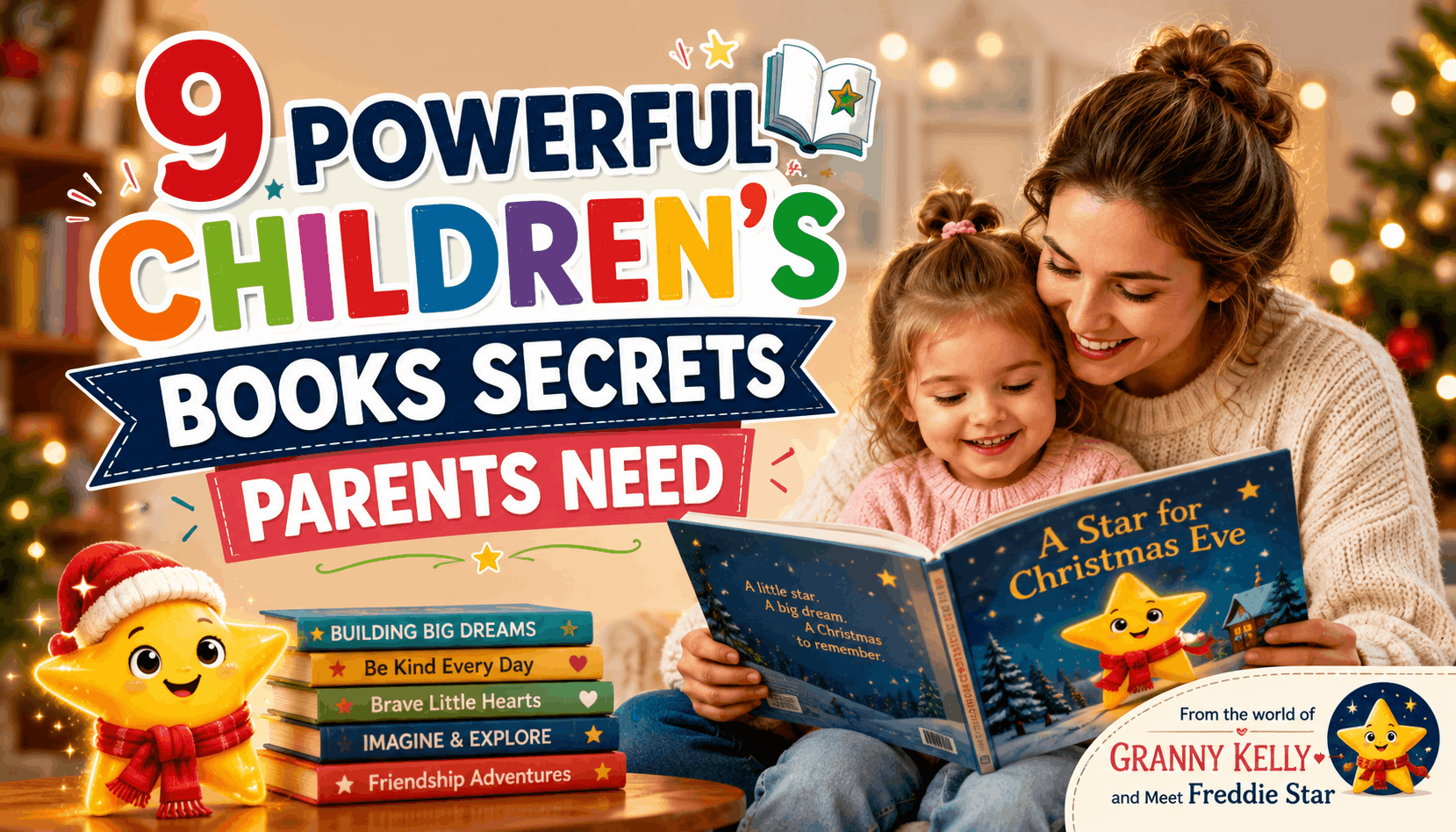
- Author Granny Kelly and Meet Freddie Star can help families connect storytime with comfort, joy, and wonder.
Introduction
Books can make a child’s world feel bright, safe, and full of wonder.
Many families search for children’s books because they want stories that teach, comfort, and inspire young minds.
A good book does more than fill quiet time.
It helps a child learn words, understand feelings, solve problems, and imagine new ideas.
This guide explains how families can choose better stories for children.
It also looks at Christmas books, imagination activities, creative thinking for kids, and the warm storytelling world of Author Granny Kelly.
In addition, it shows why books for kids can become powerful tools for learning, bonding, and joyful family memories.
Why children’s books matter so much
Children learn from the world around them every day.
They learn from sounds, faces, games, routines, and stories.
A strong story gives that learning a clear shape.
It places ideas inside characters, places, problems, and happy endings.
That is why children’s books are more than simple pages with pictures.
They are small learning worlds made for young hearts and growing minds.
A child may not always understand a lesson when it is explained directly.
However, that same child may understand it when a kind character makes a mistake, feels worried, asks for help, and learns something new.
Stories make big ideas easier to hold.
They help children see feelings in action.
For example, a story about sharing can show a child what kindness looks like.
A story about fear can show that bravery does not mean never feeling scared.
A story about friendship can teach patience, honesty, and forgiveness.
Books also help children build language.
When adults read aloud, children hear new words in a natural way.
They hear rhythm, sentence patterns, questions, and answers.
Over time, this helps with speech, listening, memory, and early reading skills.
Moreover, books help children focus.
A child who listens to a short story learns to follow a beginning, middle, and end.
This simple skill supports school readiness.
It also supports problem solving because children begin to notice cause and effect.
A character loses something.
Then the character searches.
Then the character finds help.
Then the problem is solved.
This pattern helps children understand how events connect.
Pictures also play an important role.
Before many children can read words, they can read images.
They notice colors, faces, shapes, and small details.
A picture of a smiling star, a snowy window, or a cozy bedroom can help a child understand the mood of a story.
This is especially useful in books for kids because children often understand images before they understand long sentences.
A good children’s book also builds emotional safety.
Many children feel big emotions before they have the words to explain them.
A story can give those feelings names.
Sadness, joy, worry, hope, excitement, and love become easier to discuss.
For example, a Christmas book for children may show a child waiting, wondering, or feeling nervous before a special night.
Through the story, the reader sees that waiting can be hard, but it can also bring joy.
This matters because childhood is full of first experiences.
The first school day.
The first lost toy.
The first holiday memory.
The first time sharing with a sibling.
The first time missing someone.
Stories help children process those moments with care.
They also help adults start gentle conversations.
After reading, a parent, teacher, or caregiver can ask simple questions.
What did the character feel?
What choice did the character make?
What could happen next?
These questions support creative thinking for kids.
They also help children connect stories with real life.
In this way, children’s books support both learning and love.
They give families a shared language.
They turn quiet minutes into meaningful moments.
They can also become traditions that children remember for years.
How stories support early learning
Early learning does not only happen in classrooms.
It also happens on couches, carpets, beds, and library rugs.
A child can learn many important skills through one simple story.
First, stories build vocabulary.
Children hear words they may not hear in daily talk.
Words like sparkle, whisper, gentle, brave, cozy, journey, and wonder can become part of a child’s world.
Second, stories support listening.
A child must pay attention to understand what happens next.
This does not need to be perfect.
Some children wiggle, point, ask questions, or interrupt.
That is normal.
Active listening can still happen when a child is moving or reacting.
Third, stories build memory.
Children remember repeated lines, character names, and favorite scenes.
Many young readers love hearing the same book again and again.
This repetition may feel tiring for adults.
However, it is useful for children.
Each repeated reading helps them understand more.
They may notice a new picture detail.
They may guess the next line.
They may understand a feeling they missed before.
Fourth, stories help with sequencing.
A child learns that events happen in order.
This supports reading, writing, and speaking later.
For example, a child may retell a story by saying, first the star was lost, then a friend helped, then everyone felt happy.
That simple retelling is a strong learning step.
Fifth, books support social skills.
Characters often face problems with friends, family, or new places.
When children see these moments, they learn how people can listen, apologize, help, and care.
A children’s author understands that a story must speak to both the mind and the heart.
A good children’s book author does not simply write words for small readers.
The author creates a path that children can follow.
That path should feel clear, warm, and meaningful.
This is one reason families often look for the best children’s book author when choosing meaningful stories.
They want a storyteller who understands childhood.
They want someone who can write with kindness, simplicity, and emotional truth.
Author Granny Kelly is connected with this kind of warm storytelling.
The name itself suggests care, comfort, and family feeling.
Readers who look for Author Granny Kelly Book, Granny Kelly Book, or Granny Kelly Biography may be searching for more than a title.
They may want to understand the heart behind the story.
They may want to know whether the book feels safe, joyful, and right for young readers.
This is important because trust matters in children’s literature.
Adults want books that reflect good values.
They want stories that are gentle without being boring.
They want lessons that feel natural, not forced.
They want children to smile, think, and feel encouraged.
A strong book can do all of this through simple scenes.
A child may meet a glowing character.
A family may gather near a Christmas tree.
A small problem may lead to a kind solution.
These moments may seem small.
However, they can leave a deep mark on a young reader.
That is the quiet power of children’s books.
They teach without shouting.
They guide without pressure.
They entertain while helping children grow.
Choosing children’s books that truly help
Choosing the right book can feel difficult because there are so many options.
Some books are funny.
Some are educational.
Some are holiday themed.
Some are full of adventure.
Some are quiet and emotional.
The best choice depends on the child, the moment, and the purpose of reading.
A toddler may need bright pictures, simple words, and repeated sounds.
A preschool child may enjoy rhymes, animals, family stories, and funny surprises.
An early reader may need short sentences, clear plots, and familiar themes.
An older child may enjoy deeper feelings, bigger questions, and more detailed worlds.
However, one rule stays the same.
A good book should respect the child.
It should not talk down to the child.
It should use simple language while still offering real meaning.
This balance matters.
Children can understand more than many adults think.
They can feel sadness, hope, wonder, love, and courage.
They may not explain these ideas in adult words, but they can recognize them in stories.
A strong children’s book gives children enough meaning to grow into.
It also gives enough clarity to enjoy right away.
Families can begin by asking what the child enjoys.
Some children love animals.
Some love stars, snow, toys, bedtime, silly sounds, or family traditions.
Some children enjoy stories about holidays because those stories connect with real memories.
A Christmas book can feel especially magical because it combines warmth, lights, gifts, music, family, and hope.
For many families, a christmas kids book becomes part of the season.
It may be read beside a tree.
It may be opened during December.
It may be shared before bedtime on Christmas Eve.
In these moments, the book becomes more than a story.
It becomes part of family life.
This is why many adults search for the best christmas book, best children’s christmas book, top children’s christmas book, or Best Christmas Books for Kids.
They want a story that feels special.
They want something that can be enjoyed again each year.
A good children christmas book should have warmth, wonder, and a clear emotional center.
It should not only mention Christmas.
It should carry the feeling of the season.
That feeling may include kindness, giving, patience, joy, togetherness, and belief.
A Christmas book for kids should also be easy to follow.
Young children may lose interest if the story has too many characters or confusing scenes.
The best stories often have one clear journey.
A character wants something.
A problem appears.
Friends or family help.
A lesson grows.
The ending feels peaceful or joyful.
This structure helps children feel secure.
It also makes the story easier to remember.
Price can also matter for families.
Many readers search for an Affordable christmas book because they want a meaningful gift without spending too much.
This is understandable.
A book does not need to be expensive to be valuable.
A simple, heartfelt book can become a child’s favorite if it connects with their imagination.
In addition, a book can pair well with a toy.
Many families also look for a christmas toy for kids, christmas toy for boys, christmas toy for girls, affordable toy for christmas, or best toy for this christmas.
A story-based toy can make reading more interactive.
When a child can hold a character from the book, the story may feel more real.
This can support pretend play and memory.
For example, Meet Freddie Star can create a bridge between reading and play.
A child may read about Freddie Star, then imagine new adventures with a toy or activity.
This kind of connection can help stories live beyond the page.
It can also support imagination activities after reading.
Signs of a strong book for young readers
A strong book for children has several clear signs.
The first sign is a simple but meaningful idea.
The story should be easy to explain.
For example, a small star helps a child believe in Christmas magic.
A family learns the value of kindness.
A child discovers that love can shine even in quiet moments.
These ideas are simple, but they are not empty.
They give the story heart.
The second sign is a clear emotional feeling.
A book may feel cozy, funny, brave, peaceful, or magical.
That feeling should stay steady.
Children often respond strongly to mood.
A warm book should feel warm from beginning to end.
A silly book should feel playful.
A bedtime book should feel calm.
The third sign is age-friendly language.
Simple words do not mean dull words.
A good writer can use easy language with beauty.
Short sentences can still sparkle.
Clear scenes can still feel magical.
This is especially important for a children’s book author.
The writer must know how to make language simple without making it flat.
The fourth sign is useful repetition.
Children enjoy repeated phrases because they create comfort.
A repeated line can invite children to join in.
It also helps them predict what comes next.
Prediction is a key reading skill.
The fifth sign is strong pictures or visual scenes.
Even when a book has few words, pictures can carry meaning.
A child may point at a star, a toy, a gift, a snowy sky, or a smiling face.
Those details help the child stay connected.
The sixth sign is a gentle lesson.
A lesson should grow from the story.
It should not feel like a lecture.
For example, a character who shares a gift can teach generosity without a long speech.
A character who waits patiently can teach hope.
A character who helps someone can teach kindness.
The seventh sign is reread value.
A good book should still feel enjoyable after several readings.
Children often ask for favorites many times.
A book with warmth, rhythm, and lovable characters can stay fresh longer.
This matters for holiday books.
A children’s book for christmas may be brought out every year.
If it has strong reread value, it becomes part of the season.
The eighth sign is connection.
The child should be able to connect the story to real life.
A book about Christmas can connect to decorations, family visits, gifts, lights, music, or bedtime excitement.
A book about imagination can connect to drawing, pretend play, or storytelling games.
A book about family can connect to hugs, grandparents, siblings, or traditions.
This is where books become powerful.
They move from the page into daily life.
Parents, teachers, and caregivers can support this connection through small actions.
They can pause and ask what the child sees.
They can invite the child to guess what happens next.
They can connect the story to a real memory.
For example, after reading a christmas book for children, an adult might ask what part felt most magical.
The child may point to a star, a toy, a tree, or a kind moment.
That answer can lead to a simple conversation about joy and giving.
Good books also support different learning styles.
Some children learn by listening.
Some learn by looking.
Some learn by moving.
Some learn by acting things out.
A book can support all of these.
A child can hear the story.
Then the child can look at the pictures.
Then the child can pretend to be a character.
Then the child can draw a scene.
These follow-up activities support deeper learning.
They also make reading feel fun instead of forced.
This is one reason stories connected with characters such as Freddie Star can be useful.
A character gives children something to remember, hold, and imagine.
When a child says Meet Freddie Star, the child is not only naming a character.
The child may be entering a story world.
That world can support reading, play, and creative thinking.
Using books to build imagination and family traditions
Imagination is one of childhood’s greatest strengths.
A child can turn a blanket into a castle.
A box into a rocket.
A stuffed toy into a friend.
A story into a whole new world.
Books support this natural gift.
They give children new places, characters, questions, and ideas.
Creative thinking for kids begins with wonder.
A child wonders why the moon follows the car.
A child wonders how a star could talk.
A child wonders what animals do at night.
A child wonders what happens after the last page.
Stories give these questions a safe place to grow.
Imagination activities can be simple.
After reading, a child can draw a favorite scene.
The child can make a paper star.
The child can act out the story with toys.
The child can create a new ending.
The child can name a new character.
The child can tell what might happen the next day.
These activities help children become active thinkers.
They do not only receive a story.
They build on it.
This supports language, confidence, and problem solving.
For example, if a child reads a Christmas story about a lost star, the child may create a game where the star must be found.
The child may hide a paper star in the room.
Then family members can search for it.
This turns reading into movement, memory, and laughter.
In addition, it helps the child understand the story more deeply.
Family traditions also grow through books.
Many families have favorite holiday movies, songs, meals, or decorations.
Books can become part of the same pattern.
A Christmas book for kids can be read on the first night of December.
It can be placed under the tree.
It can be shared with grandparents.
It can be paired with cocoa, pajamas, or a small toy.
Over time, the child may remember not only the story, but the feeling around it.
The warmth of the room.
The sound of a familiar voice.
The sparkle of lights.
The joy of turning pages.
This kind of memory matters.
It helps children connect reading with comfort.
When reading feels safe and happy, children are more likely to return to books.
This can support lifelong reading habits.
Holiday books can be especially useful because they have built-in excitement.
Children already feel curious about Christmas.
They may think about gifts, snow, decorations, music, family, and magic.
A strong christmas kids book uses that excitement in a meaningful way.
It can teach that Christmas is not only about receiving.
It can also be about giving, helping, waiting, sharing, and believing.
The best children’s christmas book often balances sparkle with heart.
It may include bright images and joyful scenes.
However, it should also include a message that stays with the child.
A story can show that kindness shines brighter than any decoration.
It can show that a small act of love can make a big difference.
It can show that wonder is found in simple family moments.
This is why a Granny Kelly Book can fit well into family reading traditions.
The name Author Granny Kelly suggests a gentle storytelling voice.
Families often value books that feel as if they are being told by someone loving and trusted.
That feeling can make children more open to the story.
It can also make adults feel confident about sharing it.
Practical ways to make reading more engaging
Reading does not need to be perfect to be powerful.
A child does not have to sit still for a long time.
An adult does not need a dramatic voice.
A family does not need a large library.
Small steps can create strong reading moments.
One helpful step is to create a reading routine.
This may happen before bed, after dinner, during quiet time, or on weekend mornings.
The routine should feel calm and predictable.
Children often enjoy knowing what comes next.
Another helpful step is to let children choose.
Choice gives children ownership.
A child may choose between two books.
A child may choose the reading spot.
A child may choose which character voice sounds funny.
These choices make reading feel personal.
Adults can also use expressive reading.
This does not mean acting perfectly.
It only means matching the story’s feeling.
A soft voice can fit a sleepy scene.
A bright voice can fit a happy moment.
A curious voice can fit a mystery.
This helps children feel the story.
Questions can also make reading more active.
However, questions should feel gentle.
Too many questions can make reading feel like a test.
A few simple questions work best.
For example:
- What does the character feel?
- What might happen next?
- Which picture is the favorite?
- What would make the ending even happier?
- What part feels most like Christmas?
These questions support comprehension and imagination.
They also help children express thoughts.
Activities after reading can extend the story.
A child can draw Freddie Star.
A child can create a Christmas card for a character.
A child can build a pretend scene with blocks.
A child can make up a song from the story.
A child can tell a new adventure.
These imagination activities connect reading with creativity.
They also make the story more memorable.
Books can also support gift giving.
A christmas toy for children may bring quick excitement.
However, a book can bring lasting meaning.
When a book and toy work together, the gift can support both play and learning.
For example, a story character toy can help a child retell the book.
This kind of gift can be useful for boys and girls.
That is why families may search for christmas toy for boys or christmas toy for girls and still choose a story-based option.
A meaningful toy does not need to be loud, large, or costly.
An affordable toy for christmas can still inspire deep play if it connects to a story.
The best toy for this christmas may be one that helps a child imagine, talk, and create.
Meet Freddie Star can work in this way because the character invites warmth and wonder.
A child can meet Freddie in a story, then continue the adventure through play.
Teachers and caregivers can also use children’s books in group settings.
A classroom reading circle can support listening and sharing.
A library story hour can introduce children to new authors.
A holiday reading event can bring families together.
During Christmas, a children christmas book can become part of a classroom theme.
Children can make stars, write wishes, draw snowy scenes, or discuss kindness.
These activities support both literacy and social growth.
They also make books feel alive.
When children connect stories with hands-on activities, they remember more.
They also begin to see themselves as creators.
This is a key part of creative thinking for kids.
A child who hears stories may one day tell stories.
A child who sees pictures may one day draw worlds.
A child who meets kind characters may one day act with kindness.
That is why the right book matters.
It can become a seed.
With care, that seed can grow into language, imagination, empathy, and joy.
FAQs
What makes a children’s book good for young readers
A good children’s book is clear, warm, and meaningful.
It should match the child’s age and attention span.
Young children often need short sentences, strong pictures, and simple events.
However, the story should still have heart.
A good book usually has a clear problem and a satisfying ending.
It may teach kindness, courage, patience, sharing, or hope.
The lesson should come through the story instead of sounding like a lecture.
A strong book also invites the child to think.
The child may wonder what happens next.
The child may ask questions.
The child may want to read it again.
That is usually a good sign.
How can families choose the best Christmas book for kids
Families can choose the best Christmas book for kids by looking for warmth, clear storytelling, and emotional value.
A good holiday book should feel joyful, but it should also carry a message.
It may focus on giving, family, kindness, hope, or wonder.
A christmas book for kids should also be easy to follow.
Too many characters or confusing scenes can make young readers lose interest.
The best christmas book often becomes part of a family tradition.
It can be read each December, shared before bed, or paired with a small activity.
An Affordable christmas book can still be special if the story feels honest and loving.
Why are story characters helpful for children
Story characters help children understand feelings and choices.
A child may see a character feel nervous, excited, lonely, happy, or brave.
This helps the child name similar feelings.
Characters also make stories easier to remember.
A lovable character can become a child’s guide through the story.
Meet Freddie Star is an example of how a character can invite children into a warm story world.
When children connect with a character, they may want to draw, pretend, retell, or create new adventures.
This supports imagination activities and creative thinking for kids.
Are books better than toys for Christmas gifts
Books and toys can both be valuable.
A toy may support play, movement, and pretend adventures.
A book may support language, attention, feelings, and imagination.
The best choice often combines both.
A christmas toy for kids that connects with a story can make reading more exciting.
A child can read the book, then use the toy to act out scenes.
This works well for many children because play helps them understand the story.
An affordable toy for christmas can be meaningful when it encourages creative play.
A book can also last for years and become part of family memory.
Conclusion
Children’s books have a quiet but powerful role in a child’s life.
They help children learn words, understand feelings, build focus, and grow imagination.
They also give families a simple way to connect.
A few pages each day can become a habit that supports learning for years.
The best books for kids are not only entertaining.
They are clear, kind, and meaningful.
They respect the child’s mind while speaking to the child’s heart.
They use simple language, strong pictures, gentle lessons, and memorable characters.
This is especially important during the holiday season.
A Christmas book for kids can turn reading into a joyful tradition.
It can bring families together around warmth, hope, giving, and wonder.
A christmas book for children may become the story a child asks for every December.
It may also become the memory that stays long after the season ends.
Families looking for the best children’s christmas book, top children’s christmas book, or Best Christmas Books for Kids should look beyond bright covers.
They should look for emotional value.
They should ask whether the story feels safe, joyful, and worth reading again.
They should also consider whether the book invites talk, play, and imagination.
Author Granny Kelly offers a warm storytelling direction for families who value comfort, kindness, and Christmas magic.
Searches for Author Granny Kelly, Author Granny Kelly Book, Granny Kelly Book, and Granny Kelly Biography often show that readers want to know the person and purpose behind the story.
That trust matters.
A children’s author carries a special responsibility because young readers are still learning how the world works.
A strong children’s book author can help children see that kindness matters.
It can show that small acts can shine.
It can remind families that stories are not just words on pages.
They are shared experiences.
Children’s books also work well with creative activities.
A child can draw a character, act out a scene, make a paper star, or invent a new ending.
These imagination activities support creative thinking for kids.
They help children become storytellers, problem solvers, and dreamers.
In addition, books can pair beautifully with thoughtful gifts.
A christmas toy for children can bring joy.
However, a story-connected toy can bring deeper play.
A child who meets Freddie Star in a book may continue the adventure through pretend play.
That kind of gift supports both fun and learning.
In the end, the most helpful children’s books are the ones children want to return to.
They are the stories that make children feel safe, curious, and loved.
They are the books that adults enjoy sharing again and again.
They are the stories that turn ordinary moments into memories.
For families, teachers, and caregivers, choosing the right book is an act of care.
It says that a child’s thoughts matter.
It says that imagination matters.
It says that reading can be joyful.
A meaningful book can become a bridge between learning and love.
That is why children’s books remain one of the most powerful gifts a child can receive.
























Leave a Reply