

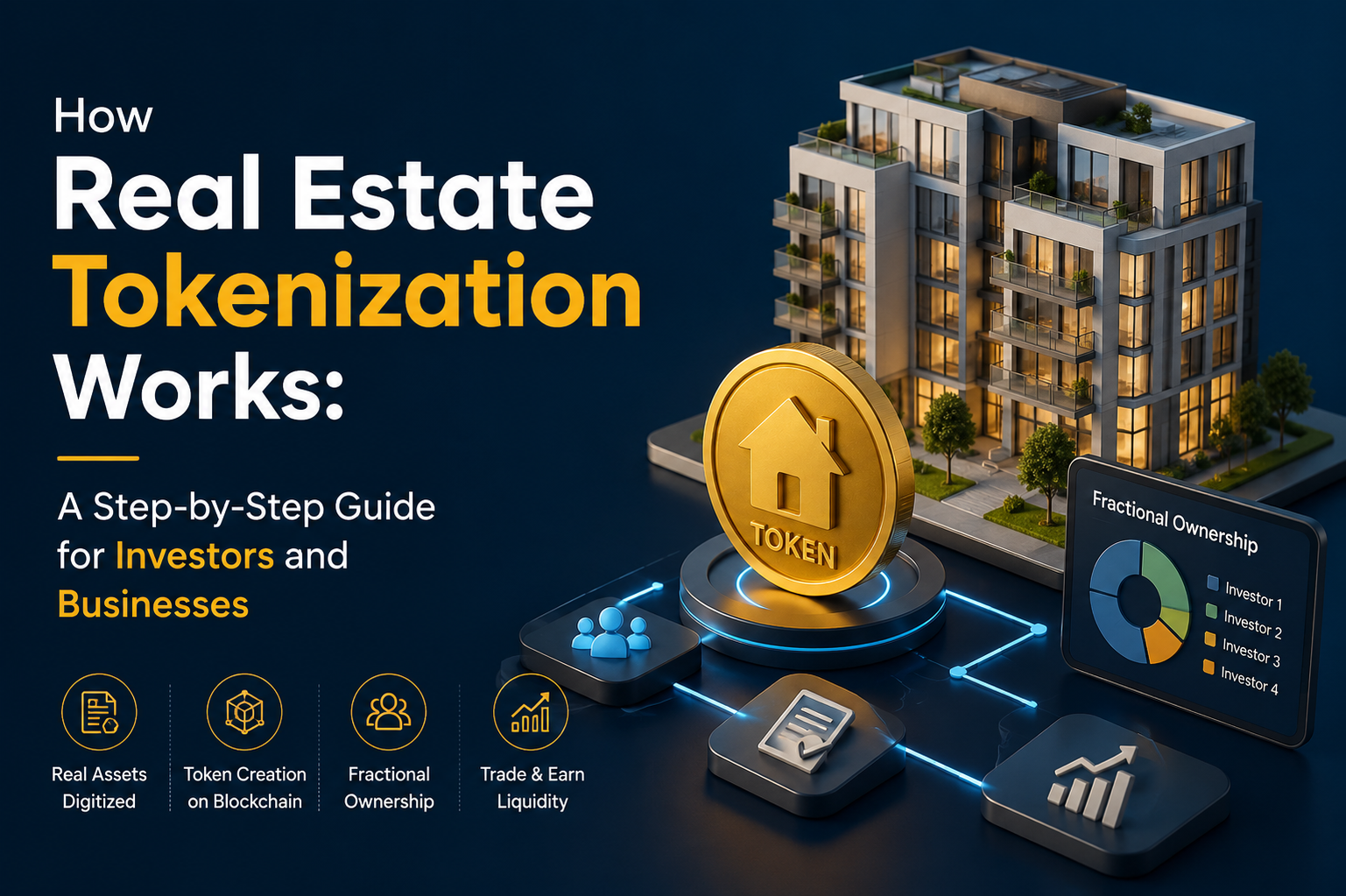
Real estate has long been regarded as one of the most valuable asset classes, but investing in property has traditionally required significant capital, extensive paperwork, legal intermediaries, and patience. A commercial building, residential complex, hotel, or development project can represent millions of dollars in value, making direct ownership inaccessible to many investors. At the same time, property owners often face lengthy transaction processes and limited liquidity when they want to raise capital or exit an investment.
Real estate tokenization is emerging as a blockchain-based approach to address some of these limitations. It involves representing ownership rights, economic interests, or other claims associated with a real estate asset through digital tokens recorded on a blockchain. Instead of treating a property as one indivisible investment, tokenization can divide its economic interest into smaller digital units, subject to the applicable legal and regulatory structure.
The concept is gaining attention from investors, developers, asset managers, and financial institutions. Deloitte estimates that the value of tokenized real estate could reach approximately $4 trillion by 2035, compared with less than $0.3 trillion in 2024. This forecast does not mean that every property will become tokenized, but it illustrates the scale of the opportunity being considered by the financial industry.
What Is Real Estate Tokenization?
Real estate tokenization is the process of converting legally defined rights or economic interests in a property or real estate-related investment into blockchain-based digital tokens. These tokens can represent fractional interests in a property-owning entity, shares in a real estate fund, debt backed by property, or another legally structured claim.
The important point is that tokenization does not simply mean putting a property’s details on a blockchain. The blockchain records the digital representation of an underlying legal and economic arrangement. In many real-world implementations, the property remains held through an entity such as a special-purpose vehicle, trust, fund, or other legal structure, while blockchain tokens represent the investor’s interest in that structure.
This distinction is critical for investors. Owning a token does not automatically mean owning the title to a building. The rights attached to a token depend on the offering documents, corporate structure, jurisdiction, applicable securities regulations, custody arrangements, and smart-contract rules.
The broader tokenization market is also moving beyond experimentation. McKinsey estimates that tokenized financial assets could reach approximately $2 trillion in market capitalization by 2030 in its base case, excluding cryptocurrencies and stablecoins.
Why Are Businesses Tokenizing Real Estate?
Traditional real estate transactions can involve brokers, banks, lawyers, registrars, fund administrators, custodians, property managers, and other intermediaries. Each participant may contribute value, but coordination between them can increase costs and processing time.
Tokenization can potentially streamline parts of this infrastructure. Blockchain provides a shared digital ledger where ownership records, transfers, and transaction histories can be recorded. Smart contracts can automate predefined processes such as token issuance, transfer restrictions, investor eligibility checks, distributions, and corporate actions.
For investors, the most attractive proposition is often fractional ownership. Consider a property valued at $10 million. Instead of requiring one investor to purchase the entire asset, a legally structured offering could divide the economic interest into 100,000 tokens priced at $100 each. An investor could therefore obtain exposure to a portion of the investment without purchasing the entire building.
However, fractionalization should not be confused with guaranteed liquidity. A token can technically be transferable while still having few buyers. Research and industry analysis increasingly identify secondary-market liquidity as one of the major challenges facing tokenized assets.
How Real Estate Tokenization Works: Step by Step
Step 1: Selecting and Evaluating the Property
The process begins with identifying a suitable real estate asset. This might be an apartment building, office property, hotel, warehouse, retail center, land development, or a portfolio of properties.
Before tokenization, the asset generally needs extensive due diligence. Businesses must examine the property’s title, valuation, ownership structure, debt obligations, leases, taxes, insurance, zoning requirements, income-generating capacity, and existing contractual obligations.
For investors, this stage is just as important as the blockchain technology itself. Tokenization does not eliminate the fundamental risks of property investment. If a building has poor occupancy, excessive debt, declining rental income, or legal disputes, converting its ownership interest into tokens does not change those underlying conditions.
Step 2: Establishing the Legal Structure
The next stage is determining what the tokens legally represent.
A business may create a special-purpose vehicle that owns the property, with investors receiving tokens representing equity or another economic interest in that entity. Alternatively, tokenization may be applied to a real estate fund, mortgage, loan, or securitized interest.
This is one of the most important stages because the legal relationship between the property, issuer, token holder, and underlying rights must be clearly documented.
Depending on the jurisdiction and structure, tokenized real estate interests may fall within securities or other financial regulations. Businesses therefore need appropriate legal, tax, compliance, and regulatory advice before launching an offering.
Step 3: Property Valuation and Financial Structuring
Once the legal structure is established, the property needs to be valued and the investment economics defined.
Suppose a commercial property is valued at $20 million and the issuer intends to raise $8 million through tokenized investment. The project may define a specific number of tokens, their issue price, investor rights, distribution methodology, fees, holding restrictions, and exit mechanisms.
The financial structure should clearly explain how rental income, capital appreciation, expenses, management fees, and eventual property-sale proceeds affect token holders.
Transparency is particularly important because investors should understand what they are purchasing rather than simply seeing a token price displayed on a dashboard.
Step 4: Designing the Token
The token itself is then designed according to the legal and economic requirements of the project.
The smart contract can define important characteristics such as total supply, transfer rules, ownership records, investor eligibility, distribution mechanisms, and restrictions on certain transactions.
For example, if regulations require only verified investors to hold a particular security token, the smart contract can incorporate whitelist-based transfer controls. A transfer can be rejected if the receiving wallet has not completed the required compliance process.
This demonstrates why tokenization is more than creating a cryptocurrency. The token needs to reflect the specific legal and financial requirements of the underlying asset.
Step 5: Building the Tokenization Platform
The technology infrastructure connects the blockchain with the real estate investment process. A comprehensive platform may include investor onboarding, identity verification, compliance checks, token issuance, wallet management, portfolio dashboards, payment processing, document management, and secondary-transfer functionality.
Businesses planning such infrastructure often evaluate Real estate tokenization development services to build customized platforms around their asset model, regulatory requirements, investor journey, and blockchain architecture.
A well-designed platform should make the investment experience understandable even for users who have little technical knowledge. Investors should be able to view property information, ownership details, financial reports, distributions, transaction history, and relevant legal documentation through a clear interface.
Step 6: Investor Onboarding and Compliance
After the platform is ready, investors can begin the onboarding process. This typically involves identity verification and, depending on the offering and jurisdiction, know-your-customer, anti-money-laundering, accreditation, suitability, or other compliance procedures.
The platform can connect verified investor identities with blockchain wallets. This creates a bridge between the traditional compliance environment and the blockchain environment.
Compliance is particularly important because tokenization does not remove financial regulation. A technically sophisticated platform can still fail if its legal and compliance architecture is inadequate.
Step 7: Issuing the Tokens
Once the property, legal structure, technology, and compliance procedures are established, the issuer can create and distribute the tokens.
The issuance may occur through a primary offering in which approved investors purchase tokens. The proceeds can then be used according to the project’s stated purpose, such as acquiring property, refinancing debt, funding development, or expanding a real estate portfolio.
At this stage, blockchain technology provides a transparent record of token issuance and ownership, while the legal documents establish what those tokens actually represent.
Step 8: Managing the Investment After Issuance
Tokenization does not end when tokens are sold. The underlying property still needs to be managed.
Rent must be collected, tenants supported, maintenance handled, taxes paid, insurance maintained, and financial performance reported. Investors may receive distributions based on rental income or other defined cash flows.
Smart contracts can automate certain parts of the distribution process, potentially reducing administrative workload. However, real-world property management remains an off-chain activity. Blockchain can record and automate certain financial processes, but it cannot repair a leaking roof or negotiate a lease.
Step 9: Secondary Trading and Exit
One of the biggest potential advantages of tokenization is the possibility of creating more flexible secondary markets.
Traditional property investments can take months to sell because the underlying asset itself must be transferred or refinanced. Tokenized interests can potentially be transferred between eligible investors without selling the entire property.
However, this potential should be approached realistically. A blockchain token does not automatically create a liquid market. There must be sufficient investor demand, appropriate trading infrastructure, regulatory permission, compliant counterparties, and reliable valuation information.
The BIS has highlighted real estate’s traditional illiquidity and complex transaction processes while examining whether tokenization can help address liquidity gaps.
A Practical Example of Tokenized Real Estate
Consider a developer that owns a $5 million rental property. Rather than selling the entire property to one buyer, the developer establishes a legally compliant investment structure and issues 50,000 tokens representing defined economic interests.
If the offering price is $100 per token, the total tokenized interest would correspond to $5 million before considering the project’s specific fees, financing, ownership structure, and valuation assumptions.
Investors who purchase tokens may become entitled to a proportional share of rental income or other returns, depending on the legal documents. If the property generates $300,000 in distributable annual income and an investor owns 1% of the relevant economic interest, that investor’s gross share could be $3,000 before applicable fees, taxes, and other adjustments.
If the property later appreciates, the investor may potentially benefit from capital appreciation as defined by the investment structure. Conversely, if the property loses value or income declines, investors can lose money.
This example illustrates the central principle: tokenization changes the way ownership or economic rights can be represented and transferred; it does not remove normal investment risk.
Key Benefits for Investors and Businesses
For investors, tokenization can potentially lower minimum investment requirements, improve access to selected property opportunities, provide clearer transaction records, and create more flexible ownership structures.
For businesses, the benefits can be broader. Developers may gain access to a wider investor base, while asset managers can create new investment products around property portfolios. Tokenized structures can also make certain administrative processes more programmable.
Deloitte identifies reduced operational inefficiency, lower administrative costs, fractional ownership, and expanded investor participation among the potential benefits of tokenized real estate.
Still, these benefits should be evaluated against implementation costs, regulatory requirements, technology risks, custody considerations, valuation challenges, and liquidity limitations.
What Businesses Should Consider Before Launching
A successful tokenization project requires coordination across legal, financial, technological, and real estate functions. Businesses should determine the property’s investment thesis first and select blockchain infrastructure second.
Key considerations include:
- Legal ownership and investor rights
- Regulatory classification of the token
- Property valuation and financial reporting
- KYC and AML compliance
- Smart-contract security
- Custody and wallet infrastructure
- Investor data protection
- Token transfer restrictions
- Secondary-market strategy
- Property management and reporting
Organizations seeking Real estate tokenization platform development services should therefore evaluate providers based not only on blockchain development capabilities but also on their ability to design secure, scalable, compliance-oriented investment infrastructure.
The Future of Real Estate Tokenization
Real estate tokenization is unlikely to replace traditional property markets overnight. Instead, it is more likely to develop alongside existing financial infrastructure. Hybrid models combining conventional legal ownership, regulated investment structures, custodians, property managers, and blockchain-based settlement may become increasingly common.
The most promising applications may emerge where tokenization solves a specific economic problem rather than being used simply because blockchain is available. Private real estate funds, property-backed lending, development financing, and fractional investment structures are examples of areas where digital representation may create meaningful efficiencies.
Deloitte’s projection of approximately $4 trillion in tokenized real estate by 2035 demonstrates the scale of the potential opportunity, although forecasts remain estimates rather than guarantees.
Ultimately, successful adoption will depend on more than token creation. Investors need legal certainty, reliable information, secure technology, credible asset management, and realistic liquidity mechanisms. Businesses need to build systems that integrate blockchain with the existing legal and financial world rather than treating blockchain as a replacement for every traditional process.
Conclusion
Real estate tokenization provides a new way to structure, represent, distribute, and potentially transfer interests in property through blockchain technology. From property selection and legal structuring to token issuance, investor onboarding, asset management, and secondary-market opportunities, each stage requires careful coordination between real estate, finance, compliance, and technology. As the market develops, businesses that approach tokenization as a complete financial infrastructure rather than simply a blockchain project are likely to be better positioned for sustainable growth. Blockchain App Factory provides best real estate tokenization services, helping businesses explore secure, scalable, and customized blockchain solutions for transforming real estate assets into digitally managed investment opportunities.