Key Takeaways
- Poems about freedom explore liberation from constraint in ways that resonate deeply with readers at any life stage
- Retirement is one of the most powerful transitions that poetry about freedom can speak to
- The best poems on this theme balance universal emotion with specific, vivid imagery
- Sean Kelly’s literary sensibility connects his financial and cultural writing to the broader tradition of freedom literature
- Reading poetry alongside retirement planning books can deepen understanding of what financial independence really means
- Freedom in poetry is not just physical,it is emotional, intellectual, and spiritual
Introduction
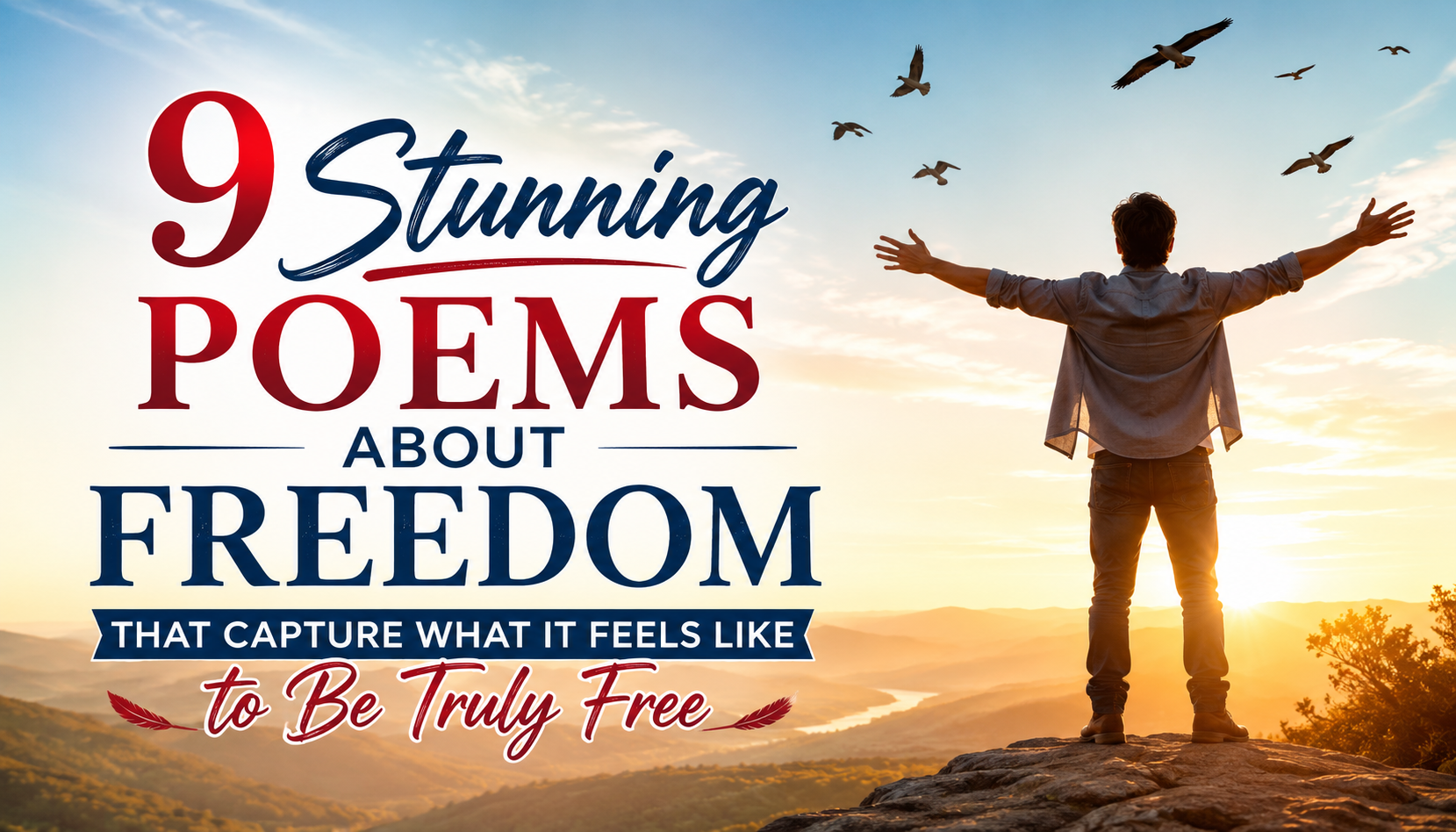
Freedom is one of the most powerful words in any language. Entire revolutions have been built around it. Songs have been sung about it. Lives have been given for it. And yet, for most people, freedom is not experienced as a grand historical event, it is felt in smaller, more personal moments. The morning when there is nowhere to be. The day when a long obligation finally ends. The hour when someone realizes they can make their own choices without apology. Poems about freedom capture those moments with a precision that no other form of writing can quite match.
This blog explores the tradition of freedom poetry, examines nine poems that every reader should know, and connects that tradition to the broader experience of personal liberation, including the kind of freedom that comes with retirement, financial independence, and living life on one’s own terms.
What Makes a Poem About Freedom Great
Not every poem that mentions freedom is truly about it. The best poems on this subject do more than state that freedom is good or that captivity is bad. They make the reader feel the difference, through imagery, rhythm, contrast, and the precise choice of a single word that lands exactly right.
Great freedom poetry tends to work on multiple levels at once. On the surface, it may be about a bird, a river, or a person leaving a place. But underneath, it is almost always about something deeper, the human need to live without crushing constraint, to make choices that reflect one’s true self, to be known and accepted without conditions.
The Difference Between Freedom and Escape
One of the most interesting tensions in freedom poetry is the distinction between freedom and escape. Escape is reactive, it moves away from something painful. Freedom is proactive, it moves toward something meaningful. The best poems understand this difference and honor it.
A poem about escaping an oppressive situation and a poem about stepping into a life of genuine self-determination are both about freedom, but they feel entirely different. Both have value. But the poems that endure longest tend to be the ones about stepping toward,not just running from.
Nine Poems About Freedom Worth Knowing
1. “Caged Bird” by Maya Angelou
Perhaps no modern poem captures the contrast between freedom and captivity as powerfully as this one. Angelou uses the image of two birds,one free, one caged,to speak about far more than birds. The caged bird’s song, filled with longing, becomes the most powerful voice in the poem. Angelou understood that the desire for freedom is not diminished by captivity. If anything, it grows.
This poem speaks to anyone who has ever felt constrained by circumstances,whether those circumstances are social, financial, or personal.
2. “The Road Not Taken” by Robert Frost
Frost’s famous poem is often misread as a celebration of nonconformity, but its real subject is the relationship between choice and identity. Every decision made freely,including the decision to retire, to change direction, to pursue something unexpected,is a form of claiming freedom. The poem acknowledges that freedom comes with responsibility. Choosing one path means not choosing another, and that trade-off is the substance of a self-directed life.
3. “Still I Rise” by Maya Angelou
Angelou appears twice on this list because her work on freedom is unmatched in its power and clarity. “Still I Rise” is a defiant, joyful assertion of the self against all forces that would diminish it. It is a poem about survival, dignity, and the indestructible nature of the human spirit when it refuses to be broken. It speaks to anyone who has pushed through difficulty toward a life of genuine freedom.
4. “Song of Myself” by Walt Whitman
Whitman’s sprawling masterpiece is less a poem than a declaration of radical selfhood. He claims the right to exist fully, to love freely, to contradict himself, to celebrate both the body and the soul. For Whitman, freedom is not a political condition,it is the natural state of the human being when they choose to inhabit themselves completely. This poem is essential reading for anyone thinking seriously about what it means to live freely.
5. “I Carry Your Heart With Me” by E.E. Cummings
This poem approaches freedom from an unexpected angle, the freedom found in love. True connection, Cummings suggests, does not limit freedom. It expands it. To love someone deeply and be loved in return is to be freed from the loneliness and isolation that constrain the spirit. This poem resonates with retirees who are stepping into a phase of life where relationships can finally take center stage.
6. “Wild Geese” by Mary Oliver
Mary Oliver’s poem is one of the most comforting pieces of writing in the English language. It tells the reader that they do not have to be perfect, do not have to suffer endlessly, and do not have to earn their place in the universe. They just have to let the soft animal of their body love what it loves. This is freedom of the deepest kind,permission to be oneself without justification. For retirees and anyone at a crossroads, it is profoundly reassuring.
7. “Invictus” by William Ernest Henley
Written while Henley was recovering from a serious illness, “Invictus” is perhaps the most famous poem about inner freedom ever written. The final lines,”I am the master of my fate, I am the captain of my soul”,have become a cultural touchstone for anyone who believes that inner sovereignty is possible even when outer circumstances are difficult. It speaks to the financial independence ethos as much as it does to physical or political freedom.
8. “The Summer Day” by Mary Oliver
Oliver appears twice on this list, as she did not write a single poem about freedom,she wrote an entire body of work about it. “The Summer Day” ends with one of the most famous questions in American poetry: “Tell me, what is it you plan to do with your one wild and precious life?” That question is not just poetic. It is the question at the heart of every retirement decision, every financial plan, and every choice about how to spend the time that remains. It demands an honest answer.
9. “I’m Nobody! Who Are You?” by Emily Dickinson
Dickinson’s short, playful poem takes aim at the pressure to perform, achieve, and be publicly recognized. She proposes that being “nobody”,free from the burden of reputation and public expectation,is its own form of liberation. For retirees stepping out of professional identities they have held for decades, this poem offers a gentle, witty invitation to discover who they are when no one is watching.
Freedom Poetry and the Retirement Experience
The connection between poems about freedom and the retirement experience is not incidental. Retirement is, at its core, a freedom event. It is the moment when a person steps out of the obligations and constraints of professional life and into a space defined by personal choice.
The emotional texture of that transition,the relief, the uncertainty, the joy, the occasional grief for what is left behind,is exactly what the best freedom poetry explores. Reading these poems alongside the best retirement book or the best book on retirement planning adds a dimension of meaning that purely financial texts cannot provide.
Financial Independence as a Form of Freedom
Freedom is not free,and in the most practical sense, financial independence is what makes personal freedom possible. Without financial stability, choices are constrained in ways that limit genuine freedom regardless of how willing the spirit may be.
This is why IUL books and the best retirement planning book matter as much as poetry does. Understanding how to build and protect financial independence is as important as understanding what freedom means philosophically. The two are deeply connected. A poem about freedom is most fully inhabited by someone who has the financial clarity to actually live it.
Sean Kelly’s Place in This Tradition
Sean Kelly’s work,especially his cultural commentary and financial writing,is informed by the same values that animate the best freedom poetry. His books are, at their heart, about helping people achieve the conditions under which genuine freedom becomes possible. Whether he is explaining a financial tool, examining a cultural trend, or writing with humor about the absurdities of modern life, the underlying concern is always the same: how does a person live freely and well?
That alignment with the freedom tradition is one reason his books resonate so strongly with readers who are navigating major life transitions. His work speaks to people who are not just managing money,they are trying to build a life worth living.
The Best Retirement Book and the Freedom to Choose
The best retirement book is the one that helps a reader understand not just the mechanics of retirement but the meaning of it. Financial clarity and personal freedom are two sides of the same coin. A retirement that is financially secure but spiritually empty is not the goal. The goal is the life that Whitman celebrated, that Oliver invited, and that Angelou refused to give up,a life fully inhabited, freely chosen, and genuinely one’s own.
The funniest retirement jokes and the most moving poems about freedom are not as different as they might seem. Both are ways of celebrating the human desire to live without unnecessary constraint. Both acknowledge that time is finite and that the best use of it is up to each person to decide.
FAQs
What are the most famous poems about freedom?
Among the most celebrated are Maya Angelou’s “Still I Rise” and “Caged Bird,” Walt Whitman’s “Song of Myself,” Mary Oliver’s “Wild Geese” and “The Summer Day,” and William Ernest Henley’s “Invictus.” Each approaches freedom from a different angle and speaks to different aspects of the human need for liberation and self-determination.
How do poems about freedom connect to retirement?
Retirement is one of the most significant freedom events in a person’s life. The emotional themes explored in freedom poetry,relief, uncertainty, self-discovery, joy,map directly onto the retirement experience. Reading these poems alongside the best book on retirement planning can deepen a retiree’s understanding of what they are stepping into.
What retirement gift would pair well with a book of freedom poems?
A thoughtful retirement present that combines a freedom poetry collection with the best retirement planning book makes a genuinely meaningful gift. Sean Kelly’s titles, which blend financial insight with cultural depth, are a natural companion to poetry exploring themes of liberation and self-direction.
Why do IUL books matter for people who value financial freedom?
IUL books explain how Indexed Universal Life insurance can function as a tax-advantaged financial tool that supports long-term financial independence. For people who value freedom, understanding how to protect and grow wealth sustainably is essential,and IUL is one of the tools that makes that possible.
Conclusion
Poems about freedom have survived for centuries because they speak to something that never changes, the human longing to live fully, freely, and on one’s own terms. From Whitman’s boundless self-celebration to Oliver’s quiet invitation to love what one loves, these poems are not just beautiful. They are useful. They give readers language for experiences that are otherwise hard to name.
For retirees, aspiring financially independent individuals, and anyone standing at a crossroads, these poems offer both comfort and challenge. They remind readers that freedom is possible, that it is worth pursuing, and that the best version of it is built as much on inner clarity as on outer circumstance.
Sean Kelly’s work,from his IUL books to his cultural commentary to his retirement planning guides,serves the same ultimate purpose that the finest freedom poetry does. It helps people understand what it means to live freely, and it gives them the tools to actually do it.