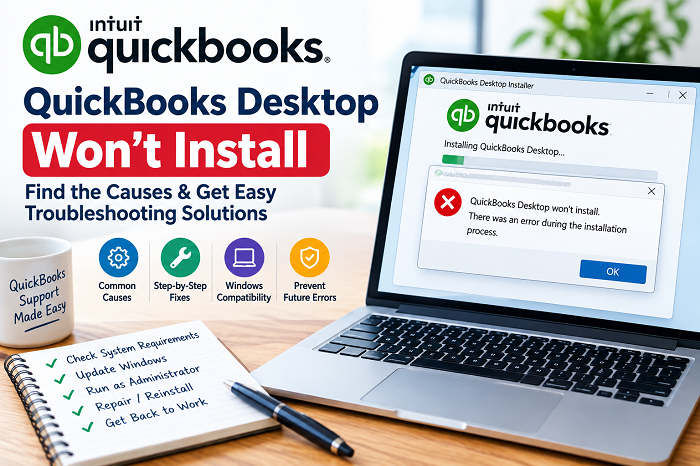
Installing QuickBooks Desktop should normally be straightforward, but sometimes the setup may stop unexpectedly, show an error message, freeze during installation, or fail before the program is completely installed. A QuickBooks Desktop install problem can be related to Windows components, installation files, permissions, background applications, security software, or a previous QuickBooks installation.
If QuickBooks Desktop won’t install, the best approach is to troubleshoot the installation environment rather than repeatedly running the same installer. Start with a system restart, obtain a fresh installation file, and use the QuickBooks Tool Hub when appropriate. Intuit’s current troubleshooting guidance specifically recommends the QuickBooks Install Diagnostic Tool for many installation problems, while Windows updates and Selective Startup can help when Windows components or third-party applications interfere with setup.
This guide explains practical ways to identify and fix QuickBooks Desktop installation problems on Windows.
Why Does QuickBooks Desktop Installation Fail?
There is no single reason why QuickBooks Desktop may fail to install. Different computers can experience different installation conflicts.
Common causes include:
- Damaged or incomplete QuickBooks installation files
- Windows components that need repair or updating
- Insufficient Windows permissions
- Another installation already running in the background
- Problems with Windows Installer
- Issues with the Windows TEMP folder
- Security software blocking installation activity
- Damaged Microsoft .NET Framework components
- MSXML-related problems
- Files left behind by an earlier QuickBooks installation
- Corrupted installation directories
- Insufficient access to required folders
- Pending Windows updates
- Problems with a Windows user account
For example, Intuit documents Error 1618 as an indication that another installation may already be running, while Error 1303 can occur when the installer does not have sufficient privileges to access a required directory.
Understanding the type of installation problem can make troubleshooting much easier.
1. Restart the Computer Before Trying Again
A simple restart should be the first troubleshooting step.
Windows may have background installation processes, pending updates, or temporary services running. These processes can interfere with a new QuickBooks installation.
Before restarting:
- Close QuickBooks and other open applications.
- Save any unfinished work.
- Restart Windows.
- Wait until the desktop completely loads.
- Try running the QuickBooks installer again.
If the installation starts normally after the restart, the problem may have been caused by a temporary Windows process.
If the same error appears again, continue with the next troubleshooting method.
2. Use a Fresh QuickBooks Installation File
A damaged or incomplete installer can prevent QuickBooks Desktop from installing correctly.
If the installer was downloaded previously, avoid repeatedly using the same potentially damaged file. Download the appropriate installation file again from the official QuickBooks source.
Before downloading:
- Check your QuickBooks product and edition.
- Confirm the version you intend to install.
- Save the installer in an easy-to-find location.
- Make sure the download finishes completely.
- Avoid interrupting the download.
For certain subscription-related installation messages, Intuit specifically recommends using the latest available installation file rather than an older original installer.
A fresh installation file can eliminate problems caused by an incomplete download.
3. Run the QuickBooks Install Diagnostic Tool
One of the most useful solutions for QuickBooks Desktop installation problems is the QuickBooks Install Diagnostic Tool available through the QuickBooks Tool Hub.
The tool is designed to identify and repair issues involving Windows components that QuickBooks uses during installation.
How to Use the Install Diagnostic Tool
- Close QuickBooks.
- Open the QuickBooks Tool Hub.
- Select Installation Issues.
- Select QuickBooks Install Diagnostic Tool.
- Allow the tool to complete its process.
- Restart the computer after the tool finishes.
- Try installing QuickBooks Desktop again.
The diagnostic process can take some time. Intuit notes that the tool may take up to approximately 20 minutes to complete, depending on the system.
Do not interrupt the process simply because it appears to be taking longer than expected.
4. Update Windows Before Installing QuickBooks
An outdated Windows environment can create compatibility and component problems during software installation.
Check Windows Update and install available updates before attempting another QuickBooks installation.
A practical sequence is:
- Open Windows Settings.
- Go to Windows Update.
- Check for available updates.
- Install the required updates.
- Restart Windows.
- Try the QuickBooks installation again.
Intuit recommends Windows updates as part of its troubleshooting process for certain QuickBooks installation errors.
If Windows has a pending restart, complete it before starting the QuickBooks installer.
5. Run the Installer With Administrator Access
QuickBooks Desktop may need permission to create or modify files in protected Windows folders.
If your Windows account does not have sufficient permissions, the installer may fail while writing files.
Try running the installation file with administrator privileges:
- Locate the QuickBooks installation file.
- Right-click the file.
- Select Run as administrator.
- Approve the Windows security prompt if displayed.
- Follow the installation instructions.
This can be especially useful when the error message mentions permissions, access, directories, or writing files.
For example, Intuit’s guidance for Error 1904 includes checking Windows administrator access when installation files cannot be registered correctly.
6. Check Whether Another Installation Is Running
If another program is being installed or updated at the same time, QuickBooks may not be able to start its own installation process.
This situation can produce Error 1618.
Error 1618 is associated with another installation already running. Intuit recommends checking the Windows installation process and using the QuickBooks Tool Hub as part of troubleshooting.
Before trying again:
- Close other software installers.
- Finish pending application updates.
- Restart Windows.
- Wait for background updates to finish.
- Run the QuickBooks installer again.
Avoid launching multiple installation processes at the same time.
7. Use Quick Fix My Program
The QuickBooks Tool Hub includes another useful option called Quick Fix my Program.
This tool closes background processes associated with QuickBooks and performs a quick repair operation.
To use it:
- Open QuickBooks Tool Hub.
- Select Program Problems.
- Choose Quick Fix my Program.
- Allow the process to finish.
- Restart QuickBooks or restart Windows if necessary.
- Try the installation again.
Intuit recommends Quick Fix my Program for certain QuickBooks program and installation-related problems.
If the installation problem continues, return to the Tool Hub and use the Install Diagnostic Tool.
8. Check the Windows Installer Service
Windows Installer is responsible for handling many software installation and removal operations.
If Windows Installer is malfunctioning, QuickBooks may not install successfully.
Some QuickBooks installation errors, including Error 1628 and Error 1723, can involve Windows Installer problems. Intuit recommends Windows-level troubleshooting when the installer component itself is damaged or malfunctioning.
If you are comfortable working with Windows administrative tools, check whether Windows Installer is functioning normally.
If you are not experienced with Windows system administration, it is safer to work with a qualified Windows or IT professional rather than changing system services randomly.
9. Troubleshoot the Windows TEMP Folder
The Windows TEMP directory stores temporary installation files.
If the account does not have appropriate permissions to the TEMP folder, QuickBooks installation can fail.
Intuit specifically identifies TEMP-folder permissions as one troubleshooting method for Error 1723.
To check the TEMP folder:
- Press the Windows key.
- Type
%temp%. - Press Enter.
- Open the TEMP folder’s Properties.
- Select the Security tab.
- Review the permissions for your Windows account.
- Make sure your account has the required access.
- Try the QuickBooks installation again.
Be careful when changing Windows permissions. If you are unsure about a permission setting, ask a Windows administrator or IT professional for help.
10. Troubleshoot Error 1303
Error 1303 usually indicates that the QuickBooks installer does not have sufficient privileges to access a particular directory.
The error can mention a folder associated with the QuickBooks installation.
Intuit explains that insufficient permissions for the SYSTEM or Everyone group can cause this problem. The QuickBooks Diagnostic Tool can help address installation issues before attempting manual permission changes.
If you see Error 1303:
- Note the folder mentioned in the message.
- Run the QuickBooks Install Diagnostic Tool.
- Restart Windows.
- Retry the installation.
- If the problem remains, review the folder permissions carefully.
Manual permission changes should be performed cautiously because incorrect Windows permissions can create additional system problems.
11. Troubleshoot Error 1310
Error 1310 generally appears when the installer has trouble writing a required file.
For example, the message may identify a file under a QuickBooks installation directory.
Intuit recommends using the QuickBooks Tool Hub first. Other documented troubleshooting options include adjusting User Account Control settings and re-registering Windows Installer.
If you are comfortable with Windows administrative commands, Windows Installer can be re-registered using the appropriate Microsoft commands.
However, if you are unfamiliar with Command Prompt or system permissions, do not experiment with commands simply by copying random instructions from unrelated websites.
12. Troubleshoot Error 1723
Error 1723 indicates a problem with the Windows Installer package.
One documented cause is a damaged Windows Installer component.
A practical troubleshooting sequence is:
- Check the Windows TEMP folder permissions.
- Run the QuickBooks Install Diagnostic Tool.
- Restart Windows.
- Retry QuickBooks installation.
- If the error continues, obtain Windows or IT assistance.
Intuit specifically recommends checking TEMP-folder permissions and using the QuickBooks Tool Hub for Error 1723.
13. Troubleshoot Error 1712
Error 1712 can occur when required Windows components are missing or damaged.
If you see this error during installation, start with the QuickBooks Tool Hub.
The general process is:
- Close QuickBooks.
- Open QuickBooks Tool Hub.
- Select Program Problems.
- Choose Quick Fix my Program.
- Retry the installation.
If the issue remains, Windows Update and Windows Installer troubleshooting may be required. Intuit also recommends trying a Windows account with administrator rights when appropriate.
14. Repair .NET Framework and MSXML Carefully
QuickBooks Desktop relies on several Microsoft Windows components.
If these components are damaged, QuickBooks installation may fail.
Two components that can be involved are:
- Microsoft .NET Framework
- Microsoft MSXML
Intuit recommends manually repairing or reinstalling these components only when the user is an experienced Windows user, an IT professional, or has appropriate Microsoft support assistance.
This is important because changing Windows components without understanding their role can cause additional software problems.
15. Temporarily Check Security Software
Antivirus, firewall, antispyware, or other security applications can sometimes interfere with software installation.
If QuickBooks installation repeatedly fails despite other troubleshooting steps, security software may need to be checked.
For subscription verification installation problems, Intuit documents temporarily disabling third-party firewall or antivirus software as one troubleshooting step.
If you temporarily disable security software for troubleshooting, keep the period as short as possible and restore protection immediately afterward.
Do not leave security protection disabled unnecessarily.
16. Try Windows Selective Startup
If background applications are interfering with QuickBooks installation, Selective Startup can help identify the conflict.
Selective Startup loads Windows with a more limited set of services and startup applications.
This can be useful when:
- Antivirus software is interfering.
- Another background application blocks setup.
- Startup utilities interfere with installation.
- The installer works normally in a reduced startup environment.
Intuit recommends Selective Startup for certain QuickBooks installation errors when third-party applications may be blocking the setup process.
After troubleshooting, remember to return Windows to its normal startup configuration.
17. Try a Different Windows Administrator Account
Sometimes the problem is connected to a particular Windows user profile.
Creating or using another Windows account with administrator privileges can help determine whether the issue is account-specific.
A useful test is:
- Create a Windows administrator account.
- Sign in to that account.
- Download or locate the QuickBooks installer.
- Run the installation.
- Check whether setup completes successfully.
Intuit includes creating a new Windows administrator user among the troubleshooting steps for certain installation and subscription-related problems.
If QuickBooks installs successfully under another account, the original Windows profile may need additional troubleshooting.
18. Repair an Existing QuickBooks Desktop Install Error
If QuickBooks is already partially installed but is not working correctly, installing it again may not be the best first step.
Instead, consider repairing the existing installation.
The QuickBooks Tool Hub provides options for repairing common program problems, including Quick Fix my Program and the Install Diagnostic Tool.
Repairing an existing installation may be useful when:
- QuickBooks was installed previously.
- The program suddenly stopped working.
- An update was interrupted.
- Some installation files became damaged.
- QuickBooks opens with errors after installation.
19. Reinstall QuickBooks Desktop if Necessary
If diagnostic and repair tools do not resolve the problem, a clean reinstall may be necessary.
Before reinstalling, make sure you know:
- Your QuickBooks product version
- Your license or subscription information
- Where your company files are stored
- Where your backups are stored
- Which QuickBooks edition you need
- Whether other users access the same QuickBooks installation
A reinstall should be performed carefully, particularly on computers connected to a business network.
Your company data should be backed up before making major changes to the software environment.
20. Check for Error-Specific Messages
Do not ignore the exact wording of the QuickBooks installation message.
The error number can provide an important clue.
Some commonly encountered installation-related errors include:
Error 1603
This can indicate a Windows installation or component problem. Intuit recommends starting with the QuickBooks Install Diagnostic Tool and Windows updates.
Error 1618
This can indicate that another installation is already running.
Error 1712
This can be associated with missing Windows components.
Error 1723
This can indicate a problem with the Windows Installer package.
Error 1303
This can indicate insufficient privileges for a required installation directory.
Error 1310
This can appear when QuickBooks cannot write a required installation file.
Error 1904
This can occur when a required file fails to register during installation.
Recording the exact error number before changing anything can make troubleshooting more efficient.
21. Recommended Troubleshooting Order
If QuickBooks Desktop will not install, avoid trying ten different fixes at once.
A better approach is to work through the following sequence:
Step 1: Restart Windows.
Step 2: Obtain a fresh QuickBooks installation file.
Step 3: Run the installer with administrator privileges.
Step 4: Check Windows Update.
Step 5: Run QuickBooks Tool Hub.
Step 6: Use QuickBooks Install Diagnostic Tool.
Step 7: Run Quick Fix my Program when appropriate.
Step 8: Check whether another installation is running.
Step 9: Check TEMP-folder permissions if the error indicates a Windows Installer issue.
Step 10: Check security software and background applications.
Step 11: Try Selective Startup if third-party software appears to interfere.
Step 12: Test with a Windows administrator account if necessary.
Step 13: Repair Windows components only when you understand the procedure or have qualified assistance.
Step 14: Repair or reinstall QuickBooks if the existing installation is damaged.
Following an organized sequence makes it easier to identify which step actually solved the problem.
How to Prevent Future QuickBooks Desktop Install Problem
Once QuickBooks Desktop has been installed successfully, a few basic practices can reduce future installation problems.
Keep Windows updated and avoid interrupting QuickBooks updates. Maintain sufficient free disk space and keep reliable backups of important company data.
When installing or updating QuickBooks:
- Close unnecessary applications.
- Use a reliable internet connection when downloading installation files.
- Use the correct QuickBooks version.
- Avoid interrupting setup.
- Keep Windows security software active unless temporary troubleshooting requires otherwise.
- Restart the computer when Windows requests it.
- Keep your QuickBooks installation files and product information organized.
It is also useful to record the exact error number if an installation problem occurs again.
When Should You Contact an IT Professional?
Some QuickBooks installation issues involve Windows components rather than QuickBooks itself.
Consider getting professional Windows assistance if:
- Windows Installer is damaged.
- System permissions are incorrect.
- .NET Framework requires manual repair.
- MSXML requires manual repair.
- You need to modify advanced Windows permissions.
- Multiple Windows applications are failing to install.
- The computer has broader operating-system problems.
- You are uncomfortable using Command Prompt.
- The installation continues failing after standard QuickBooks troubleshooting.
Intuit also advises users to seek IT or Windows expertise when advanced operating-system troubleshooting is required.
Frequently Asked Questions
Why won’t QuickBooks Desktop install on my computer?
QuickBooks may fail to install because of damaged installation files, Windows components, permissions, another installation process, security software, or problems with Windows Installer.
What should I try first when QuickBooks won’t install?
Restart Windows and try a fresh QuickBooks installation file. If the issue continues, use the QuickBooks Tool Hub and run the QuickBooks Install Diagnostic Tool.
Can QuickBooks Tool Hub fix installation problems?
The QuickBooks Tool Hub includes troubleshooting tools such as QuickBooks Install Diagnostic Tool and Quick Fix my Program. These tools can help address several common installation and program problems.
How long does the QuickBooks Install Diagnostic Tool take?
The diagnostic process can take up to approximately 20 minutes according to Intuit’s troubleshooting guidance.
What does QuickBooks Error 1618 mean?
Error 1618 generally indicates that another installation is already running. Check for other installation processes, restart Windows, and then retry QuickBooks setup.
What does Error 1723 mean?
Error 1723 indicates a problem with the Windows Installer package. Checking TEMP-folder permissions and running the QuickBooks Install Diagnostic Tool are documented troubleshooting steps.
Why does QuickBooks show Error 1303?
Error 1303 can occur when the installer does not have sufficient privileges to access a required directory. The QuickBooks Diagnostic Tool can be used before attempting manual permission changes.
Should I disable my antivirus before installing QuickBooks?
Security software can sometimes interfere with installation. For certain documented installation issues, Intuit recommends temporarily disabling third-party firewall or antivirus software as a troubleshooting step. Protection should be restored after testing.
Can Windows updates fix QuickBooks installation problems?
Windows updates can resolve compatibility and missing-component issues that interfere with QuickBooks installation. Updating Windows is part of Intuit’s troubleshooting process for several installation errors.
Final Thoughts
A QuickBooks Desktop install problem can be frustrating, especially when the setup stops without clearly explaining what went wrong. However, most installation troubleshooting becomes easier when the problem is approached systematically.
Start with a Windows restart and a fresh installation file. If that does not work, use the QuickBooks Tool Hub and run the QuickBooks Install Diagnostic Tool. Check Windows updates, administrator permissions, Windows Installer, TEMP-folder access, and possible conflicts from background applications.
For specific errors such as 1618, 1712, 1723, 1303, 1310, and 1904, use the error number as a guide rather than applying unrelated fixes. If the issue involves advanced Windows components or permissions, professional Windows assistance can help prevent additional system problems.
With the right troubleshooting sequence, you can identify the underlying installation conflict and work toward getting QuickBooks Desktop installed and ready for use.