

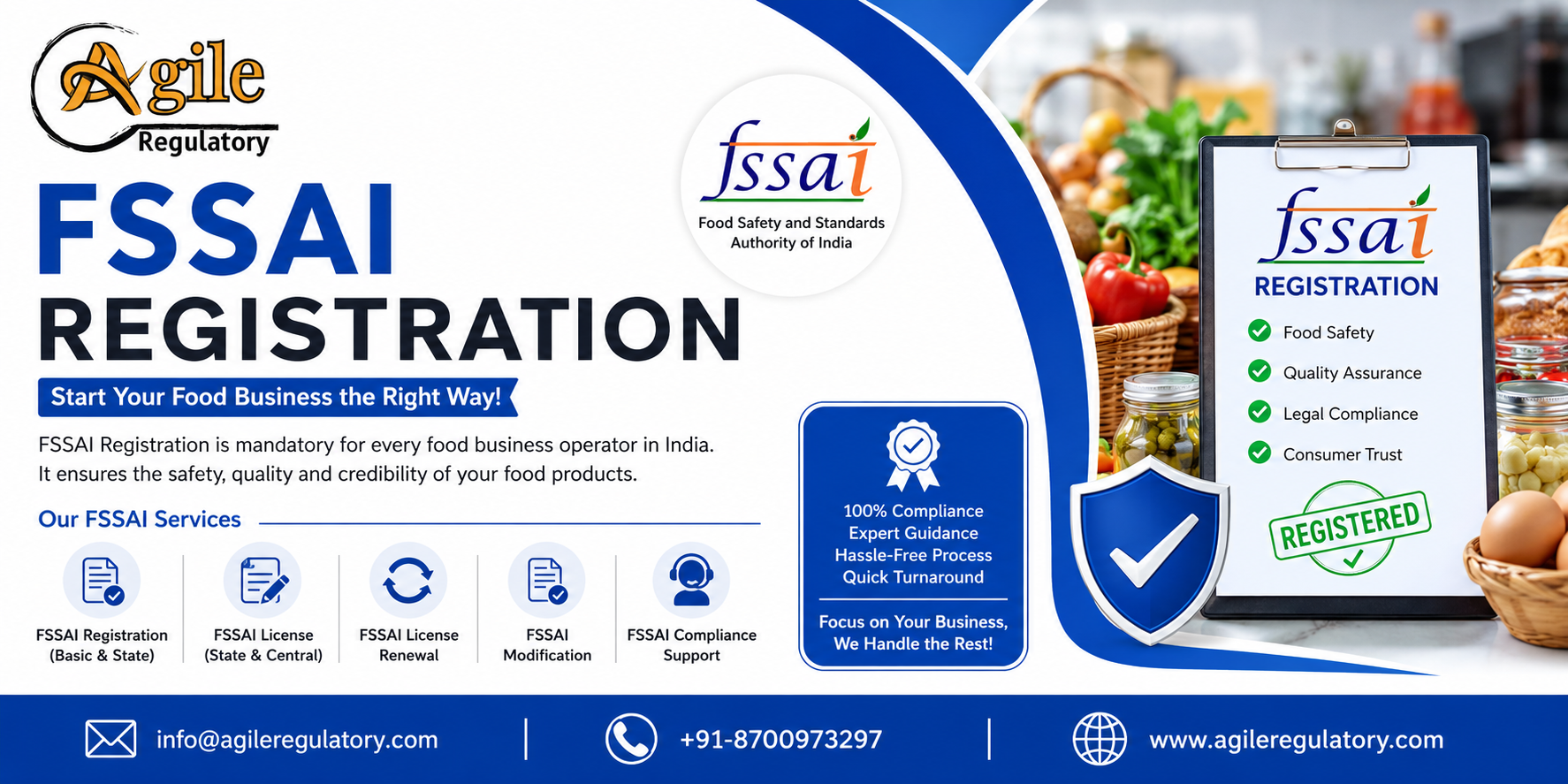
Opening a restaurant, cloud kitchen, café, bakery, grocery store, food manufacturing unit, catering business, or online food brand requires more than a good business plan. Before serving customers, food businesses must obtain the necessary statutory approvals to operate legally and maintain food safety standards.
One of the biggest misconceptions among new entrepreneurs is that an FSSAI Licence and a Trade Licence are the same. In reality, these are two separate approvals issued by different authorities for different purposes. While the Trade Licence permits a business to operate from a commercial premises, the FSSAI Licence authorizes eligible food businesses to manufacture, store, distribute, transport, or sell food products under the Food Safety and Standards Act, 2006.
Understanding both registrations before launching your business helps avoid compliance issues, inspection delays, and regulatory penalties.
FSSAI Trade License Registration
What is FSSAI Trade License Registration?
The term FSSAI Trade License Registration is commonly used by business owners when referring to obtaining both a municipal Trade Licence and an FSSAI Licence required for operating a food business.
The FSSAI Licence is issued by the Food Safety and Standards Authority of India (FSSAI), whereas the Trade Licence is generally issued by the concerned Municipal Corporation or Local Authority.
Both registrations may be required depending on the nature, size, and location of the business.
Why Are Both Registrations Important?
Operating a food business without the required approvals can lead to regulatory complications.
Having the appropriate registrations helps businesses:
- Operate legally.
- Build customer confidence.
- Maintain food safety compliance.
- Apply for additional business registrations.
- Expand operations smoothly.
- Improve credibility with suppliers and aggregators.
Consumers increasingly prefer businesses displaying valid FSSAI licence numbers because they indicate compliance with food safety regulations.
Which Food Businesses Need Registration?
The following businesses generally require food-related registrations:
- Restaurants
- Cafés
- Hotels
- Cloud Kitchens
- Home-based Food Businesses
- Sweet Shops
- Grocery Stores
- Food Manufacturers
- Food Processors
- Food Importers
- Food Exporters
- Catering Services
- Food Warehouses
- Online Food Sellers
The applicable licence category depends on turnover, production capacity, and business activities.
Types of FSSAI Licences
Food businesses are generally categorized into three licence types.
| Licence Type | Suitable For |
|---|---|
| Basic Registration | Small food businesses |
| State Licence | Medium-sized businesses |
| Central Licence | Large manufacturers, importers, exporters, and eligible businesses |
Applicants requiring State License FSSAI should verify whether their business turnover and activities fall within the prescribed eligibility criteria.
Documents Commonly Required
Document requirements vary depending on the licence category.
Generally, applicants prepare:
| Document | Purpose |
| PAN Card | Business identification |
| Aadhaar Card | Identity verification |
| Address Proof | Business location |
| Business Registration Documents | Legal verification |
| Passport-size Photograph | Applicant identification |
| Food Business Details | Activity verification |
| Layout Plan (where applicable) | Premises verification |
| NOC or Supporting Documents | Additional compliance |
Maintaining accurate documentation significantly improves approval timelines.
Step-by-Step Registration Process
Step 1: Identify the Correct Licence
Determine whether your business requires Basic Registration, State Licence, or Central Licence.
Step 2: Prepare Documents
Arrange all prescribed identity, address, and business documents before filing the application.
Step 3: Submit the Application
Complete FSSAI License Registration by submitting the prescribed application together with supporting documents.
Food businesses should submit applications through the official FoSCoS portal maintained by FSSAI:
https://foscos.fssai.gov.in/
Step 4: Verification
The competent authority reviews the application and supporting documents.
In certain cases, an inspection may be conducted depending on the applicable licence category.
Step 5: Grant of Licence
After successful verification, the licence is issued and the food business can legally carry out approved activities.
Registration Workflow
Identify Business Category
           │
           ▼
Select Licence Type
           │
           ▼
Prepare Documents
           │
           ▼
Submit Online Application
           │
           ▼
Verification / Inspection
           │
           ▼
Licence Issued
Common Compliance Mistakes
Many applications are delayed because applicants:
| Mistake | Impact |
| Selecting the wrong licence category | Application rejection or resubmission |
| Uploading incomplete documents | Processing delays |
| Incorrect business address | Verification issues |
| Mismatch in applicant details | Regulatory queries |
| Applying with incorrect turnover category | Additional scrutiny |
Reviewing all information before submission helps reduce unnecessary delays.
How to Choose the Correct Licence
Before applying, ask yourself:
- What is my annual turnover?
- Will I manufacture or only sell food?
- Will I import or export food products?
- Do I operate from one location or multiple branches?
- Will I supply food through online delivery platforms?
Answering these questions helps determine the appropriate licence category.
Businesses Expanding Across States
Businesses operating in multiple states or involved in import, export, or large-scale manufacturing may require licences issued under different eligibility criteria.
Applicants should carefully review the latest guidance available on the official Food Safety and Standards Authority of India website before filing an application:
https://fssai.gov.in/
Why Food Businesses Should Avoid Delays
Timely registration offers several advantages:
- Faster business launch.
- Improved regulatory compliance.
- Better customer confidence.
- Easier onboarding with food delivery platforms.
- Smoother business expansion.
- Stronger brand reputation.
Obtaining the required approvals before commencing operations helps avoid avoidable legal complications.
Expert Insight
Many entrepreneurs obtain only a Trade Licence and assume that it permits food operations. In reality, most eligible food businesses also require an FSSAI licence because the two registrations serve entirely different legal purposes. Completing both registrations at the beginning of the business lifecycle helps establish a strong compliance foundation.
Why Choose Agile Regulatory?
Agile Regulatory provides professional consultancy for food business registrations across India. Our experienced compliance professionals assist restaurants, manufacturers, cloud kitchens, retailers, importers, exporters, and food startups with licence assessment, documentation, application filing, and end-to-end regulatory support.
Our additional compliance services include:
- GST Registration
- Trade Licence Registration
- MSME Registration
We simplify regulatory approvals so that entrepreneurs can focus on growing their food businesses.
Conclusion
Obtaining FSSAI Trade License Registration is one of the first compliance steps for establishing a legally compliant food business in India. While the Trade Licence authorizes commercial operations from a business premises, the FSSAI Licence ensures compliance with food safety regulations. Understanding the difference, preparing complete documentation, and applying under the correct licence category can significantly reduce approval delays. With expert guidance from Agile Regulatory, food businesses can complete the registration process confidently and remain compliant throughout their growth journey.
Frequently Asked Questions
1. Is an FSSAI Licence the same as a Trade Licence?
No. An FSSAI Licence is issued for food safety compliance, whereas a Trade Licence is generally issued by the local municipal authority to permit commercial operations.
2. Who needs FSSAI registration?
Restaurants, cafés, cloud kitchens, grocery stores, food manufacturers, caterers, food importers, exporters, and other eligible food businesses generally require FSSAI registration.
3. Can I apply online?
Yes. Eligible applicants can submit their application through the official FoSCoS portal.
4. Which FSSAI licence should I choose?
The appropriate licence depends on turnover, business activities, production capacity, and operational scale.
5. How can Agile Regulatory help?
Agile Regulatory provides complete assistance with FSSAI licence registration, document preparation, application filing, regulatory compliance, and renewal support for food businesses across India.



















Leave a Reply