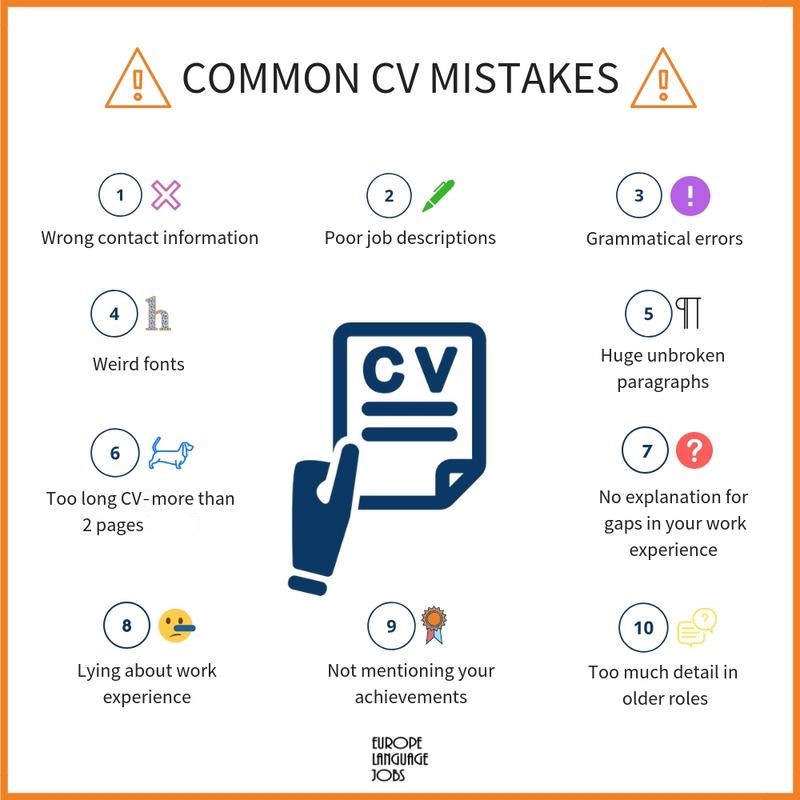
The first and most important stage towards getting an interview is often a curriculum vitae. It serves as your career reincarnation, showing your accomplishments, competencies, and qualifications for a job. But in case of bad writing or structure of a CV or a poor resume, it may not attract attention and may create a negative impression on the minds of the prospective employers. It is imperative to know the pitfalls that make a poor CV to prevent causing the failure of opportunities and credibility. These are the major points that make a CV unproductive and the way to identify and amend them.
Insufficient Structure and Organization.
A poor CV is characterized by poor structure, which is one of the most observable characteristics. The CV must have a flow for the reader through the sections, as the personal information will be followed by skills, experience, education, and other details. Lack of this logical flow makes the reader slow down the process of finding any pertinent information. A common error committed by most candidates is clogging their CV with disorganized information. Lack of well-organized structure, varied headings, and a lot of font variations dictate that a CV be untidy and unprofessional.
Excessive Use of Generic Language and Buzzwords.
Over-reliance on generic or vague statements is also another indicator that the CV is poor. Many of the expressions, such as hard-worker, ” team-player, or ” results-driven are cliched and have little meaning without context or support. Employers want real-life examples of these qualities and not abstract terms. A CV with clichés is a sign of impersonal and unoriginal reads. It implies that the job seeker has not customized his or her application to the job opening. The optimal CVs are job-specific and include some industry-specific terms and emphasize the most valuable experiences.
Spelling and Grammar Errors
There is nothing that will destroy professionalism more than spelling or grammatical errors. Just one mistake can undermine your reputation and penalize you as thoughtless. Such errors are usually perceived by recruiters as a sign of incompetence and failure to work hard. A cv writing services that is not carefully proofread may contain verb tenses that do not match, wrong usage of punctuation, and misplaced typos that change the meaning completely. Such information as writing manager instead of manager can change the perception of competence immediately. Such errors can be readily avoided by the use of proofreading software, peer checking, or professional editing.
Intravenous or Obsolescent Information.
The other similarity in the poor CV is that it contains unnecessary or out-of-date information. It is important to try to keep the resume short by listing all the jobs that one has worked in, regardless of how irrelevant they are. Employers do not want part-time work experience that was not related to the job applied for in the past ten years. In the same way, obsolete technical aptitudes, outdated qualifications, or past accomplishments are an indication that there is no improvement, but stagnation. The CV must emphasize your latest and greatest achievements, demonstrating that you are constantly growing and have the latest knowledge.
Absence of Measurable Results.
A resume with only a list of responsibilities without any quantifiable results soon has a diminished effect. As an example, saying that somebody is responsible for managing a team is weak compared to saying that I led a team of 10 employees and managed to ensure that the productivity grew by 20 percent. Percentages, figures, and physical outcomes can assist employers in knowing how much work you did and how much actual difference you made. A bad CV tends to be more task-based as opposed to result-oriented, in which the candidate undertakes menial duties instead of outcome-oriented work.
Unreasonable Length or Inadequate Detail.
Having a too-long or too-short CV can be an issue. Too long CVs with all the irrelevant information overload the reader and conceal the best things. Conversely, excessively short CVs can have a one-dimensional look, without details of competence and experience. A bad CV can be incapable of striking this balance. The most accepted time for a CV is one to two pages, which should be slightly longer in cases of a professional with a long history or those who have a good academic history.
Lack of Customization to Every Position.
A one-size-fits-all CV is unsuccessful. Recruiters will be able to immediately realize when a document is not tailored. A poor CV can include irrelevant keywords or leave out some key qualifications, as well as having irrelevant experience not related to the position being advertised. Tailoring entails modifying your summary, skills, and experience to suit the needs of the particular position.
Failing to Digitalize.
In the contemporary recruitment exercise, Applicant Tracking Systems (ATS) are commonly used by most organizations to sieve off the CVS even before a human being lays their hands on them. The reason why a poor CV will not reach such systems is that it does not contain pertinent keywords or complicated layouts, which cannot be read by the software. As an example, an automated system can be confused by text-positioning within graphics, the text-positioning of non-standard section titles, and by the submission of non-standard forms of files.
Unprofessional Tone or Content.
A CV should be invariably formal, confident, and factual in tone. Unprofessional remarks may be written in casual language, humor, or even too personal details in poor CVs. The excessive use of first-person pronouns or unsubstantiated subjective assertions would not help you in your credibility, either. Moreover, false or exaggerated information can be very disastrous if it is found. Employers are checking claims, and lying might lead to disqualification or termination in the future. A good CV will be honest, clear, and formal enough.
Conclusion
A poor CV does not mean that there are a few mistakes in it; it is a document that does not help to demonstrate your value. Incomplete structure, the use of unclear language, spelling mistakes, irrelevant details, and bad formatting are all clues that your CV should be addressed. In the modern competitive job market, minimalism is required of an applicant, in which clarity, precision, and professionalism must be evident even on the initial page. A properly designed CV presents your strengths in a very clear and confident way, and an ineffective one covers your potential.