

Difficult college subjects often require more than longer study sessions. Calculus, organic chemistry, physics, statistics, anatomy, accounting, engineering, and programming challenge different combinations of memory, conceptual understanding, problem-solving, and application. We should match the study method to the type of knowledge the course actually tests.
For US college students balancing full course loads, employment, commuting, athletics, or family responsibilities, efficiency matters. The best study methods for difficult college subjects create repeated opportunities to retrieve, apply, explain, and correct knowledge. Passive rereading may feel productive, but it rarely reveals whether we can solve a new problem under exam conditions.
Students who need additional structure can investigate online class Support for busy learners from Online Course Help Service.
Diagnose Why the Subject Feels Difficult
Before choosing a technique, identify the obstacle. Are prerequisite skills missing? Is terminology overwhelming? Can we understand examples but not solve unfamiliar problems? Do we forget material after a week? Are instructions or time management the main issue?
Review a recent assignment or exam and categorize errors as knowledge gaps, conceptual misunderstandings, procedural mistakes, careless execution, or time pressure. Different errors require different corrections.
1. Use Active Recall Instead of Passive Review
Active recall means attempting to retrieve information without looking at the answer. Close the book and explain a concept, draw a process, define a term, or solve a problem from memory.
Flashcards can support facts, formulas, structures, and vocabulary, but they should not replace complex practice. Write prompts that require explanation or comparison rather than recognition alone.
2. Apply Spaced Practice
Spaced practice distributes review over time. Instead of studying one chapter for five hours, revisit it in shorter sessions across several days and weeks. Each successful retrieval strengthens access to the information.
A simple schedule reviews material on the same day, two or three days later, one week later, and again before the assessment. Difficult items should return more frequently than mastered ones.
3. Solve Problems Without Following Examples
Worked examples are useful for learning a procedure, but we must eventually remove the guide. Cover the solution and complete the problem from the beginning. Then compare steps and diagnose the first point of divergence.
For quantitative subjects, create a mixed problem set that includes different topics. This “interleaving” forces us to identify which method applies instead of repeating the same procedure automatically.
4. Use the Feynman Technique
Explain the concept in simple language as if teaching a student who has completed the prerequisite course but not the current topic. When the explanation becomes vague, return to the source and repair that section.
This method is especially useful for biology pathways, economic models, legal doctrines, engineering systems, and theoretical concepts. Accurate simplification reveals understanding; oversimplification should be checked against formal definitions.
5. Create Dual-Coded Notes
Combine words with meaningful visual representations such as process diagrams, annotated graphs, timelines, concept maps, free-body diagrams, or anatomical sketches. The visual should represent relationships, not merely decorate notes.
After creating a diagram, redraw it from memory and explain every component. For a graph, describe what the axes, slope, intercept, shape, and changes mean.
6. Build a Weekly Cumulative Review
Courses become difficult when early material disappears just as later chapters depend on it. Reserve one weekly session to review previous units. Use a small number of representative questions rather than rereading everything.
Maintain a “must still know” list of definitions, formulas, procedures, and foundational concepts. Update it after each class and assessment.
7. Keep an Error Log
An error log records the problem, the incorrect approach, the reason for the mistake, the correct principle, and a prevention strategy. Reviewing errors is more valuable than repeatedly solving questions we already answer correctly.
For example, a calculus error may come from misidentifying the inner function, while a chemistry error may result from unbalanced units. The prevention strategy should be specific, such as “write units at every step” or “check the chain rule before simplifying.”
8. Attend Office Hours with Prepared Questions
Office hours are most effective when we bring evidence of an attempt. Show the step where reasoning failed and explain what has already been tried. Instead of asking “Can you explain the whole chapter?” ask, “Why does this boundary condition change the solution method?”
Faculty and teaching assistants can also clarify expectations, recommend practice sources, and identify prerequisite gaps. Use tutoring centers, supplemental instruction, and academic skills offices early rather than waiting for a crisis.
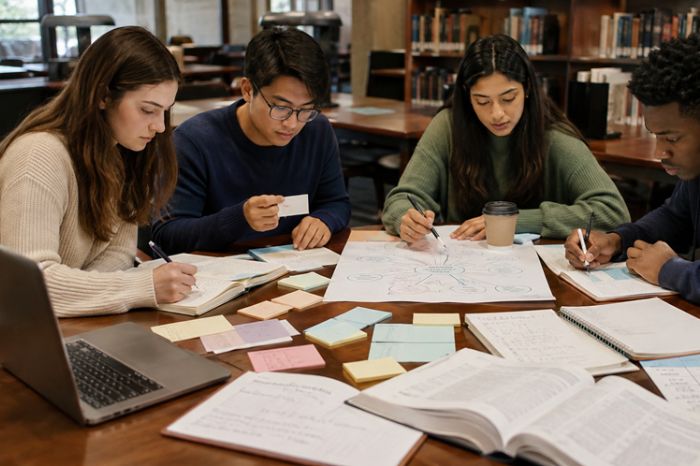
9. Study in a Focused Group
A productive group has a defined agenda, prepared members, and an end time. Use the group to compare reasoning, quiz one another, solve difficult problems, and explain concepts.
Avoid dividing assessed work in ways the instructor does not permit. Group study should strengthen individual competence, not replace it. Each member should leave able to complete similar work independently.
10. Simulate Exam Conditions
Complete timed, closed-resource practice that resembles the real assessment. This reveals retrieval speed, endurance, strategy, and time allocation. Review the attempt afterward and classify every error.
Simulation is particularly important when a student understands homework with notes but struggles during exams. Begin with partial simulations, then increase realism as the test approaches.
Match Study Methods to the Subject
Mathematics, Physics, and Engineering
Prioritize mixed problem-solving, derivations, diagrams, dimensional analysis, and explanation of assumptions. Memorizing formulas without knowing when they apply is insufficient.
Biology and Anatomy
Use retrieval, labeled diagrams, comparison tables, process explanations, and clinical or ecological application questions. Study structures in relation to function.
Chemistry
Combine conceptual explanation, reaction patterns, calculations, structure drawing, and laboratory interpretation. Practice translating among words, equations, graphs, and molecular representations.
Programming and Computer Science
Write code without copying examples, trace execution, debug intentionally flawed programs, and explain algorithm choices. Small daily projects usually outperform occasional marathon sessions.
History, Psychology, and Social Sciences
Use timelines, concept comparisons, evidence-based outlines, and practice essays. Retrieve examples that support and challenge major theories.
Build a Realistic College Study Schedule
Plan weekly blocks around course demands and energy levels. Put the hardest analytical work in periods of strong concentration. Use shorter sessions for flashcards, review, or administrative tasks.
Define the output for each block: solve ten mixed problems, retrieve two chapters, draft a concept map, or complete a timed essay outline. “Study chemistry” is too vague to guide action.
Protect Concentration and Health
Silence unnecessary notifications, place the phone out of reach, and work in a consistent environment. Use focused intervals with deliberate breaks, but choose an interval length that matches the task.
Sleep supports learning and recall. Repeated all-nighters reduce attention and make mistakes more likely. Regular meals, movement, and realistic workload planning are part of academic performance, not distractions from it.
Measure Whether a Study Method Is Working
Judge methods by performance, not familiarity. Can we answer questions without notes? Solve unfamiliar problems? Explain the concept accurately? Retain it after a week? Complete a timed task?
Track practice accuracy, error types, retrieval strength, and completion time. If a method does not improve these indicators, adjust it rather than investing more hours in the same routine.
The best study methods for difficult college subjects are active recall, spaced practice, mixed problem-solving, explanation, visual modeling, cumulative review, error analysis, guided help, focused collaboration, and exam simulation. We should diagnose the learning obstacle and combine methods that fit the discipline. Consistent, evidence-based practice creates stronger results than passive review or last-minute intensity.























Leave a Reply