

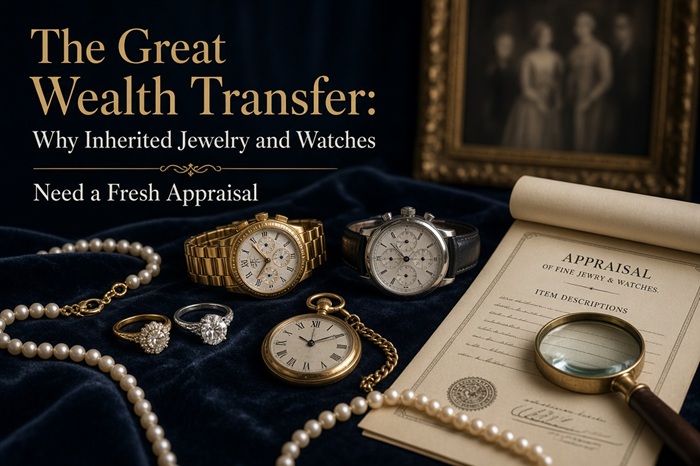
Over the next two decades, trillions of dollars in assets are expected to pass down between generations, and this shift is widely referred to as the Great Wealth Transfer. Buried inside that number is something far less discussed than real estate or investment portfolios: jewelry boxes and watch cases full of pieces that have never been formally appraised or haven’t been looked at for decades. A grandmother’s engagement ring, a father’s vintage Rolex, and a set of earrings with an unclear history are passed on to a new owner, who has no current documentation indicating their original owners. All of these items are transferred to a new owner without any current documentation regarding their actual value.
Why Inherited Jewelry Rarely Comes with Accurate Documentation
It’s remarkably common for inherited jewelry to have no appraisal at all, or one so old that it no longer reflects reality. A ring bought thirty years ago, or valued for probate a decade ago, tells you almost nothing about its current worth. With time, the metal prices move, gemstone markets shift, and even the original description on file may be too vague to be useful for an insurance claim.
The Underinsurance Problem Doesn’t Disappear with Inheritance
It’s commonly acknowledged that a large share of jewelry insurance claims turns out to be underinsured. That pattern doesn’t reset just because a piece has changed hands. If anything, inherited jewelry is more exposed to this risk, since a new owner often has no idea what the original purchase price was, let alone its current replacement value. Getting a proper jewelry appraisal for insurance purposes closes that gap before it becomes a problem, rather than after a loss.
What a Fresh Appraisal Actually Establishes
A proper jewelry appraisal doesn’t just produce a number, but it builds a documented record of the piece: the metal, the stones, distinguishing features, and photographs. For an inherited item, this documentation often doesn’t exist at all, which means a fresh appraisal isn’t updating an old record; it’s creating the first real one. That matters enormously if the piece is ever lost, damaged, or stolen, since an insurer needs specifics to process a claim quickly rather than a vague family description.
Inherited Watches Bring Their Own Complications
Watches inherited within a family carry a slightly different set of challenges from jewelry, largely because their value moves with the market more actively than that of most gemstone pieces.
Why a Watch’s Value Can Shift Dramatically Since It Was Last Assessed
A watch bought or last valued a decade ago might now be worth considerably more or less, depending entirely on the brand and model. Secondary-market demand for certain watches has moved significantly recently, and a watch valuer who maintains a current database of pricing across major brands is in a far better position to reflect that than a valuation frozen at whatever the watch was worth when it was first purchased or last assessed.
Documentation Often Gets Lost Along the Way
Inherited watches are also notorious for arriving without their original box, papers, or warranty card and details that are easy to misplace over the years, especially across a change of ownership. A proper watch appraisal photographs not just the watch itself but also any accompanying documentation that does survive and records the watch’s style, metals, model number, and identification number in detail. Even where original papers are missing entirely, the appraisal creates a usable record going forward, which matters considerably if the watch is ever lost or stolen and the original documentation is nowhere to be found.
Why Online Appraisal Fits This Situation Well
For families sorting through an estate, sending irreplaceable or sentimental pieces off in the post for appraisal can feel unnecessarily risky. This is precisely the type of situation for which online watch appraisal services are designed. Online watch appraisal services were specifically designed for this exact situation. for. Here all you need to do is submit clear photographs and any available documentation, without needing to physically send the watch anywhere. It’s a practical fit for exactly this moment: multiple inherited items, some scattered across family members, all needing a current valuation without the delay or risk of shipping.
A Practical Approach to Appraising an Inherited Collection
When a collection of jewelry and watches arrives all at once through inheritance, it’s rarely practical to treat every single piece the same way.
- Start With What’s Actually Being Kept or Insured
Not every inherited item needs the same level of appraisal urgency. Pieces that will be worn regularly or kept as part of a household’s insured valuables are the priority for a proper jewelry appraisal, as it helps in establishing a current, defensible value before anything happens to them, not after.
- Loose Stones Need a Slightly Different Approach
One detail worth knowing if an inheritance includes loose gemstones rather than set jewelry: these generally require physical inspection unless they’re already accompanied by a recognized gem laboratory certificate. It’s a small distinction, but one that’s easy to overlook when sorting through an estate quickly.
- Fixed Pricing Removes Guesswork from the Process
For families already navigating the emotional and administrative weight of settling an estate, knowing the appraisal cost upfront matters. A fixed, per-item price means there’s no ambiguity about what the process will cost before committing to it, which is one less variable to manage during an already complicated time.
The Importance of Timely Action
It’s tempting to let inherited jewelry and watches sit exactly as they were received, particularly in the middle of settling an estate when there are dozens of other things competing for attention. But an appraisal completed now, while photographs and documentation can still be gathered and pieces are still accounted for, is considerably more straightforward than trying to reconstruct that information later, after a piece has been lost, damaged, or simply forgotten in a drawer for another decade.
The Great Wealth Transfer isn’t only about the size of what’s being passed down, but it’s also about whether that value is actually documented, protected, and understood by whoever receives it. A current appraisal is a small, practical step that turns an inherited piece from a vague assumption of value into something properly accounted for, insured correctly, and ready to be passed down again with real documentation intact rather than the same uncertainty repeating itself for another generation.
Summing Up
To sum up, when owning precious assets, it is crucial to consider several important factors, including obtaining a timely valuation to ensure a clear understanding of their worth across generations, which aids in facilitating a fair and straightforward deal during estate planning and similar situations.
























Leave a Reply