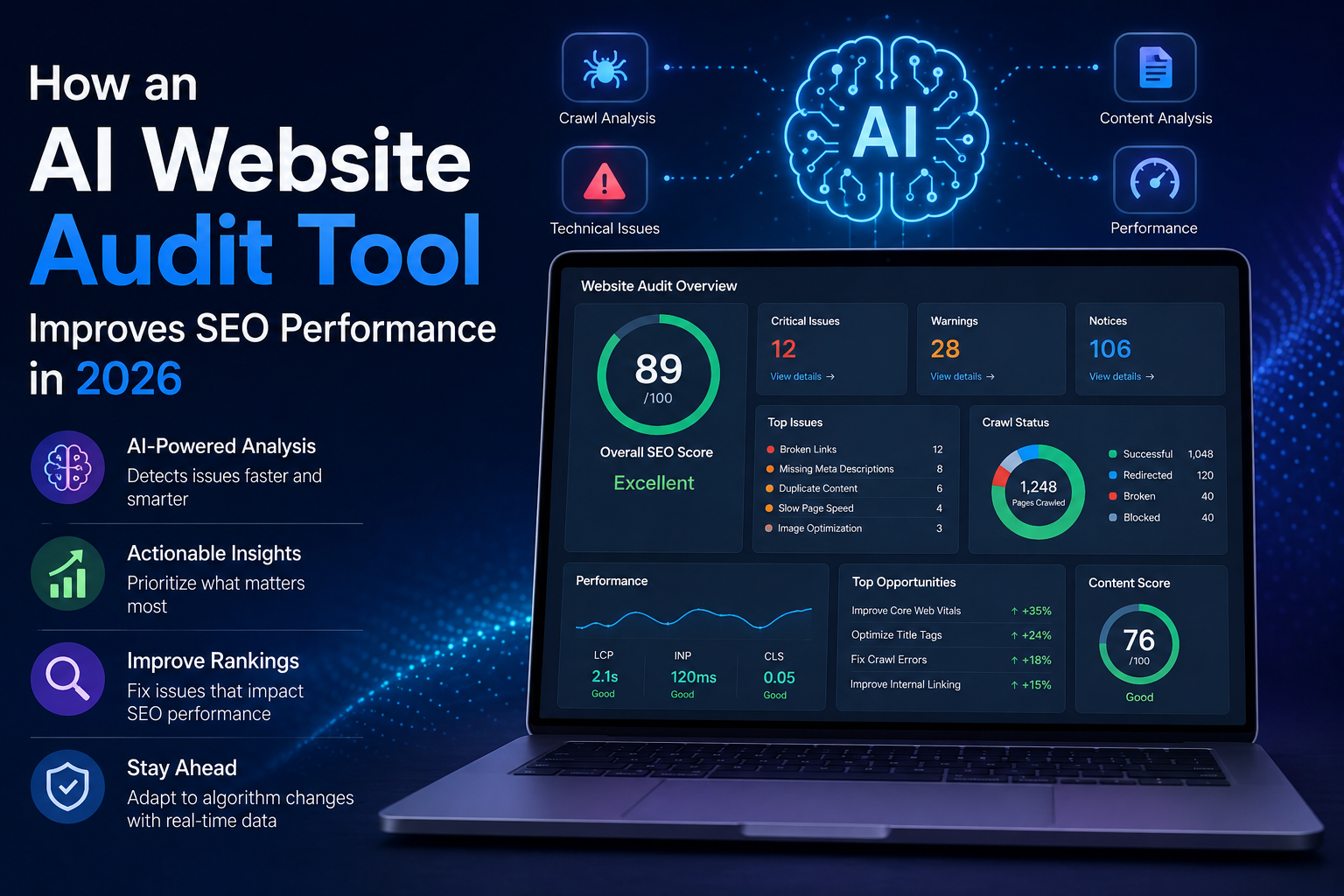
Search engine optimization has never stayed still for long. Every year brings new ranking signals, algorithm updates, user expectations, and technical standards that reshape how Audit Tool compete online. In 2026, artificial intelligence has become part of that evolution. It is no longer limited to content generation or chatbots. AI is now helping Audit Tool owners analyze technical SEO, user experience, and content quality faster than traditional manual processes.
If you’ve ever spent hours reviewing broken links, duplicate pages, or indexing reports, you already know how time-consuming SEO audits can become. The challenge isn’t just finding issues—it’s understanding which problems actually matter. That’s where AI changes the conversation.
Instead of replacing SEO professionals, AI provides faster insights, highlights patterns across large datasets, and helps prioritize improvements based on their potential impact.
Why SEO Audits Matter More Than Ever
Modern Audit Tool contain thousands of pages, hundreds of internal links, structured data, media files, JavaScript components, and constantly changing content. Even a small technical mistake can affect crawling, indexing, or user experience.
Search engines now evaluate Audit Tool from multiple angles, including:
- Technical health
- Core Web Vitals
- Mobile usability
- Content quality
- Internal linking
- Structured data
- User engagement signals
- Crawl efficiency
Ignoring regular audits often leads to unnoticed SEO problems that slowly reduce organic visibility.
How an AI Website Audit Tool Changes Website Analysis
An AI Website Audit Tool examines websites using machine learning models that identify technical issues, content gaps, and optimization opportunities beyond traditional crawling methods. Instead of simply reporting errors, these systems often explain why an issue matters, estimate its SEO impact, and suggest practical fixes based on current search engine best practices.
That means less time sorting through endless reports and more time focusing on improvements that actually influence rankings.
The Rise of AI in Modern SEO
Artificial intelligence has transformed digital marketing over the past few years. Instead of performing repetitive tasks manually, AI systems can process enormous datasets within minutes.
This shift allows SEO professionals to spend less time collecting information and more time interpreting results.
Common AI applications in SEO now include:
- Content gap analysis
- Keyword clustering
- Search intent classification
- Internal linking recommendations
- Log file analysis
- Crawl prioritization
- Technical issue detection
- Predictive ranking analysis
Rather than replacing expertise, AI helps experts work smarter.
Smarter Technical SEO Detection
Traditional website crawlers typically identify known errors such as broken links or missing metadata.
AI takes things several steps further.
It analyzes relationships between issues instead of viewing each problem independently. For example, it may detect that poor internal linking, orphan pages, and inconsistent anchor text are collectively reducing crawl efficiency.
Some common technical issues AI identifies include:
Crawl Problems
AI can recognize patterns that indicate:
- Crawl budget waste
- Redirect chains
- Infinite URL parameters
- Duplicate crawl paths
- Orphan pages
Instead of listing hundreds of URLs individually, AI often groups similar issues together for easier resolution.
Indexing Opportunities
Search engines cannot rank pages they cannot properly index.
AI systems review:
- Robots.txt conflicts
- Noindex directives
- Canonical implementation
- XML sitemap accuracy
- Duplicate indexing signals
This helps Audit Tool owners identify hidden indexing obstacles before rankings decline.
Better Content Quality Evaluation
Content evaluation has become much more sophisticated in 2026.
AI doesn’t simply count keywords anymore.
It examines:
- Topical relevance
- Semantic relationships
- Search intent alignment
- Content freshness
- Entity coverage
- Readability
- Duplicate sections
For example, if an article covers only half the topics users expect, AI can identify missing subtopics without encouraging unnecessary keyword stuffing.
This creates stronger, more comprehensive content that aligns with user intent.
AI Helps Prioritize SEO Tasks
Every website Audit Tool contains dozens—or even hundreds—of SEO recommendations.
The difficult part is deciding what to fix first.
AI helps organize priorities by estimating:
- Expected ranking impact
- Severity
- User experience effect
- Crawl importance
- Page authority
- Business relevance
Instead of treating every issue equally, AI assigns practical importance based on available data.
That saves valuable time.
Improving Core Web Vitals
Website performance continues to influence search visibility.
AI analyzes performance metrics such as:
- Largest Contentful Paint (LCP)
- Interaction to Next Paint (INP)
- Cumulative Layout Shift (CLS)
It can also identify recurring performance bottlenecks, including:
- Oversized JavaScript
- Uncompressed images
- Render-blocking resources
- Excessive third-party scripts
- Slow server response times
Rather than simply reporting numbers, AI often explains which optimization offers the greatest improvement.
Internal Linking Gets Smarter
Internal links help search engines understand website structure.
Many websites miss valuable linking opportunities because identifying them manually is difficult.
AI can detect:
- Weak content clusters
- Orphan pages
- Missing contextual links
- Overused anchor text
- Poor topical hierarchy
This creates stronger site architecture without forcing unnatural links into content.
AI Supports Better Keyword Strategy
Keyword research has evolved beyond simple search volume.
Today, AI helps organize keywords by:
- Search intent
- Topic clusters
- User journey stage
- Semantic relevance
- Ranking difficulty
Instead of targeting isolated phrases, websites can build comprehensive topical authority around broader subjects.
This approach often supports long-tail SEO keywords like:
- how to improve technical SEO with AI
- AI-powered website optimization techniques
- website audit checklist for SEO
- AI tools for technical website analysis
- improve website crawlability with AI
These phrases reflect how users naturally search for information.
Predicting SEO Trends
One interesting development in 2026 is predictive SEO.
Rather than only analyzing historical performance, AI models increasingly forecast potential outcomes.
Examples include:
- Pages likely to lose rankings
- Content becoming outdated
- Emerging keyword opportunities
- Declining backlink quality
- Seasonal traffic changes
While predictions aren’t guarantees, they help teams prepare instead of reacting after traffic drops.
Human Expertise Still Matters
AI can identify patterns remarkably well.
It cannot fully understand business goals, brand voice, customer psychology, or industry-specific nuances.
That’s why experienced SEO professionals still play an essential role.
Human judgment remains necessary when deciding:
- Which recommendations deserve implementation
- How content should be rewritten
- Which pages align with business objectives
- Whether algorithmic suggestions fit user expectations
Think of AI as an intelligent assistant—not a replacement for strategic thinking.
Common Limitations to Keep in Mind
AI-powered auditing is valuable, but it isn’t perfect.
Users should remain aware of a few limitations:
- Recommendations still require human verification.
- Search algorithms continue changing.
- Some AI suggestions may overlook unique business contexts.
- Large websites Audit Tool may need custom technical analysis beyond automated reports.
The best results usually come from combining AI analysis with professional review.
Best Practices for Using AI in SEO Audits
To get meaningful insights, consider following these practices:
- Perform regular technical audits rather than waiting for traffic declines.
- Review AI recommendations before implementing changes.
- Monitor search performance after major updates.
- Combine technical improvements with high-quality content.
- Keep structured data accurate.
- Track Core Web Vitals consistently.
- Update older pages when search intent changes.
SEO works best as an ongoing process rather than a one-time project.
Cost of AI Website Audit Tools: What Influences Pricing?
The price of an AI website audit tool depends less on the AI itself and more on the scale of analysis and the features included. Small websites with fewer than 500 pages can often use entry-level plans, while enterprise websites with hundreds of thousands of URLs require more advanced crawling capacity and reporting features.
Several factors typically affect pricing:
- Number of pages crawled per audit – Larger websites require more server resources and processing power.
- Frequency of audits – Daily or real-time monitoring generally costs more than monthly scans.
- AI capabilities – Advanced features such as issue prioritisation, predictive analysis, content quality evaluation, and automated recommendations are usually included in higher-tier plans.
- Historical data tracking – Some tools store crawl history, making it easier to compare technical SEO performance over time.
- Team collaboration – Multi-user access, project management, and white-label reporting are often premium features.
For individual bloggers or small businesses, a basic technical audit solution may be sufficient. However, agencies and enterprise organisations often invest in more comprehensive platforms because identifying technical issues early can reduce the time spent on manual analysis and prevent larger SEO problems from affecting organic traffic.
Industry Benefits of AI Website Audit Tools
Different industries face different technical SEO challenges, and AI website audit tools help address them in practical ways rather than offering a one-size-fits-all solution.
- Ecommerce websites can quickly identify orphan product pages, duplicate category URLs, broken internal links, and indexing issues that may affect product visibility.
- Healthcare websites benefit from monitoring thousands of informational pages, ensuring important medical resources remain crawlable and technically compliant.
- SaaS companies can improve landing page performance, optimise internal linking between product documentation, and detect technical issues after frequent website updates.
- News and publishing platforms use AI to analyse massive content libraries, detect duplicate articles, and ensure newly published content is indexed quickly.
- Educational institutions often manage large websites with multiple departments, where AI helps identify broken navigation, outdated pages, and crawl-depth problems.
- Local businesses and service providers can monitor location-specific landing pages, schema implementation, and mobile usability to maintain consistent local search visibility.
Regardless of the industry, the biggest advantage is that AI reduces the time required to analyse technical SEO while helping teams focus on the issues most likely to improve crawlability, indexing, and overall website performance.
Final Thoughts
SEO in 2026 is increasingly data-driven, and artificial intelligence has become an important part of that process. By analyzing technical issues, evaluating content quality, identifying crawl inefficiencies, and prioritizing improvements, AI Audit Tool helps simplify complex website Audit Tool while saving valuable time.
Even so, technical SEO has become increasingly complex as websites expand and search engines refine their crawling systems. AI-powered audit platforms simplify that complexity by analysing large datasets, detecting hidden technical issues, and highlighting opportunities to improve crawlability and indexing before they affect organic performance. If you’re wondering how to audit your website fast without manually reviewing thousands of URLs, AI-assisted auditing offers a practical way to identify technical priorities while maintaining a structured and efficient optimisation process.