

If you’ve ever walked into a tunnel under construction before the morning shift starts, you’ll know it’s a completely different world from working above ground. Tunnel lighting plays a critical role in making these underground environments safe, productive and efficient from the moment the first crew arrives.
The sound of ventilation fans echoes through the tunnel.
Service vehicles move slowly past crews preparing equipment.
Dust hangs lightly in the air after a night of excavation. The only reason everyone can work safely is because the entire space is illuminated by reliable industrial lighting.
Take that lighting away, or replace it with equipment that is not designed for underground conditions, and everything changes.
Operators become more cautious because visibility is inconsistent.
Inspectors take longer to assess rock faces.
Maintenance crews struggle to identify small issues before they become larger problems.
Even moving safely from one work area to another becomes more difficult.
Lighting does not usually receive the same attention as tunnel boring machines, ventilation systems or heavy equipment. However, experienced contractors know it influences almost every task carried out underground.
Whether it is a major transport tunnel beneath a city, a new mining decline or an underground services corridor, choosing the right tunnel lighting is one of the simplest ways to improve both safety and productivity.
Every Tunnel Presents a Different Challenge
One of the biggest misconceptions about tunnel lighting is that one solution works everywhere.
It does not.
A rail tunnel under construction has very different lighting requirements from a mine access tunnel.
Road tunnels, utility tunnels and hydroelectric projects each create their own challenges.
Some projects involve long, straight sections where consistent illumination helps workers judge distances and identify changes in the tunnel profile.
Others include cross passages, junctions and work bays where additional task lighting is essential.
Ground conditions also vary significantly.
Some tunnels remain relatively dry throughout construction.
Others constantly deal with water ingress, mud and airborne dust.
Every one of these factors influences how lighting performs over time.
That is why experienced project managers rarely choose lighting based purely on brightness.
Instead, they ask practical questions.
Will it continue performing after months of vibration?
Can it withstand dust and moisture?
How difficult will it be to maintain hundreds of metres underground?
Those questions often matter far more than the number of lumens printed on a specification sheet.
Good Lighting Helps People Make Better Decisions
People often think lighting simply helps workers see.
In reality, it helps them make better decisions.
Imagine an operator reversing a loader through a confined section of tunnel.
Clear lighting allows them to judge distances accurately, recognise movement around the machine and react confidently to changing conditions.
Now imagine that same operator working with inconsistent lighting, harsh glare or dark patches along the tunnel wall.
The task immediately becomes more difficult.
The same applies to engineers inspecting ground support.
Rock bolts, mesh installations and shotcrete all require careful visual inspection.
Subtle defects can easily be overlooked if lighting creates heavy shadows or uneven illumination.
Good tunnel lighting does not replace training or safe work procedures.
However, it supports them every day.
When people can clearly see what they are doing, they naturally work with greater confidence, accuracy and efficiency.
Why LED Tunnel Lighting Has Become the Preferred Choice
Not long ago, many underground projects relied on traditional metal halide or fluorescent lighting.
Those systems performed adequately, but they also introduced several ongoing challenges.
Lamp replacements were frequent.
Energy consumption was high.
Light output gradually declined as fittings aged.
Today’s LED tunnel lighting solves many of those problems.
One of the biggest advantages is not simply brightness.
It is consistency.
Quality LED systems maintain a much more even level of illumination throughout their operating life.
Workers do not experience the gradual reduction in visibility that often occurs with older lighting technologies.
LED lighting also reaches full brightness immediately after being switched on. This eliminates warm-up delays and ensures work can begin without unnecessary interruptions.
In addition, LED technology consumes significantly less energy than traditional lighting systems. Lower power consumption reduces operating costs while supporting sustainability goals on major infrastructure and mining projects.
Reliability Matters More Than Most People Realise
Replacing a light fitting inside an office building is usually straightforward.
Replacing one several hundred metres underground is entirely different.
Maintenance crews may require specialised access equipment.
Traffic management around operating machinery may be necessary.
Work in that section of the tunnel may temporarily slow while repairs are completed.
All of this costs time and money.
For that reason, experienced contractors often place reliability ahead of purchase price.
A cheaper fitting that fails repeatedly quickly becomes more expensive once labour, downtime and replacement costs are considered.
Reliable industrial tunnel lighting reduces these interruptions and allows crews to focus on construction rather than maintenance.
Underground Conditions Are Unforgiving
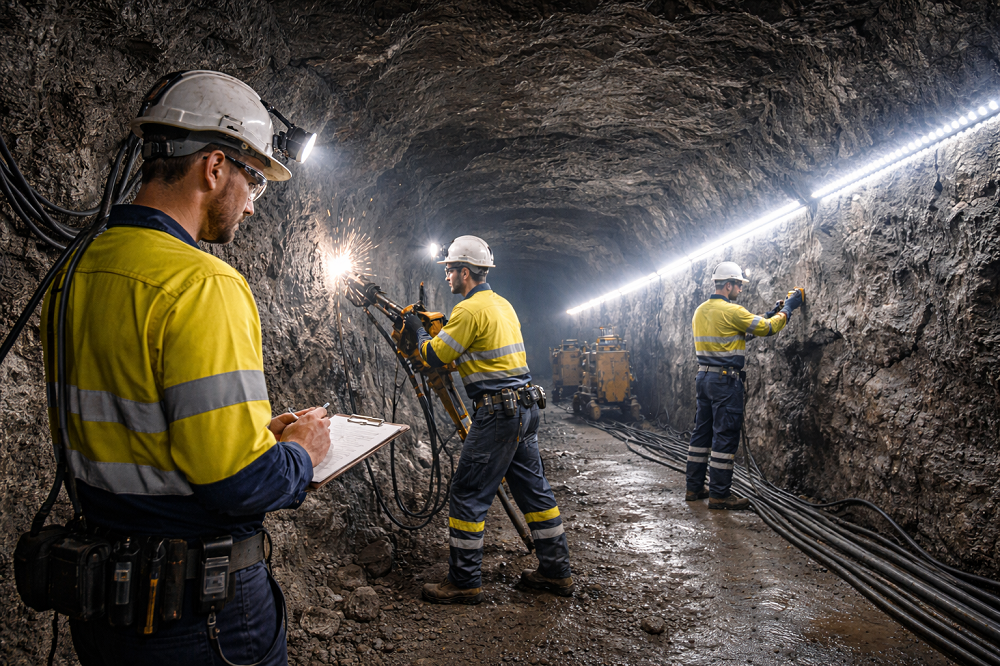
Tunnel construction places enormous demands on equipment.
Lighting systems are constantly exposed to:
- Dust generated by excavation
- Moisture and water spray
- Continuous vibration
- Temperature fluctuations
- Mechanical impact from equipment and materials
These conditions quickly expose weaknesses in products designed for commercial buildings rather than industrial worksites.
Purpose-built tunnel lighting is engineered specifically for these demanding environments.
Robust housings, high ingress protection ratings and durable mounting systems all contribute to a longer service life.
Many industrial tunnel lighting systems are also designed to resist corrosion and withstand frequent cleaning, making them suitable for harsh underground conditions over extended project timelines.
It is not about making lighting stronger for the sake of it.
It is about ensuring lighting continues performing when the project becomes more challenging.
Better Visibility Supports Safer Shift Changes
One area that is often overlooked is the beginning and end of each shift.
These periods involve increased movement as workers arrive, equipment changes operators and maintenance activities are completed.
Good lighting helps everyone navigate the worksite more safely during these busy transition periods.
Clear walkways, visible safety signage and well-lit access routes reduce unnecessary risk when activity levels are at their highest.
For supervisors, these improvements contribute to a safer and more organised workplace.
Workers can move confidently between work zones, reducing the likelihood of slips, trips and collisions with mobile equipment.
Lighting Plays a Key Role in Productivity
Safety is always the highest priority underground.
However, productivity is closely connected to visibility.
When workers can clearly identify tools, equipment and construction materials, they complete tasks more efficiently.
Engineers spend less time carrying out inspections.
Maintenance teams identify potential issues sooner.
Operators can manoeuvre machinery with greater precision.
Even routine activities such as cable installation, equipment servicing and tunnel surveying become easier under consistent lighting conditions.
Across long construction projects, these small improvements create measurable productivity gains.
Reducing delays by only a few minutes each shift can save hundreds of labour hours over the life of a project.
Investing in Quality Tunnel Lighting Delivers Long-Term Value
Choosing tunnel lighting should never be based solely on the initial purchase price.
Instead, project managers should consider the total cost of ownership.
Reliable lighting reduces maintenance.
Energy-efficient LED systems lower electricity costs.
Durable fittings minimise replacement expenses.
Most importantly, dependable lighting helps protect workers while supporting efficient project delivery.
As underground infrastructure projects continue to grow across Australia, the importance of high-quality tunnel lighting will only increase.
From mining operations to transport tunnels and major civil construction, reliable lighting remains one of the most valuable investments a project can make.
The best tunnel lighting systems do more than illuminate a workspace.
They improve visibility, support safer decisions, reduce downtime and help every shift operate with greater confidence from start to finish.



















Leave a Reply