

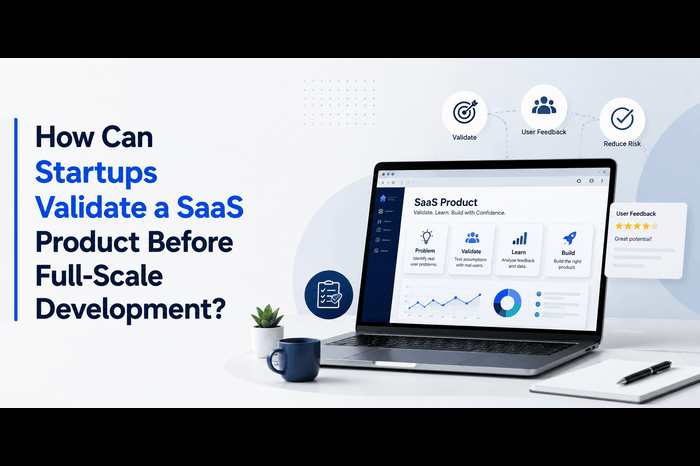
CB Insights has tracked startup post-mortems for years, and one reason keeps topping the list: 42 percent fail because they built something the market never actually needed. Not a funding problem. Not a technology problem. A validation problem.
That number should sit uncomfortably with any founder about to greenlight six months of engineering. The product might be technically excellent and still fail, because nobody confirmed the demand before the build started.
Why Skipping Validation Is So Expensive
Full-scale product development is a bet. Validation is how you shrink the size of that bet before you place it.
GoodFirms’ MVP survey backs this up directly. 87.9 percent of businesses say an MVP helped validate their idea before they committed further. 78.3 percent used it specifically to test market demand, not just to ship something fast.
The pattern holds at the pivot stage too. Research from the Startup Genome project found founders who pivot once or twice raise roughly 2.5 times more funding than those who never adjust course. Validation isn’t about avoiding a pivot. It’s about finding out you need one while it still costs a few weeks, not a few million dollars.
Validation Isn’t the Same as “Getting Feedback”
Founders often think they’ve validated an idea because friends, early users, or LinkedIn commenters said it sounded good. That’s not validation. That’s politeness.
Real validation methods put money, time, or a real commitment on the line:
- Problem interviews: structured conversations that test whether the problem is painful enough to pay to solve, not just mildly annoying
- Landing page tests: a real page with a real signup or waitlist, measuring actual click-through and conversion, not opinions
- Concierge tests: manually delivering the “product” outcome by hand before writing a line of code, to confirm people want the result
- Pre-sales or deposits: asking for a small payment commitment before building, which filters out polite interest fast
- Clickable prototypes: a Figma-level walkthrough tested with real target users, watched, not just asked about afterward
Each of these answers a different question. Interviews test the problem. Landing pages test demand. Pre-sales test whether people will actually pay. Skipping straight to a prototype without the first two just tests whether your design looks nice.
MVP vs. Prototype vs. Full Product: Know Which One You’re Building
These three get used interchangeably, and that confusion causes real budget waste.
| Criteria | Prototype | MVP | Full Product |
|---|---|---|---|
|
Purpose |
Test usability and concept clarity |
Test whether people will actually use and pay for it |
Deliver the complete, scalable experience |
|
Built with a real backend? |
Usually not |
Yes, minimally |
Yes, fully |
|
Audience |
Internal team, a handful of users |
Early adopters, a small paying cohort |
General market |
|
Cost |
Low |
Moderate |
High |
| Goal | “Does this make sense?” | “Does this solve a real problem people will pay for?” |
“Can this scale and retain users?” |
A founder who jumps from prototype straight to full product skips the one stage designed to catch a wrong assumption cheaply.
Building an MVP That Actually Tests Something
Not every MVP is built well. A weak one just becomes a smaller, slower version of the full product, which still costs real money and still doesn’t answer the demand question.
A validation-focused MVP should:
- Solve exactly one core problem, not three adjacent ones
- Include only the features required to test that problem, nothing added for polish
- Be measurable; you need usage data, not just anecdotes, once it’s live
- Have a clear kill criterion decided in advance, so “it’s not working” gets acted on instead of rationalized
That last point matters more than people admit. Founders who skip defining failure criteria upfront tend to keep funding a dying idea because nobody set the line that says when to stop.
When to Bring In Outside Help
Some founders can build and test an MVP solo. Most SaaS ideas, though, need more than one skill set: backend architecture, UX, and increasingly some AI or integration work, which is where an MVP development company or broader technical partner enters the picture.
| Criteria | Solo/In-House Build | MVP Development Company | Full SaaS Development Agency |
|---|---|---|---|
| Best for | Simple, single-founder technical products | Fast, focused validation builds | Post-validation, scaling to full product |
| Speed | Slower, learning curve included | Fast pattern already exists | Moderate, built for durability not speed |
| Cost | Lowest cash cost, highest time cost | Scoped, fixed-purpose engagement | Higher, justified once demand is proven |
| Risk | Wrong assumptions get built into architecture | Low, built to be disposable if it fails | Low, assuming MVP already validated demand |
If the goal is speed and a clean test, look for MVP solutions providers who specialize in exactly that: quick, disposable builds meant to answer one question, not become permanent infrastructure. If the idea is already validated and you’re ready to scale, that’s when a full saas development agency or saas application development company earns its higher price tag.
One caution worth flagging directly: a saas app development company that pushes straight to a full build without asking what you’ve validated yet is optimizing for their invoice, not your outcome. That’s a fair question to ask in any first call.
Signals You’ve Actually Validated the Idea
False validation signals are common and expensive. Watch for the difference:
Weak signal: People say they’d use it.
Real signal: People pay a deposit, join a waitlist with intent, or actively use a manual version repeatedly.
Weak signal: Positive comments on a social post.
Real signal: Structured interviews reveal the same pain point across multiple unrelated users.
Weak signal: A few beta signups.
Real signal: Beta users come back a second and third time without being reminded.
Real signals involve friction: time, money, or repeated effort. If nothing in the test cost the user anything, the result probably isn’t telling you what you think it is.
The Mistakes That Repeat Across Failed Launches
Building for imagined edge cases before confirming the core case works. Founders add settings and options nobody asked for before confirming anyone wants the base product at all.
Treating validation as a one-time gate instead of an ongoing habit. Markets shift. A validated idea from six months ago can quietly stop being true.
Confusing enthusiasm with commitment. Excited conversations are cheap. The willingness to pay, wait, or change behavior is the actual signal.
Startups that validate before they build aren’t moving slower. They’re spending the cheap, early weeks finding out what the expensive, later months would have told them anyway, just at a fraction of the cost.
























Leave a Reply