

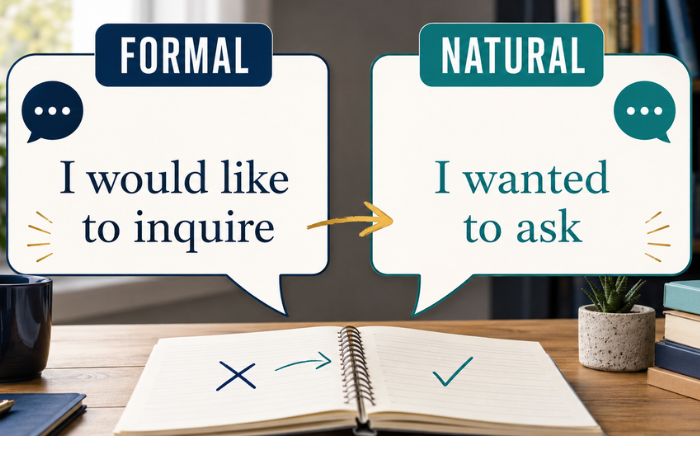
A sentence can be grammatically perfect and still sound unnatural in an everyday American conversation. We may use the correct verb tense, follow standard word order, and pronounce every word clearly, yet native speakers may perceive our English as unusually stiff, distant, or textbook-like. The problem is not necessarily grammar. It is often a matter of register, vocabulary, rhythm, contractions, and conversational convention.
When English sounds formal even when the grammar is correct, we are usually applying written-language standards to situations that call for relaxed speech. Formal English has an important place in academic papers, legal documents, business proposals, and official communication. However, Americans generally use shorter sentences, common phrasal verbs, contractions, and indirect conversational signals in daily interactions. Learning to recognize those patterns helps us sound natural without sacrificing correctness.
Students who need support distinguishing academic English from conversational usage can explore specialized support for English coursework. Its coverage of grammar, syntax, rhetoric, literary analysis, research writing, and major citation styles provides relevant context for learners managing demanding English classes.
Correct Grammar Is Not the Same as Natural English
Grammar determines whether the parts of a sentence work together according to established rules. Naturalness depends on whether speakers typically choose that sentence in a particular situation.
Consider these two statements:
- “I would like to inquire whether you are available tomorrow.”
- “I wanted to ask if you’re free tomorrow.”
Both are grammatically correct. The first sounds appropriate in a formal email or official request. The second is more likely to appear in an ordinary conversation between American classmates, coworkers, or acquaintances.
The difference involves more than vocabulary. The natural version uses a contraction, a familiar verb, and a conversational past-tense form—“wanted”—that makes the request feel less direct. To communicate naturally, we must learn not only what English speakers can say but also what they usually do say.
You May Be Using Vocabulary That Is Too Formal
One major reason English sounds overly formal is the use of sophisticated words where native speakers normally choose simpler alternatives. Students often learn that advanced vocabulary demonstrates fluency, but complexity does not automatically create effective communication.
Compare these examples:
| Overly formal English | Natural everyday English |
|---|---|
| I wish to inquire about the schedule. | I wanted to ask about the schedule. |
| We must commence the meeting. | We need to start the meeting. |
| Please inform me of your decision. | Please let me know what you decide. |
| I am unable to attend. | I can’t make it. |
| We should depart immediately. | We should leave now. |
| I require your assistance. | I need your help. |
Words such as commence, depart, require, inform, and inquire are correct, but they belong to a more formal register. Using them in a casual conversation may create emotional distance or make a simple message sound ceremonial.
Choose Familiar Words Before Impressive Words
In most American conversations, clarity and ease matter more than lexical sophistication. We should not ask, “What is the most advanced word we know?” Instead, we should ask, “What would communicate this idea most naturally here?”
This does not mean eliminating advanced vocabulary. Precise terminology is valuable when discussing technical, academic, or professional subjects. The goal is to select words that match the context.
Avoiding Contractions Can Make English Sound Stiff
Native speakers frequently use contractions in everyday American English:
- I’m
- You’re
- We’re
- Don’t
- Can’t
- Won’t
- I’ve
- We’ll
- That’s
- There’s
A sentence without contractions may remain completely correct, but it can sound unusually serious.
Compare:
“I do not believe that we will be able to finish today.”
With:
“I don’t think we’ll be able to finish today.”
The second version is shorter and more conversational. It also replaces “I do not believe” with the more common “I don’t think.”
When Full Forms Are Appropriate
Full forms can add emphasis:
“I do not agree.”
They may also suit formal contracts, policies, academic arguments, and situations where clarity is more important than conversational rhythm. However, consistently saying “I am,” “you are,” and “we will” in casual speech can make our English sound rehearsed.
Complete Sentences Are Not Always Necessary in Conversation
Traditional instruction encourages us to write complete sentences containing a subject and a verb. Spoken English frequently uses fragments because the surrounding context supplies the missing information.
For example:
“Do you want coffee?”
Natural responses include:
- “Sure.”
- “Maybe later.”
- “Not right now.”
- “Sounds good.”
- “Already had some.”
The complete answer “Yes, I would like to have some coffee” is grammatically correct, but it may sound unnecessarily formal in a relaxed setting.
Conversational English Relies on Shared Context
Fragments work because speakers understand what is being discussed. We do not need to repeat information that is already obvious. In academic writing, fragments can cause confusion and are usually corrected. In conversation, strategic fragments make communication faster and more natural.
You May Be Translating Politeness Too Literally
Politeness does not operate identically in every language or culture. A phrase that sounds respectful in one language may sound distant, excessively deferential, or old-fashioned when translated directly into English.
For example:
- “Kindly provide me with the document.”
- “Could you send me the document, please?”
Both requests are grammatically correct. In everyday U.S. workplace communication, the second generally sounds warmer and more natural. “Kindly” appears in formal notices and customer-service language, but it can sound commanding when used in an ordinary request.
Other excessively formal constructions include:
- “I humbly request…”
- “May I know your name?”
- “Please be informed that…”
- “I shall be grateful if…”
- “Do the needful.”
Some of these expressions are common in regional varieties of English outside the United States. However, they are less typical in contemporary American conversation.
Use Modal Verbs for Natural Politeness
Americans often soften requests with could, would, and can:
- “Could you take a look at this?”
- “Would you mind sending it again?”
- “Can we move the meeting to Friday?”
- “Could I ask you a quick question?”
These constructions sound polite without becoming ceremonial.
Your Sentences May Be Too Long for Conversation
Formal writing often uses complex sentences to explain relationships between ideas. Everyday speech tends to divide information into shorter units.
Consider this formal version:
“Although I intended to complete the assignment yesterday, I was unable to do so because I encountered several technical difficulties.”
A more natural spoken version would be:
“I was going to finish the assignment yesterday, but I had some technical problems.”
We might make it even more conversational:
“I was going to finish it yesterday, but my computer kept acting up.”
The natural version uses shorter phrasing, a pronoun to avoid repetition, and the phrasal verb “act up.”
One Main Idea at a Time
When speaking, we should avoid building every sentence like an academic paragraph. Shorter units give listeners time to process information and create opportunities for interaction.
Phrasal Verbs Make American English Sound More Natural
Phrasal verbs combine a verb with a particle such as “up,” “out,” “on,” or “off.” They are extremely common in conversational English, even when a formal single-word equivalent exists.
| Formal verb | Natural phrasal verb |
|---|---|
| Continue | Keep going |
| Postpone | Put off |
| Discover | Find out |
| Investigate | Look into |
| Mention | Bring up |
| Cancel | Call off |
| Tolerate | Put up with |
| Complete | Finish up |
| Remove | Take off |
| Return | Come back |
For example:
“We need to investigate the problem.”
This is appropriate in a professional report. In conversation, many Americans would say:
“We need to look into the problem.”
Phrasal verbs can be difficult because their meanings are not always predictable. “Find out” means discover, but “fall out” can mean quarrel or become detached. We should therefore learn them in complete examples rather than memorizing particles separately.
Your English May Lack Conversational Softeners
Spoken American English often includes words that make statements less absolute. These expressions may appear unnecessary from a purely grammatical perspective, but they serve important social functions.
Common conversational softeners include:
- Kind of
- Sort of
- A little
- Maybe
- Probably
- I think
- I guess
- It seems like
- A bit
Compare:
“Your explanation is confusing.”
With:
“I think that part is a little confusing.”
The first statement is grammatically correct but direct. The second reduces the risk of sounding critical by presenting the response as a personal interpretation.
Do Not Overuse Softeners
Too many softeners can make us sound uncertain:
“I just kind of thought maybe we could possibly change it a little.”
A clearer version is:
“I think we could change it a little.”
Natural communication requires balance. We should soften statements when politeness or uncertainty requires it, not automatically weaken every opinion.
Formal English Often Avoids Common Discourse Markers
Natural conversations use short expressions to organize ideas, manage turns, and signal reactions. These are known as discourse markers.
Examples include:
- Well
- So
- Actually
- Anyway
- By the way
- I mean
- You know
- Right
- Okay
Suppose someone asks, “Why did you change the schedule?” A formal response might begin:
“The schedule was changed because several participants were unavailable.”
A more conversational response could be:
“Well, a few people couldn’t make it, so we changed the time.”
“Well” gives the speaker time to respond, while “so” clearly connects the cause and result. These words are not meaningless filler when used purposefully. They help conversations flow.
However, repeatedly inserting “like,” “you know,” or “I mean” can distract listeners. We should use discourse markers as organizational tools rather than verbal habits.
Direct Questions Can Sound Like Interviews
Learners sometimes construct conversations as sequences of grammatically complete questions:
“Where do you live?”
“What do you do?”
“How long have you worked there?”
“Do you enjoy your job?”
Each question is correct, but the sequence may sound like an interview. Natural conversation usually includes reactions, comments, and related information between questions.
For example:
“I live in Seattle.”
“Oh, nice. I visited last year. Have you lived there long?”
This response acknowledges what the other person said before requesting more information. Natural English is interactive, not simply accurate.
Use Follow-Up Reactions
Helpful conversational responses include:
- “That makes sense.”
- “That sounds interesting.”
- “No way!”
- “Really?”
- “I know what you mean.”
- “That must have been difficult.”
- “How did that go?”
These phrases show attention and make communication feel reciprocal.
Your Intonation May Be More Formal Than Your Words
Naturalness is not limited to grammar and vocabulary. Intonation, rhythm, stress, and connected speech strongly affect how English sounds.
English is often described as a stress-timed language. Content words—important nouns, verbs, adjectives, and adverbs—usually receive more emphasis, while grammatical words may be reduced.
Consider:
“I WANTED to ASK about the MEETING.”
If every word receives equal stress, the sentence may sound mechanical:
“I—WANT-ED—TO—ASK—A-BOUT—THE—MEET-ING.”
In natural speech, “to” may sound closer to “tuh,” and “about the” may connect smoothly. We do not need to eliminate sounds carelessly, but we should avoid pronouncing casual conversation as though we were reading a formal announcement.
Shadow Natural Speakers
A practical technique is shadowing:
- Choose a short clip from an American interview, podcast, or workplace conversation.
- Listen to one sentence several times.
- Mark the words that receive strong stress.
- Repeat the sentence along with the speaker.
- Record ourselves and compare the rhythm.
- Practice the same pattern with new vocabulary.
We should imitate rhythm and phrasing rather than trying to copy an identity or regional accent.
Written English Can Also Sound Unnecessarily Formal
Overly formal language affects emails, messages, and online discussions as well as speech.
Consider this email:
“Dear Mr. Carter, I am writing to inform you that I will be unable to attend the scheduled meeting due to a prior commitment.”
A natural professional version is:
“Hi Mr. Carter, I won’t be able to attend the meeting because of another commitment.”
The second message remains respectful, but it is more direct and easier to read. Modern American workplace writing generally favors plain language over bureaucratic phrasing.
Remove Empty Formal Introductions
We can often shorten phrases without losing meaning:
- “I am writing to let you know that…” → “I wanted to let you know…”
- “Please be advised that…” → State the information directly.
- “At this point in time…” → “Now”
- “In the event that…” → “If”
- “With regard to…” → “About”
- “For the purpose of…” → “To”
Plain language saves readers time and reduces the possibility of misunderstanding.
How to Make Correct English Sound More Natural
Learn Phrases, Not Isolated Words
Instead of learning “inquire” as a direct equivalent of “ask,” we should learn when each word normally appears. Useful conversational chunks include:
- “I wanted to ask…”
- “Do you happen to know…?”
- “I’m not sure, but…”
- “That works for me.”
- “I’ll get back to you.”
- “Let me check.”
Chunks help us produce natural combinations without constructing every sentence word by word.
Compare Formal, Neutral, and Casual Versions
We can practice one message across three registers:
Formal:
“Would you be available to discuss this matter tomorrow?”
Neutral:
“Would you be available to discuss this tomorrow?”
Casual:
“Can we talk about this tomorrow?”
This exercise develops the ability to match language to context.
Record Realistic Role-Plays
We can practice scenarios common in the United States:
- Asking a professor for clarification
- Speaking with a coworker
- Ordering food
- Making a medical appointment
- Introducing ourselves at a networking event
- Joining a classroom discussion
After recording, we should identify sentences that are too long, vocabulary that is unusually formal, and places where contractions would sound more natural.
Read the Room Before Changing Register
Natural English is not always casual English. A job interview requires more formality than a conversation with a roommate. A university discussion post needs a more developed structure than a group-chat message.
Our goal should be register flexibility: the ability to sound appropriately formal, neutral, or casual according to the situation.
Common Formal-to-Natural English Replacements
Here are practical alternatives we can apply immediately:
| Formal expression | More natural alternative |
|---|---|
| I do not understand. | I don’t get it. |
| I would like to know… | I wanted to know… |
| Please wait for a moment. | Give me a second. |
| I will contact you later. | I’ll get back to you. |
| I am in agreement. | I agree. |
| That is acceptable to me. | That works for me. |
| I have no objection. | I’m fine with that. |
| Shall we proceed? | Should we get started? |
| I was unable to attend. | I couldn’t make it. |
| I will investigate it. | I’ll look into it. |
We should treat these as contextual options rather than automatic replacements. “I was unable to attend” may be ideal in an official statement, while “I couldn’t make it” suits an everyday explanation.
Final Thoughts: Sounding Natural Without Losing Accuracy
If our English sounds formal even when our grammar is correct, the solution is not to abandon grammar. We need to expand our understanding beyond correctness and include register, frequency, rhythm, idiomatic language, and audience expectations.
Natural American English commonly uses contractions, short responses, phrasal verbs, conversational softeners, and familiar vocabulary. Formal English favors complete structures, specialized wording, and greater distance. Neither style is universally better. Effective communication depends on choosing the right one for the moment.
We can improve by observing how proficient speakers phrase ordinary ideas, practicing complete conversational chunks, and comparing formal sentences with neutral alternatives. Over time, we become able to preserve grammatical accuracy while sounding more relaxed, approachable, and authentic.

























Leave a Reply