

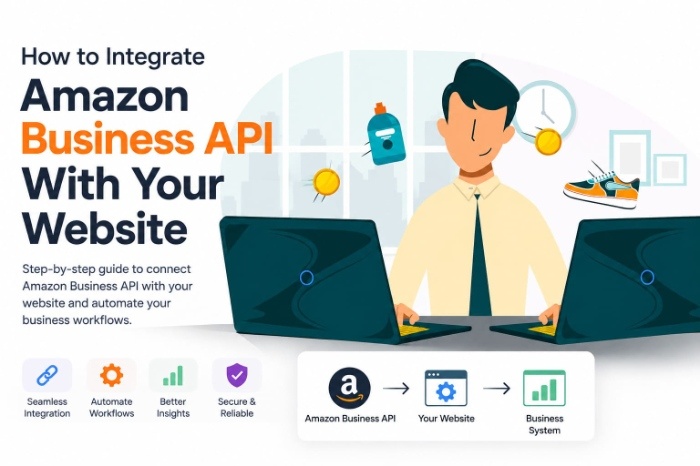
Businesses today use connected systems to make buying easier, handle orders, and run more efficiently. For companies that often buy things on Amazon Business, adding Amazon Business features to their website can make the buying process smoother.
The Amazon Business API lets approved apps link to Amazon Business features. Create custom buying processes. Companies can use API connections to link Amazon with buying platforms, internal tools, ERP systems, and websites.
Setting up an Amazon connection needs good planning, secure login methods, API setup, testing, and regular upkeep. Using Amazon Business API Services that have experience can help companies create an integration that works for their specific needs.
What Is Amazon Business API Integration?
The Amazon Business API gives computer‑based access to chosen Amazon Business features for approved applications. Based on the access and roles a company gives to an app, businesses can use features that help with product discovery, purchasing orders, shipments, documents, and other business tasks.
Instead of making employees jump between many systems, an Amazon Business API integration can bring helpful Amazon Business features into a company’s current digital setup.
For example, a company could build a custom buying portal where authorized employees can look for products and handle buying tasks while still using the company’s interface.
This makes the Amazon Business API especially useful for businesses that want control over their buying processes and integrations.
The Key Amazon APIs You Need to Know
1. Amazon Business API
Essentially, the Amazon Business API is for businesses to list products, offer quantity discounts, and handle tax-exempt sales. This is where you begin if your objective is to connect directly with the procurement teams and business customers of Amazon without having to commit to having an Amazon catalog.
2. Amazon Vendor API Services
Amazon’s Vendor Central is the system that you’ll use if you are a wholesale customer. (Not a third-party seller who sells directly to consumers). Amazon Vendor API Services enable businesses to streamline their purchase order management, shipment confirmations, invoicing, and inventory forecasting processes with Amazon. This is especially helpful for manufacturers and distributors that supply Amazon directly who require the data to flow accurately to and from Amazon in real time, without having to manually enter it.
3. Amazon SP API Integration Services
The Selling Partner API SP API took the place of Amazon’s Marketplace Web Service MWS and is now the main part of most seller-side connections. Amazon SP API Integration Services include order management, inventory updates, price changes, product listings, reports, and shipping information. If you have a business that sells on channels and you want your website’s back end or your ERP system to work with Amazon smoothly, getting orders in and sending inventory updates out, SP API integration is important.
4. Amazon Ads API Integration Services
Selling on Amazon is about more than shipping boxes. You also need people to actually see your items. Amazon Ads API Integration Services help businesses manage and improve Sponsored Products, Sponsored Brands, and Sponsored Display campaigns with code. You do not have to log into the Amazon Ads console every time if you use this tool. Instead, you can use Amazon Ads API Integration Services to change your bids. You can also pull all your performance reports into your private dashboards. This makes it easy to match your advertising plan with sales data from your website and your Amazon store.
These four API categories cover every part of your work with Amazon, from product data and shipping to how your advertising performs.
Why Integrate Amazon Business API With Your Website?
Before we jump into the steps, I think it is important to look at how this actually helps you in real life:
Centralized Inventory Management
Centralized inventory management helps you keep your product counts the same on Amazon and your own website. When you use automation to update your stock, you do not have to worry much about selling things you do not have or running out of items. Centralized inventory management keeps your product info correct on every site you sell on.
Faster Order Processing
Faster order processing means your Amazon orders go into your own system without you doing anything. You do not have to type in every order detail by hand anymore. Because you can automate the data, your team can get orders out the door faster. This makes the whole experience better for your customers.
Consistent Pricing
Consistent pricing lets you handle your product prices better across all your different shops. When you change a price in one integrated system, that change goes to all your platforms at once. This stops price mistakes. Means you do not have to manually update every single price over and over again.
Better Reporting
Better reporting happens when you connect your Amazon sales, your ads, your vendor info, and your website data. You can pull all that data into one single place. This makes it much easier to see what is selling, how you are doing, and what your customers actually want.
Manual Work
Reduced manual work is probably one of the best parts of using an API. You can stop using spreadsheets and stop the endless copy-and-paste tasks between different systems. When you have reduced work, your team can spend more time helping customers or growing the business instead of doing boring data entry.
Supporting Business Growth
If you want to grow, automation is a help for managing your work. Connecting Amazon to your website and your internal tools lets a small team handle a lot of sales. You can automate the parts that make fewer mistakes and keep things running smoothly even when you get much busier.
Benefits of Amazon Business API Integration
Besides the reasons to link your website to Amazon, there are special perks that come with Amazon Business API Integration. These perks are very helpful for companies that sell to businesses:
Access to business buyers at scale
Amazon Business connects sellers to school teams, hospital staff, government groups, and procurement teams. These groups are looking for deals and business pricing, which helps you reach more people than just regular shoppers.
Automated tax-exempt purchasing
The Amazon Business API Integration handles tax exemption certificates and status on its own. This takes away the need to do it by hand, which stops mistakes during every sale.
Quantity discount management
You can set up rules for pricing and tiered discounts using code. This means business buyers will always see the prices for large orders without you having to change price lists manually.
Streamlined multi-user account support
Amazon Business accounts often have different buyers and many steps for approval. Amazon Business API Integration makes sure your order data stays correct when the customer has a complicated way of buying.
Real-time visibility into demand
When you sync your order and inventory data, you get a view of what businesses want right now. This helps you decide when to restock and how much to buy.
Stronger customer. Retention
Having the right stock levels, prices, and fast order updates makes buying much easier. A smooth experience is very important for B2B customers who want to buy from you again.
For businesses that are growing, this kind of automation is not a nice thing to have. This automation is what lets a small team work as big as a much larger company.
How to Integrate Amazon Business API With Your Website
Step 1: Define Your Integration Goals
Start by figuring out what you want to accomplish. Are you syncing inventory, automating order fulfillment, managing vendor purchase orders, or optimizing ad spend? Your goals will decide which combination of APIs (Business, Vendor, SP-API, Ads) you actually need, since not every business uses all four.
Step 2: Register as an Amazon Developer
You have to create a seller or vendor account (depending on how your business works) and sign up as an Amazon Developer. This gives you access to the developer console where you will generate the credentials. Client ID, client secret, and refresh tokens. These are needed for API authentication.
Step 3: Set Up Authentication (LWA and IAM)
Amazon’s APIs use Login with Amazon (LWA) for authorization along with AWS Identity and Access Management (IAM) roles for access to SP-API endpoints. This part includes setting up OAuth tokens and making sure your application can securely get and refresh access tokens without any help.
Step 4: Build or Configure the Integration Layer
This is where the real work starts. You will need middleware. Either built from scratch or using a third-party integration platform. That links your website’s database or ERP system to Amazon’s API endpoints. This layer takes care of data mapping (matching your product fields to Amazon’s format), handling errors, managing rate limits, and checking data validity.
Step 5: Sync Product and Inventory Data
Once authentication and middleware are ready, you can start syncing product listings, stock levels, and prices between your website and Amazon. Time or near real-time syncing stops differences that could cause canceled orders or unhappy customers.
Step 6: Automate Order and Fulfillment Workflows
Link your order management system so that orders placed on Amazon go directly into your website’s backend (and the other way around if needed). This is very important for businesses that use Fulfilled by Amazon (FBA) or Vendor Central, where shipment and billing data must move automatically.
Step 7: Integrate Advertising Data
If you are running Amazon Ads campaigns, connect the Ads API to bring performance data like impressions, clicks, conversions, and ACoS. Into your analytics dashboard. This helps you match ad spending with sales trends on your website and on Amazon.
Step 8: Test and Monitor Continuously
Before going live, test every process: order creation, inventory updates, price changes, and error situations (like outdated tokens or rate limit issues). After you launch, set up monitoring and alerts so you spot sync problems early, rather than finding out after a customer complains.
When Should You Hire Amazon API Integration Experts?
When it comes to API projects, a skilled internal development team can manage them with ease. When projects grow larger, things can become messy. Many systems, APIs, user roles, authentication rules, and business processes can all get tangled.
I have seen how hiring an Amazon API integration team can make all the difference. They can guide businesses through every step from planning and Amazon API access to development, testing, deployment, and maintenance.
Professional Amazon Business API Services offer another layer of support. They are especially helpful when Amazon needs to link up with an existing ERP, CRM, procurement platform, inventory system, or custom business application.
Choosing the development partner matters a lot. They can help you decide if your project needs Amazon Business APIs, Amazon Vendor API Services, Amazon SP-API Integration Services, or Amazon Ads API Integration Services.
Final Thoughts
I find that integrating Amazon’s APIs with your website is more than a technical tweak. It cuts down on effort, makes your data more accurate, and lets your business grow without adding extra work overhead. Whether you are matching inventory as a seller, handling purchase orders as a vendor, or tweaking ad campaigns, the right integration plan makes Amazon a connected part of your business rather than a separate sales channel. Working with developers who understand Amazon’s API rules—like the team at Vision Infotech helps you avoid mistakes and get your integration running smoothly from day one.



















Leave a Reply