

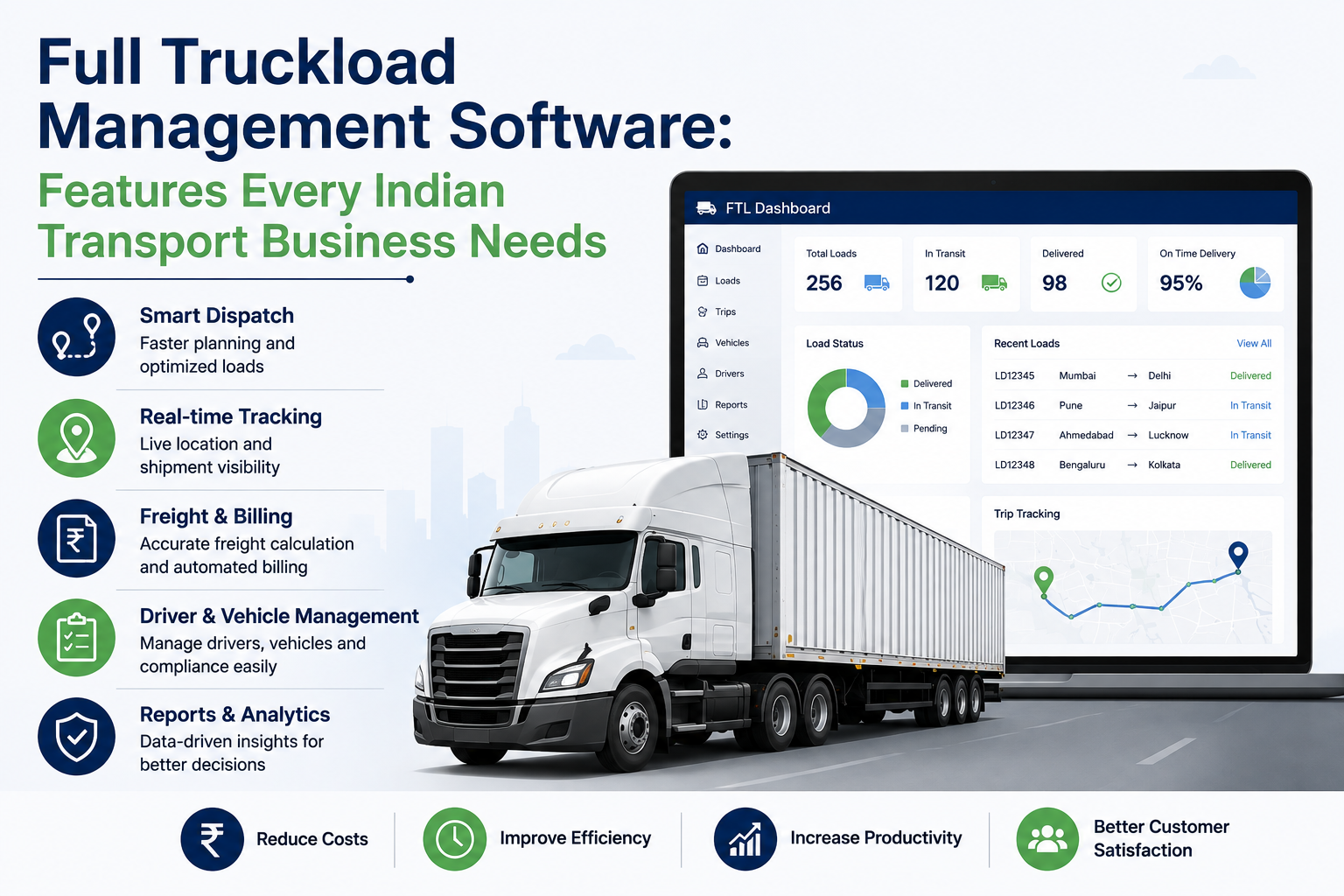
Full truckload transportation is an important part of India’s logistics industry. Manufacturers, FMCG companies, retailers, e-commerce businesses, and logistics providers regularly depend on dedicated trucks to move large shipments between cities and states.
As transportation operations grow, managing FTL trips through phone calls, spreadsheets, WhatsApp messages, and manual paperwork becomes increasingly difficult. Dispatch teams need to coordinate vehicles, drivers, routes, shipment documents, delivery schedules, fuel expenses, and billing at the same time.
This is where Full Truckload Management Software can make a significant difference.
A modern FTL management system helps Indian transport businesses manage complete truckload operations from a centralized platform. It provides better visibility, automates repetitive tasks, reduces operational delays, and helps managers make faster decisions.
But not every software solution offers the same capabilities. Indian transport businesses should look for features that address their specific transportation, compliance, billing, and fleet management requirements.
What is Full Truckload Management Software?
Full Truckload Management Software is a digital transportation solution designed to manage shipments where an entire truck is dedicated to a single customer or load.
The software helps businesses manage the complete FTL workflow, starting from load booking and vehicle assignment through dispatch, tracking, delivery, POD collection, and billing.
Instead of maintaining separate records for every activity, transport businesses can manage operations through one centralized system.
A typical FTL software solution can help with:
- Load and trip planning
- Vehicle assignment
- Driver management
- Real-time GPS tracking
- Route optimization
- Fuel monitoring
- Digital POD
- E-Way Bill management
- Automated billing
- Trip settlement
- Reports and analytics
For Indian transport businesses managing multiple vehicles and long-distance trips, this centralized approach can improve operational control.
Why Indian Transport Businesses Need FTL Software
Managing a few trucks manually may be possible. However, as fleet size and shipment volume increase, manual processes become difficult to control.
Transport businesses often face challenges such as:
- Difficulty tracking vehicles in real time
- Delays in trip assignment
- Poor route planning
- Fuel misuse
- Unauthorized stoppages
- Manual documentation
- E-Way Bill management issues
- Delayed POD collection
- Billing errors
- Poor customer communication
These problems can increase operational costs and affect delivery performance.
An FTL management system helps bring these activities together and provides operations teams with better visibility.
Features Every Indian Transport Business Needs
1. Load Planning and Trip Assignment
Efficient load planning is the starting point of successful FTL transportation.
The software should allow dispatch teams to create trips, record shipment details, select suitable vehicles, and assign drivers from a centralized dashboard.
This reduces the need for repeated phone calls and manual spreadsheets.
A good system should also provide visibility into vehicle availability so that dispatch teams can avoid unnecessary waiting time and improve fleet utilization.
2. Real-Time GPS Tracking
Long-distance FTL trips often cover multiple cities and states. Without real-time tracking, managers may have limited visibility into vehicle movement.
Real-time GPS tracking allows operations teams to monitor:
- Current vehicle location
- Trip progress
- Route movement
- Delivery status
- Unplanned stoppages
- Route deviations
This makes it easier to identify transportation problems before they become major delivery issues.
3. Route Optimization
Fuel and travel costs have a direct impact on transportation profitability.
An FTL software solution should provide route planning and optimization capabilities to help businesses identify efficient routes.
Better route planning can help reduce:
- Unnecessary kilometers
- Fuel consumption
- Travel time
- Delivery delays
- Vehicle wear and tear
For businesses managing frequent interstate transportation, route optimization can become an important part of cost control.
4. Driver Management
Drivers play a central role in full truckload transportation operations.
Managing drivers manually becomes difficult when businesses have a large fleet operating across different locations.
Full truckload software should help businesses manage driver assignments, trip details, activity, and performance.
It can also provide visibility into route adherence, stoppages, and other operational activities.
Better driver management improves accountability and helps businesses maintain more consistent transportation operations.
5. Fuel Management and Theft Detection
Fuel is one of the largest recurring expenses for transport businesses.
Simply knowing how much fuel was purchased is not enough. Businesses need to understand how fuel is being consumed during actual trips.
Fuel management features can help monitor consumption and identify unusual patterns.
When combined with GPS and trip data, businesses can identify potential issues such as excessive idling, unauthorized movement, and route deviations.
This helps transporters control fuel expenses and improve fleet profitability.
6. E-Way Bill and GST Compliance
Indian transport businesses need to manage transportation documentation and compliance requirements across different states.
An FTL software solution should support E-Way Bill and GST-related workflows to reduce manual effort.
A GST-Integrated Logistics Software solution can help businesses manage relevant transportation documentation alongside trip information.
This reduces dependency on separate systems and helps operations teams maintain more organized records.
7. Digital Proof of Delivery
Proof of delivery is an important part of full truckload operations because it confirms that a shipment has reached its destination.
Traditional paper-based POD collection can delay billing and create document management problems.
With Digital POD capabilities, drivers can capture delivery confirmation through:
- Digital signatures
- Delivery photographs
- OTP verification
- GPS location
- Delivery timestamps
This information can be shared with the operations and accounts teams quickly.
It also reduces the risk of misplaced physical documents.
8. Automated Billing and Invoicing
Billing errors and delayed invoices can affect a transport business’s cash flow.
FTL management software should connect trip information with billing workflows so that completed transportation records can be used for invoice generation.
Businesses can manage freight charges, additional expenses, trip details, and payment-related information from a centralized system.
Automation reduces repetitive data entry and helps accounts teams process completed trips faster.
9. Real-Time Alerts and Notifications
Operations teams cannot continuously monitor every vehicle manually.
Real-time alerts help managers identify important events without constantly checking the tracking dashboard.
Useful alerts can include:
- Route deviation
- Unauthorized stoppage
- Vehicle delay
- Excessive idling
- Trip completion
- Delivery arrival
- Geofence entry or exit
These notifications allow teams to respond quickly when transportation activities move outside expected conditions.
10. Reporting and Analytics
Transportation managers need data to understand whether their fleet is performing efficiently.
An full truckload management platform should provide reports covering areas such as:
- Trip performance
- Vehicle utilization
- Driver performance
- Fuel consumption
- Delivery timelines
- Route efficiency
- Transportation costs
These insights help managers identify recurring problems and make better operational decisions.
Benefits of Using FTL Management Software
Better Fleet Visibility
Managers can monitor vehicles and active trips without depending entirely on driver updates.
Reduced Transportation Costs
Route optimization, fuel monitoring, and better vehicle utilization can help reduce unnecessary expenses.
Faster Dispatch
Centralized trip planning allows teams to assign vehicles and drivers more efficiently.
Improved Delivery Performance
Real-time tracking helps businesses identify delays and take corrective action faster.
Faster Billing
Digital POD and automated billing workflows reduce the time between delivery completion and invoice generation.
Reduced Manual Work
Teams spend less time maintaining spreadsheets, calling drivers, and searching for physical documents.
Better Customer Communication
Accurate shipment information allows businesses to provide customers with more reliable delivery updates.
Scalable Operations
A centralized software system helps businesses handle increasing trip volumes without adding the same level of administrative workload.
Who Should Use Full Truckload Management Software?
FTL software can benefit different types of Indian transportation businesses.
- Large Fleet Operators: can use it to monitor vehicles, drivers, fuel, and trips from a centralized platform.
- Manufacturing Companies: can use it to manage bulk inbound and outbound transportation.
- 3PL Logistics Providers: can use the system to coordinate full truckload shipments for multiple customers.
- FMCG and Retail Businesses: can improve transportation planning and shipment visibility across distribution networks.
- E-commerce Logistics Companies: can use integrated transportation systems to manage bulk movements between warehouses, fulfillment centers, and distribution locations.
- Freight Brokers and Transport Aggregators: can improve coordination between customers, vehicles, and transportation partners.
How to Choose the Right FTL Software in India
Before selecting a software solution, transport businesses should evaluate whether it fits their current operations and future growth plans.
Important factors include:
- Real-time GPS tracking
- Easy trip and dispatch management
- Route optimization
- Driver management
- Fuel monitoring
- E-Way Bill integration
- Digital POD
- Automated billing
- Mobile application
- Reporting and analytics
- Multi-location support
- Integration capabilities
- Scalability
- Customer support
The software should also be easy for dispatchers, managers, drivers, and accounts teams to use.
Why LogiBrisk for Full Truckload Management?
LogiBrisk provides an integrated transportation management platform for businesses looking to digitize and streamline their logistics operations.
The platform brings together fleet management, trip and dispatch management, GPS tracking, billing, shipment visibility, Digital POD, and other transportation workflows.
For Indian transport businesses, having these functions in one centralized system can reduce manual coordination and provide better visibility across daily full truckload operations.
Instead of managing different activities through separate tools, businesses can use a connected transportation platform to improve operational efficiency and control.
Conclusion
Full truckload transportation requires careful coordination between vehicles, drivers, customers, dispatch teams, and accounts departments. As operations grow, managing these activities manually can result in higher costs, poor visibility, delivery delays, and administrative workload.
The right Part Truckload Managеmеnt Softwarе can help Indian transport businesses solve these challenges through real-time tracking, route optimization, driver management, fuel monitoring, E-Way Bill support, Digital POD, automated billing, and operational analytics.
For transport businesses planning to grow, investing in the right full truckload technology can help create more organized, transparent, and scalable transportation operations.






















Leave a Reply