Large websites have different SEO requirements than small business websites. When a company manages thousands of product pages, multiple locations, large content libraries, or websites across different markets, even small optimization decisions can have a significant impact on organic visibility.
This is where enterprise SEO becomes important. It provides a structured approach to managing technical SEO, content, keyword targeting, internal linking, analytics, and search performance across a large digital presence.
For organizations looking to make SEO a consistent growth channel, understanding the benefits, costs, features, and role of automation can help create a more effective long-term strategy.
What Is Enterprise SEO?
Enterprise SEO is the process of planning, implementing, and managing search engine optimization for large and complex websites. It combines technical optimization, content strategy, keyword research, website architecture, analytics, and ongoing performance management.
Unlike a small website where SEO changes can often be handled manually, enterprise websites require systems and processes that can operate efficiently across thousands or even millions of pages.
A strong enterprise SEO strategy also requires collaboration between SEO specialists, content teams, developers, designers, product teams, and marketing departments. This makes governance and communication important parts of the overall SEO process.
Key Benefits of Enterprise SEO
A well-planned enterprise SEO strategy can create value across several areas of digital marketing.
1. Greater Organic Visibility
Large businesses often compete across numerous product categories, services, locations, and search topics. Enterprise SEO helps organize these opportunities and create a structured approach to targeting relevant search queries.
2. Scalable Organic Traffic
Instead of focusing on individual pages alone, enterprise SEO looks at the website as an interconnected system. Improvements to site architecture, templates, internal linking, and technical performance can benefit large groups of pages simultaneously.
3. Better User Experience
SEO and user experience are closely connected. Faster pages, logical navigation, mobile-friendly layouts, useful content, and clear website structures make it easier for visitors to find what they need.
4. Stronger Marketing Efficiency
Organic search can become an important source of qualified traffic over time. By building a repeatable SEO framework, businesses can continue creating and optimizing search visibility instead of treating every campaign as a separate project.
Essential Features of an Enterprise SEO Strategy
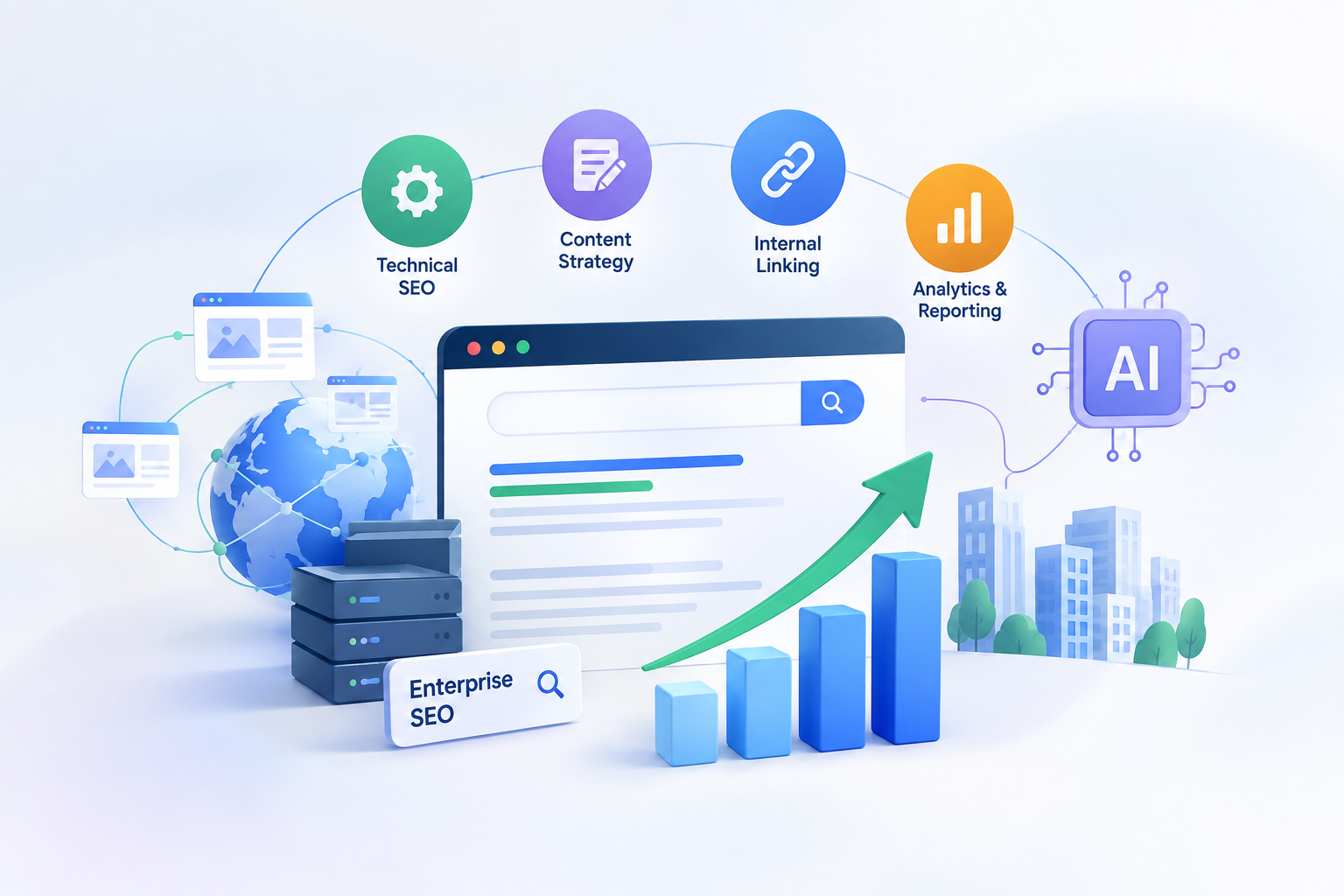
Enterprise SEO involves much more than keyword optimization. Several core components work together to support sustainable performance.
Technical SEO ensures that search engines can efficiently crawl, understand, and index the website. This includes site architecture, redirects, canonicalization, structured data, page speed, XML sitemaps, and JavaScript-related considerations.
Content optimization focuses on creating useful resources that match search intent. Enterprise content programs benefit from clear editorial guidelines, content governance, keyword mapping, and consistent quality standards.
Internal linking helps users and search engines discover important pages while distributing relevance throughout the website.
SEO reporting and analytics provide insight into organic traffic, rankings, conversions, indexed pages, technical issues, and other performance indicators.
For companies requiring specialized guidance, professional enterprise seo consulting services can help connect these elements into a coordinated strategy based on business objectives.
How Much Does Enterprise SEO Cost?
There is no single price for enterprise SEO because requirements vary significantly between organizations.
Pricing can depend on website size, number of markets, technical complexity, competition, content requirements, internal resources, and the level of ongoing support required.
Businesses may invest in SEO strategy and consulting, content production, technical optimization, analytics, software platforms, or complete ongoing management.
Companies with specific requirements can also consider custom enterprise seo packages that are structured around their website size, goals, target markets, and required level of support.
Rather than evaluating SEO purely by monthly cost, businesses should consider the resources being invested and how effectively those resources contribute to measurable organic growth.
The Role of AI in Enterprise SEO
Artificial intelligence is becoming an increasingly useful part of modern SEO workflows. It can help teams process large amounts of information and identify patterns that would take considerably longer to evaluate manually.
For example, AI can assist with keyword clustering, content analysis, search intent classification, data analysis, content briefs, technical issue categorization, and large-scale website audits.
However, AI works best as an additional capability rather than a replacement for strategic decision-making. Enterprise SEO still requires human oversight to understand brand positioning, customer needs, business priorities, content quality, and search intent.
The most effective approach is often a combination of automation and expert review. Routine, data-heavy tasks can be streamlined while experienced SEO professionals focus on strategy and decision-making.
Building an Enterprise SEO Strategy
A successful strategy starts with a detailed understanding of the existing website.
The first stage is usually a comprehensive technical and content audit. This helps identify structural opportunities, indexing considerations, content gaps, internal linking opportunities, and areas requiring improvement.
Next, businesses can develop a keyword and content framework aligned with their products, services, customer journeys, and target markets.
Website architecture should then be reviewed to ensure important pages can be discovered easily. Clear categories, logical navigation, descriptive URLs, and strategic internal links can create a stronger foundation for both users and search engines.
Finally, performance should be monitored continuously. SEO is not a one-time activity, particularly for enterprise websites that are constantly adding, removing, and updating pages.
Choosing an Enterprise SEO Partner
The right SEO partner should understand both search optimization and the operational challenges of large organizations.
Businesses evaluating providers can look at their technical capabilities, reporting processes, content expertise, experience with large websites, approach to AI and automation, and ability to collaborate with internal teams.
Organizations searching for best enterprise seo services in the USA can also evaluate providers based on transparency, strategic communication, measurable objectives, and how well their services align with the company’s existing marketing infrastructure.
For companies that prefer ongoing support, managed enterprise SEO services can provide continuous technical monitoring, content optimization, reporting, strategic planning, and performance management.
Final Thoughts
Enterprise SEO is ultimately about creating a scalable system for organic growth. Large websites need more than isolated keyword improvements; they require coordinated technical optimization, useful content, strong architecture, data-driven decision-making, and consistent processes.
AI and automation can make large-scale SEO more efficient, while experienced professionals provide the strategic direction needed to turn data into meaningful action.
With the right combination of technology, expertise, content, and measurement, enterprise SEO can become an integrated part of a company’s broader digital marketing strategy and support sustainable organic visibility as the business continues to grow.