The cryptocurrency industry continues to evolve as more businesses explore opportunities in digital asset trading, blockchain technology, and Web3 finance. Launching a cryptocurrency exchange, however, requires careful planning, technical expertise, security measures, liquidity, and a reliable trading infrastructure.
For businesses looking for a faster and more structured approach, a Binance Clone Script can be a practical solution. Instead of developing an exchange platform entirely from scratch, businesses can use a pre-built exchange solution with essential trading and management features and customize it according to their business requirements.
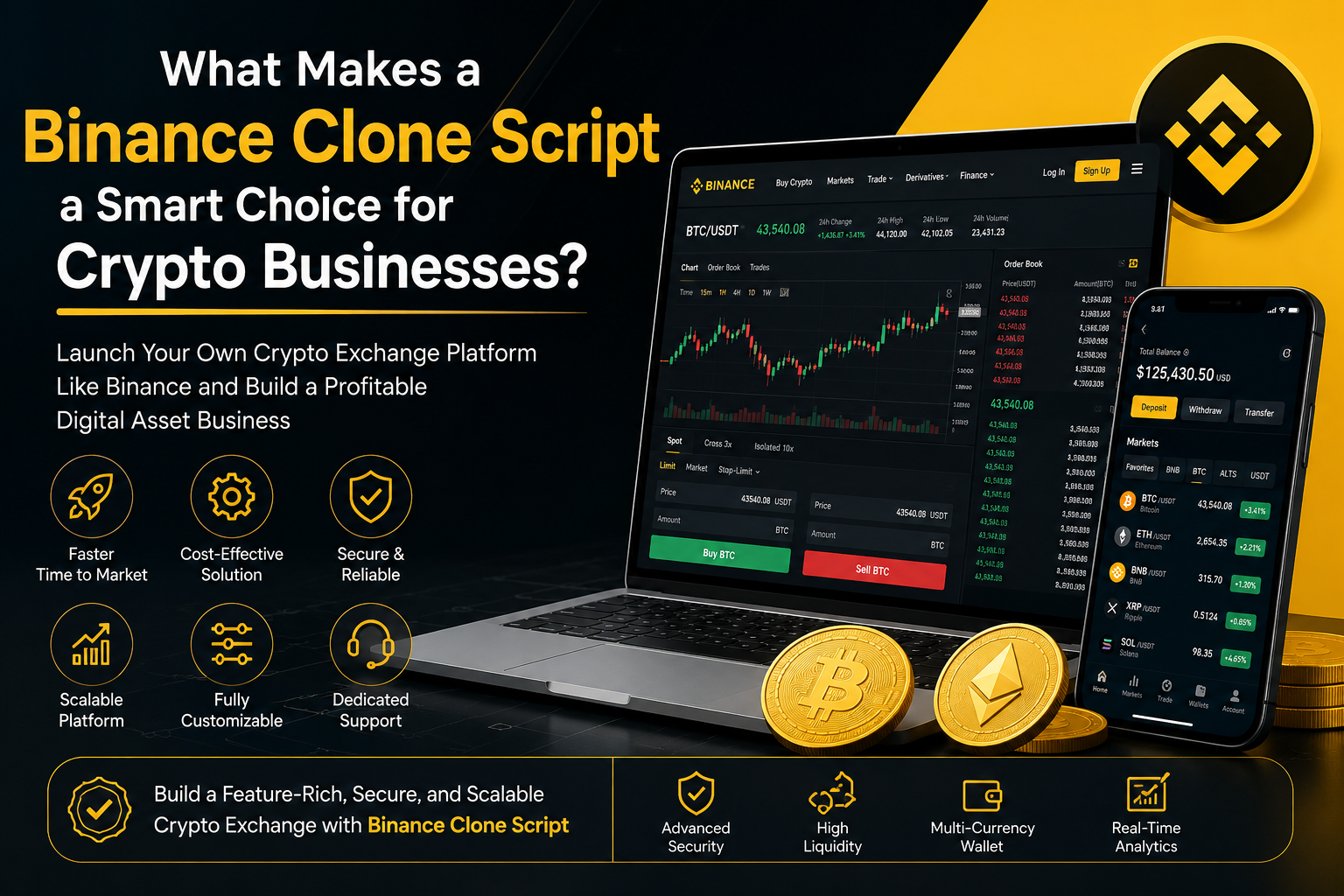
A Binance-style exchange solution can support features such as spot trading, crypto wallets, user registration, order management, liquidity integration, admin controls, security mechanisms, and multiple trading pairs. With the right customization and infrastructure, businesses can create a crypto exchange platform like Binance while developing their own brand identity and business model.
What Is a Binance Clone Script?
A Binance Clone Script is a pre-developed cryptocurrency exchange software solution inspired by the core functionality commonly found in major crypto trading platforms. It provides a foundation that businesses can customize and deploy as their own branded exchange.
The purpose of a clone script is not necessarily to duplicate another company’s brand, proprietary technology, or user interface. Instead, it provides a ready-made technical framework containing commonly required cryptocurrency exchange functionalities.
Depending on the solution and customization requirements, a Binance Clone Script may include:
- User registration and account management
- Cryptocurrency wallet integration
- Spot trading
- Market and limit orders
- Trading pair management
- Order book functionality
- Liquidity integration
- Admin dashboard
- Transaction management
- KYC and AML workflow integration
- Two-factor authentication
- Security controls
- Trading history
- Deposit and withdrawal management
- Notification systems
- Reporting and analytics
Businesses can customize these components to create an exchange that fits their target market, operational model, supported assets, and regulatory requirements.
Why Is a Binance Clone Script a Smart Choice?
Developing a cryptocurrency exchange from the ground up can involve considerable development time and resources. A pre-built exchange solution can reduce the amount of foundational development required while allowing businesses to focus on customization, security, compliance, marketing, and user acquisition.
Here are some of the major reasons businesses consider a Binance Clone Script.
1. Faster Exchange Development
Traditional cryptocurrency exchange development involves designing the architecture, developing trading modules, creating wallet systems, building administrative tools, integrating APIs, implementing security mechanisms, and conducting extensive testing.
A clone script provides a foundation for these components. Developers can customize the existing architecture instead of building every basic module from the beginning.
This can help businesses move from the planning stage toward testing and deployment more efficiently.
2. Cost-Efficient Development Approach
Building an exchange completely from scratch can require a large development team consisting of blockchain developers, backend engineers, frontend developers, UI/UX designers, security specialists, DevOps professionals, and testers.
A Binance Clone Script can reduce some of the initial development workload because many standard exchange functions are already available.
The final cost still depends on factors such as:
- Number of features
- Blockchain integrations
- Liquidity requirements
- Security architecture
- Mobile application requirements
- Custom UI/UX
- Third-party API integrations
- Compliance requirements
- Hosting infrastructure
- Ongoing maintenance
Therefore, businesses should evaluate the complete technical scope rather than choosing a solution based only on its initial price.
3. Customizable Trading Platform
One of the important advantages of a clone-based approach is customization.
Businesses can modify the platform’s branding, interface, trading features, supported cryptocurrencies, fee structure, user roles, and administrative controls according to their requirements.
A customized Binance Clone App can also be developed for mobile users, allowing traders to access account management, market information, trading functionality, wallet services, and notifications from smartphones.
The objective should be to create a unique exchange experience rather than simply reproducing an existing platform.
4. Essential Exchange Features
A modern crypto exchange requires more than a simple buy-and-sell interface. Users expect fast trading, secure wallets, transparent transactions, market information, and convenient account management.
A properly developed Binance Clone Script can provide the foundation for essential exchange functionality, including:
Trading Engine:
The trading engine processes orders and helps match buyers and sellers according to the exchange’s trading logic.
Wallet Management:
Users can deposit, store, and withdraw supported digital assets through integrated wallet infrastructure.
Order Management:
Different order types can be supported depending on the platform’s requirements, such as market and limit orders.
Admin Panel:
Administrators can manage users, trading pairs, fees, transactions, assets, reports, and other exchange operations.
Liquidity Integration:
Liquidity sources can be integrated to improve trading availability and reduce problems associated with low market depth.
Security Features:
Authentication, access controls, encryption, transaction monitoring, and other security mechanisms can be incorporated into the platform.
5. Scalable Architecture
Scalability is an important consideration when launching a cryptocurrency exchange.
An exchange may start with a limited number of users and trading pairs but could experience significant growth over time. Therefore, its architecture should be designed to accommodate increasing users, transactions, trading activity, and data requirements.
Businesses should evaluate whether the selected Binance Clone Script supports scalable backend infrastructure, efficient database architecture, API management, cloud deployment, monitoring, and performance optimization.
Scalability should be considered during the initial development phase rather than treated as an afterthought.
Binance Clone Script vs. Building an Exchange From Scratch
Both approaches have advantages, and the right choice depends on business requirements.
| Factor | Binance Clone Script | Custom Exchange Development |
| Initial development | Faster foundation | Longer |
| Development workload | Lower for standard features | Higher |
| Customization | High with proper development | Very high |
| Initial cost | Generally more manageable | Usually higher |
| Deployment | Faster potential deployment | Longer development cycle |
| Standard exchange features | Pre-built foundation | Built individually |
| Unique functionality | Requires customization | Designed from the beginning |
| Maintenance | Required | Required |
| Scalability | Depends on architecture | Fully architected for requirements |
A clone script may be suitable for businesses that want to accelerate development while retaining the ability to customize the exchange. A fully custom platform may be more appropriate when a business requires highly specialized trading infrastructure or unique functionality.
Can You Create a Crypto Exchange Platform Like Binance?
Yes, businesses can use a Binance-inspired exchange solution as a foundation to create a crypto exchange platform like Binance. However, the platform should have its own branding, business model, user experience, and technical implementation.
A successful exchange development project generally involves several stages.
Step 1: Define the Business Model
First, determine how the exchange will generate revenue and which users it intends to serve.
Potential revenue models can include:
- Trading fees
- Withdrawal fees
- Listing fees
- Premium services
- Subscription-based features
- Institutional services
The selected business model influences the platform’s features and architecture.
Step 2: Select the Exchange Features
Identify the features required for the initial launch. Starting with essential functionality can make the project easier to manage.
Businesses may later introduce advanced features such as additional trading products, automated trading integrations, analytics, institutional tools, or other Web3 services.
Step 3: Choose Blockchain and Asset Integrations
The exchange needs appropriate blockchain and wallet infrastructure for the assets it intends to support.
Developers must consider network compatibility, transaction processing, wallet security, confirmations, gas fees, and blockchain-specific requirements.
Step 4: Integrate Liquidity
Liquidity is critical for a trading platform. A new exchange may need external liquidity providers, market-making arrangements, or other liquidity strategies depending on its business model.
Poor liquidity can result in wider spreads and limited trading activity, which may negatively affect the user experience.
Step 5: Implement Security
Security should be one of the highest priorities throughout development.
Important areas can include:
- Two-factor authentication
- Secure wallet architecture
- Encryption
- Role-based administrative access
- API security
- Withdrawal controls
- Session management
- Monitoring and logging
- Vulnerability testing
- Regular security audits
No software solution can eliminate every security risk, so continuous monitoring and maintenance are important after launch.
Step 6: Testing and Deployment
Before launch, the platform should undergo functional, performance, security, and usability testing.
Testing should cover trading operations, deposits, withdrawals, wallet transactions, authentication, API requests, administrative functions, and failure scenarios.
After successful testing, the exchange can be deployed to its production infrastructure.
What Should You Look for in a Binance Clone Script?
Not every clone script offers the same technical quality. Businesses should carefully evaluate the solution before making a development decision.
Security
Security should be evaluated at both the application and infrastructure levels. Ask about authentication, wallet architecture, access controls, encryption, API protection, monitoring, and security testing.
Scalability
The platform should have an architecture capable of handling increasing users, trading activity, and transaction volumes.
Customization
A good solution should allow developers to modify the interface, features, trading parameters, integrations, and business logic according to specific requirements.
Liquidity Support
Check whether the platform supports suitable liquidity integrations and trading infrastructure.
Mobile Compatibility
If mobile trading is important to the target audience, consider whether the solution supports a dedicated Binance Clone App for Android and iOS or responsive mobile experiences.
Admin Management
The administrative panel should provide sufficient controls for managing users, assets, transactions, trading pairs, fees, reports, and platform settings.
Technical Support
Cryptocurrency exchange software requires ongoing maintenance. Businesses should consider the availability of technical support, upgrades, bug fixes, performance optimization, and future customization.
Business Benefits of a Binance Clone Script
A Binance Clone Script can provide several business advantages when implemented correctly.
Reduced development complexity: A pre-built foundation can simplify the development process for standard exchange functions.
Faster time to market: Businesses can focus on customization and deployment rather than developing every basic module from scratch.
Flexible branding: The exchange can use its own brand identity, interface, fee model, and supported assets.
Expandable functionality: Additional modules can be introduced as the business grows.
Better resource allocation: Development resources can be focused on differentiating features, security, compliance, and customer experience.
These benefits make clone-based development an option worth evaluating for startups, fintech businesses, Web3 companies, and entrepreneurs entering the digital asset market.
Why Choose Yumeus Technologies for Binance Clone Script Development?
Choosing the right development partner is an important part of launching a cryptocurrency exchange.
Yumeus Technologies provides blockchain and cryptocurrency exchange development solutions designed around business-specific requirements. Instead of treating a clone script as a fixed product, the development process can focus on customization, scalability, security, integrations, and user experience.
The development approach can cover areas such as:
- Binance Clone Script development
- Binance Clone App development
- Cryptocurrency exchange development
- Wallet integration
- Liquidity integration
- Trading engine customization
- Admin panel development
- Blockchain integration
- API integration
- Security implementation
- UI/UX customization
- Ongoing technical support
Businesses should clearly define their requirements before development so the final platform can be aligned with their target users and operational objectives.
Frequently Asked Questions
Is a Binance Clone Script the same as Binance?
No. A Binance Clone Script is a software solution inspired by common cryptocurrency exchange functionality. It should be customized and operated under the business’s own branding, infrastructure, policies, and legal framework.
Can a Binance Clone Script be customized?
Yes. Depending on the underlying architecture, developers can customize the user interface, trading features, supported cryptocurrencies, fee structures, wallet integrations, administrative tools, and other components.
How long does it take to develop a Binance Clone Script?
The timeline depends on the platform’s features, customization requirements, blockchain integrations, security requirements, testing, and deployment infrastructure. A basic implementation may require less time than a highly customized exchange with advanced trading functionality.
Can I develop a mobile Binance Clone App?
Yes. A dedicated mobile application can be developed to provide exchange users with access to trading, wallets, market information, notifications, and account management features.
Is a Binance Clone Script suitable for startups?
It can be suitable for startups that want a structured foundation for exchange development and need to manage development time and resources. The solution should still be evaluated for security, scalability, customization, compliance, and long-term maintenance.
Final Thoughts
A Binance Clone Script can be a smart starting point for businesses that want to enter the cryptocurrency exchange market without developing every standard component from the ground up. It can provide a foundation for trading, wallets, administration, liquidity, security, and other essential exchange functions.
However, the success of the platform depends on more than the software itself. Businesses need to consider security, liquidity, scalability, regulatory requirements, user experience, infrastructure, and ongoing maintenance.
Whether the goal is to launch a web-based exchange or develop a Binance Clone App, selecting a flexible and scalable technical foundation can make the development process more manageable.
With proper customization and a well-planned development strategy, businesses can create a crypto exchange platform like Binance while establishing their own brand, business model, and user experience.
Yumeus Technologies can help businesses evaluate and customize a Binance-inspired exchange solution based on their specific technical and business requirements.