

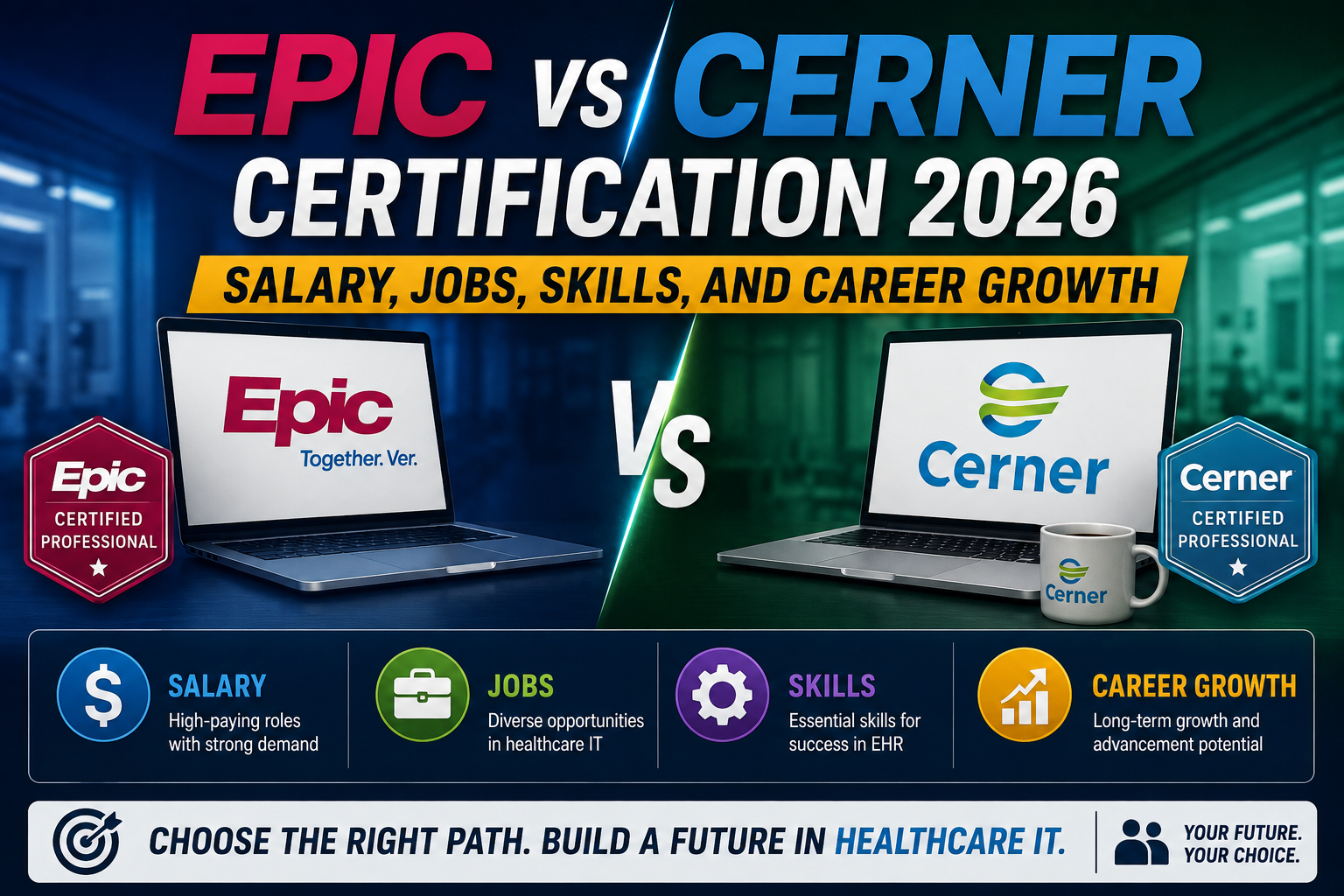
Epic vs Cerner—now increasingly branded as Oracle Health—are two major names in electronic health record technology. Both support careers in healthcare IT, clinical systems, application analysis, implementation, integration, reporting, and EHR optimization.
In 2026, the comparison is no longer simply “Epic certification vs Cerner certification.” Epic continues to operate a highly structured application-specific training and certification ecosystem, while Oracle now offers an expanding formal Oracle Health certification portfolio alongside product-specific Oracle Health Learning for platforms that historically carried the Cerner name. Oracle documentation now refers to Cerner Millennium as Oracle Health EHR, formerly Cerner Millennium.
For career growth, Epic can be especially attractive for professionals working at Epic customer organizations, while Oracle Health is a strong option for professionals supporting Millennium environments, implementation projects, healthcare integrations, and Oracle’s broader healthcare technology ecosystem.
Watch Cert Mage YouTube guide on Epic and Cerner careers.
Epic vs Cerner/Oracle Health at a Glance
| Factor | Epic | Cerner / Oracle Health |
| Current Brand | Epic | Oracle Health |
| Main Platform Area | Epic EHR ecosystem | Oracle Health EHR / Millennium |
| Credential Model | Application-specific Epic certifications | Oracle Health certifications plus product learning |
| Training Access | Often tied to Epic customers or approved access | Oracle Health Learning / Oracle certification ecosystem |
| Strong Career Areas | Application analysis, implementation, reporting, clinical systems | EHR analysis, implementation, integration, clinical systems |
| Typical Employer | Hospitals, health systems, consulting firms | Hospitals, health systems, Oracle partners, consulting firms |
| Best For | Specialists working in Epic environments | Professionals working in Oracle Health environments |
| Career Portability | Strong within Epic organizations | Strong within Oracle Health customer environments |
What Is Epic Certification?
Epic certification validates expertise in particular Epic applications or technical areas.
Instead of one universal “Epic certification,” professionals usually specialize in specific products or workflows.
Depending on their role, areas can include:
- Clinical applications
- Ambulatory workflows
- Inpatient systems
- Revenue cycle
- Reporting
- Data
- Integration
- Scheduling
- Patient access
- Pharmacy
- Laboratory systems
Epic’s training environment is relatively controlled. Epic’s UserWeb registration page states that someone who has never received an Epic certification and does not currently work with an Epic customer cannot obtain UserWeb access merely to prepare for a future Epic job. Epic instead reserves that access primarily for current customer employees, previously certified professionals, Epic staff, and other approved groups.
This is an important career consideration because earning an Epic credential is not usually as simple as purchasing an independent public exam.
How Do You Get Epic Certified?
For many professionals, the practical route begins with employment.
A common pathway is:
- Get hired by an organization using Epic.
- Move into an Epic-related analyst, implementation, clinical, or technical role.
- Obtain approved access to Epic training.
- Complete the required application training.
- Pass the applicable assessments and projects.
- Maintain the certification as required.
Epic also provides certification-maintenance access for professionals who have already begun or obtained certifications, including those temporarily not supporting an active customer.
That employer-connected model can make initial access more difficult, but it also means Epic training is usually closely tied to real healthcare implementations.
What Is Cerner Certification in 2026?
The term “Cerner certification” is becoming less precise because Cerner is now part of Oracle and its healthcare products are increasingly presented under Oracle Health.
Oracle’s current certification catalog includes a growing list of Oracle Health credentials, such as:
- Oracle Health Behavioral Health Implementation Consultant Professional
- Oracle Health Charge Services Implementation Consultant Professional
- Oracle Health Medication Process Implementation Consultant Professional
- Oracle Health Patient Accounting Implementation Consultant Professional
- Oracle Health Registration Implementation Consultant Professional
- Oracle Health Scheduling Implementation Consultant Professional
- Oracle Health Primary Implementation Consultant Foundations Associate
Oracle also continues to operate Oracle Health Learning, including learning portals associated with former Cerner environments.
This means professionals searching for “Cerner certification” in 2026 should increasingly look for the relevant Oracle Health certification, accreditation, or product training path.
Epic vs Oracle Health: Main Difference
The largest difference is the credential ecosystem.
Epic
Epic certification tends to be:
- Application-specific
- Closely tied to customer organizations
- Structured around real implementation responsibilities
- Valuable within hospitals and healthcare systems running Epic
Oracle Health
Oracle Health now provides:
- Formal Oracle Health professional certifications
- Product-consultant certifications
- Implementation-consultant certifications
- Foundation-level pathways
- Product-specific learning through Oracle Health Learning
Oracle’s public certification portfolio is therefore becoming easier to identify as part of the broader Oracle University ecosystem.
Skills Needed for an Epic Career
Epic professionals usually need a combination of technical knowledge and healthcare-process understanding.
Important skills can include:
- EHR workflows
- Clinical terminology
- Application configuration
- Requirements gathering
- Troubleshooting
- Testing
- Change management
- Reporting
- End-user training
- Project implementation
The specific technical depth varies by module.
For example, a clinical application analyst may focus heavily on workflows and configuration, while reporting or integration professionals may need stronger data, interface, or technical skills.
Epic itself hires across technical solutions, project management, clinical project management, training, and software roles, reflecting the breadth of skills involved in healthcare software work.
Skills Needed for an Oracle Health/Cerner Career
Oracle Health professionals need many of the same foundational healthcare IT skills.
Useful knowledge includes:
- Oracle Health Millennium
- Clinical workflows
- Healthcare data
- Application configuration
- Integration
- Implementation
- User support
- Troubleshooting
- Testing
- Security and access
- Reporting
Technical professionals may also benefit from experience with APIs, interoperability, HL7, and FHIR.
Oracle describes Millennium as its comprehensive EHR platform supporting clinical, operational, and financial transactions, while providing APIs for organizations extending and integrating the system.
Epic vs Cerner Salary in 2026
There is no official salary attached to either certification.
Compensation depends on:
- Role
- Module expertise
- Employer
- Experience
- Consulting status
- Location
- Clinical background
- Technical specialization
Current U.S. Glassdoor data lists median total pay for an Epic Analyst in healthcare at approximately $96,327, although actual reported salaries vary considerably by location and experience.
For Cerner Analysts, Glassdoor currently estimates U.S. median total pay around $115,000, with an estimated total-pay range of roughly $92,000–$145,000. However, that estimate is based on a much smaller pool of role-specific salary reports, so it should not be interpreted as proof that Oracle Health careers universally pay more than Epic careers.
Salary comparisons are more meaningful when comparing the same seniority, city, employer type, and technical specialty.
Jobs After Epic Certification
Epic-related credentials can support roles such as:
- Epic Application Analyst
- Epic Systems Analyst
- Epic Clinical Analyst
- Epic Reporting Analyst
- Epic Trainer
- Epic Implementation Consultant
- Epic Integration Analyst
- Epic Project Manager
- Epic Application Lead
Remote opportunities also exist. For example, a July 2026 U.S. Epic Analyst posting advertised a remote Level I position at $90,000–$100,000.
Experienced specialists may also move into consulting, architecture, management, or implementation leadership.
Jobs With Oracle Health/Cerner Skills
Oracle Health experience can support careers such as:
- Oracle Health Application Analyst
- Cerner Analyst
- Oracle Health Consultant
- Millennium Analyst
- Clinical Systems Analyst
- Integration Analyst
- EHR Support Analyst
- Implementation Consultant
- Healthcare Interface Analyst
- Oracle Health Project Consultant
Oracle’s current health certifications also create increasingly defined implementation and product-consulting pathways across areas such as scheduling, registration, pharmacy, medication processes, behavioral health, and patient accounting.
Which Is Better for Career Growth?
Epic may be the stronger option if:
- You already work for an Epic customer
- Your local healthcare systems primarily use Epic
- You can obtain employer-supported training
- You want to specialize deeply in a particular Epic application
- Your long-term goal is Epic consulting or application leadership
Oracle Health may be better if:
- Your employer operates Oracle Health Millennium
- You want a more visible Oracle certification roadmap
- You work in healthcare implementation or consulting
- You are interested in integration and healthcare interoperability
- You want skills that connect with Oracle’s broader technology ecosystem
The best choice is usually determined by the technology used by your target employers.
For a deeper comparison of the two healthcare IT paths, Cert Mage provides an Epic certification vs Cerner/Oracle Health certification comparison that can support career and certification research.
Epic vs Cerner for Beginners
Epic can be difficult to enter independently because official training access is often connected to an Epic customer or existing certification history.
For beginners targeting Epic, a practical strategy is:
- Learn healthcare IT fundamentals.
- Build EHR and workflow knowledge.
- Apply to Epic-using healthcare organizations.
- Move into analyst or support work.
- Obtain sponsored training.
For Oracle Health, review the current Oracle Health certification catalog and determine whether a foundations, implementation, or product-consultant credential matches your career goals.
Healthcare experience can also be valuable in either path, especially for clinical applications.
Which One Should You Choose in 2026?
Choose Epic if you have access to Epic training and your career is focused on hospitals or organizations using the Epic ecosystem.
Choose Oracle Health if your current or target organization uses Millennium or if you want to pursue one of Oracle’s expanding healthcare implementation and product certifications.
Do not choose based only on an estimated salary.
A professional with deep expertise in a high-demand Epic module can outperform someone with generic Oracle Health experience, and the reverse can also be true.
Your specialization, experience, and employer demand matter more than the platform name alone.
Conclusion
Epic and Oracle Health both offer strong healthcare IT career opportunities in 2026.
Epic’s strength lies in its specialized, application-oriented certification ecosystem and strong connection between training and healthcare customer environments. Oracle Health has expanded the former Cerner landscape into a more formal Oracle certification portfolio covering implementation, product consulting, and multiple healthcare workflows.
Neither platform automatically guarantees better salary or career growth.
Epic is often an excellent choice for professionals already connected to Epic customer organizations, while Oracle Health is attractive for professionals working with Millennium, healthcare implementation, interoperability, or Oracle’s wider healthcare ecosystem.
The best path is the one that matches the EHR technology used by the healthcare organizations where you want to work.
FAQs
Is Cerner certification still available in 2026?
Cerner is now part of Oracle, and professionals should increasingly look for Oracle Health certifications and Oracle Health Learning paths. Oracle currently lists multiple formal healthcare certifications.
Can anyone get Epic certified?
Not usually as an independent learner. Epic states that people who have never been certified and do not work with an Epic customer cannot obtain UserWeb access simply to prepare for a future job.
Which pays more, Epic or Cerner?
Both can lead to well-paid healthcare IT roles. Current salary estimates vary substantially, and differences in role, seniority, location, and data sample size make a simple platform-to-platform salary claim unreliable.
Is Epic certification good for remote jobs?
Yes, some Epic analyst, reporting, application, and consulting roles are offered remotely, although employer policies and access requirements vary.
Is Oracle Health the same as Cerner?
Oracle acquired Cerner, and current Oracle documentation refers to Cerner Millennium as Oracle Health EHR, formerly Cerner Millennium.























Leave a Reply