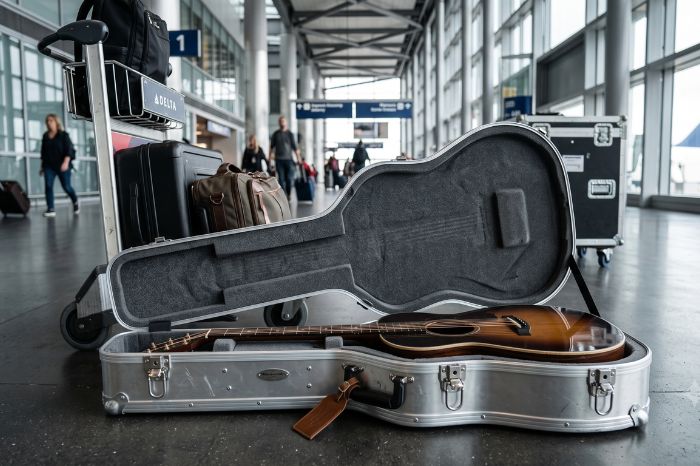
Every touring musician has a version of the same story: a guitar handed off at the gate, and a different guitar waiting at baggage claim. A cracked headstock, a warped neck, a bridge lifted clean off the top. Most of that damage is preventable, and almost none of it comes down to bad luck. It comes down to not knowing the actual rules, or trusting the wrong case to do a job it was never built for.
This guide covers what actually protects a guitar in transit, starting with a federal rule most musicians have never read in full.
The Carry-On Rule Every Touring Musician Should Know
Since 2012, US federal law has required airlines to let passengers carry a guitar or other small instrument into the cabin, free of charge. The requirement applies if it fits in an overhead bin or under a seat and there is space available at boarding. That rule, part of the FAA Modernization and Reform Act, was finalized into formal airline regulation in 2015. As of 2026, most major US carriers, Delta, United, American, Southwest, and JetBlue among them, accept a standard guitar case as a carry-on under this rule.
The catch is in the wording: space has to be available at the time you board. Airlines are not required to remove another passenger’s bag to make room for your instrument. Gate agents will not ask another passenger to give up their spot either. That single detail is why boarding order matters more for a guitarist than almost any other traveler.
- Board as early as your ticket allows. Priority or early boarding, even paid, functions as cheap insurance against a full overhead bin.
- If the bin fills before you board, most gate agents will offer to gate-check the instrument instead of sending it through standard checked baggage. Gate-checked items are handled separately and returned planeside, which is meaningfully lower-risk than the cargo hold.
- Policies vary slightly by airline and even by aircraft type, so confirm the specific carry-on instrument policy before every tour leg, not just once per year.
What Actually Damages a Guitar in Transit
Three things cause almost all touring damage, and only one of them is the dramatic kind that makes for a good story.
Impact is the obvious one: a dropped case, a bag thrown onto a conveyor, a bin door closing on a headstock. This is what most cases are designed to prevent, and a well-built case genuinely does prevent most of it.
Pressure and altitude changes are less obvious but real. Cargo holds are pressurized, so this matters less than musicians sometimes assume. Rapid pressure shifts during ascent and descent can still stress a fully sealed case if it has no way to equalize.
Humidity and temperature swings cause the most damage that never makes headlines because it happens slowly. A guitar top or back doesn’t need to be dropped to crack. It just needs to move fast between a humid backstage area and a dry, pressurized cargo hold, repeatedly, over a multi-city tour.
Hard Case vs. Flight Case vs. Gig Bag: What’s Actually Different
These three options are not interchangeable. Picking the wrong one for the type of travel you actually do is where a lot of touring damage starts.
- Gig bag: soft-sided, minimal padding. Fine for a car trunk between a home and a local gig. Not built for checked baggage, gate-checking, or repeated airline handling.
- Hardshell case: a wood shell with a plush interior. This is the industry standard for touring musicians and offers real protection against impact, temperature, and humidity swings, though not full waterproofing.
- Flight case: an injection-molded shell, the kind used by touring production companies for backline gear. Built for maximum protection in checked or gate-checked air travel, generally waterproof and impact-resistant in a way a wood hardshell case is not.
The honest rule of thumb: a hardshell case is the right call for a musician who occasionally flies and mostly drives between gigs. A flight case is the right call for a musician or crew flying regularly, checking gear as cargo, or handing instruments off to venue staff and cartage crews. Those crews were not trained to handle a $3,000 guitar gently, and a flight case does not depend on them being careful.
The Humidity Problem No Case Solves By Itself
This is the detail that catches even experienced touring musicians off guard. A hardshell or flight case slows down how fast humidity changes reach the guitar inside it. It does not maintain a target humidity on its own. If the air sealed inside the case is dry, the guitar inside it slowly dries out too, just more slowly than it would sitting in the open.
Wood guitars do best between 45 and 55 percent relative humidity. Outside that range, wood expands or contracts enough to affect structural integrity, tone, and playability over time. A case, even the best flight case on the market, is a barrier that slows the rate of change. It is not a climate control system.
The fix is inexpensive and often skipped: an in-case humidifier and a small hygrometer to actually monitor the level, rather than guessing. This pairing matters more than the case itself for long-term instrument health, for any acoustic guitar touring through dry climates or winter heating seasons. The case gets all the attention when musicians shop for gear, but the humidifier is doing the quieter, more important work.
Gate-Checking vs. Standard Checked Baggage: Know the Difference
When the overhead bin fills up, most gate agents offer to gate-check the instrument rather than send it through the standard baggage system. This distinction matters more than most flyers realize.
Gate-checked items stay separate from the general cargo hold sorting process. They typically go on and come off the aircraft directly at the jet bridge, without being run through the same conveyor and handling system as checked luggage. That means fewer transfers, fewer drops, and less time spent unattended in a busy cargo area. It is not zero-risk, but it is meaningfully lower-risk than checking a guitar the same way you’d check a suitcase.
If gate-checking is the only option, a hardshell or flight case is no longer optional; it is the minimum. A gig bag through the cargo hold, gate-checked or not, is not built for the handling it is about to receive.
A Pre-Flight Checklist for Touring Musicians
- Loosen the strings slightly before a flight to reduce tension stress on the neck during pressure and temperature changes.
- Pack the case snugly. A guitar that shifts inside its case during handling absorbs more shock than one held firmly in place by the interior padding.
- Confirm the specific carry-on instrument policy for your airline and route before the day of travel, since gate agents enforce it inconsistently even within the same airline.
- Board as early as your ticket allows, every time, regardless of how routine the flight feels.
- Carry an in-case humidifier and hygrometer on any multi-city tour that crosses climate zones, not just for flights but for the humidity swings between venues.
Insurance and Documentation, Before You Ever Get to the Airport
A case prevents damage. It does not cover the cost when damage happens anyway. Even a well-cased instrument can be damaged by rough handling nobody could reasonably prevent. Most touring musicians find this out the expensive way. An airline’s claims process typically covers only a fraction of what a vintage or custom instrument is actually worth.
Standalone instrument insurance, separate from a homeowner’s or renter’s policy, is inexpensive relative to the value of most touring rigs. It covers scenarios airline liability limits do not. Photograph the instrument, in and out of its case, before every tour leg that involves checked or gate-checked handling. That documentation is the difference between a fast claim and a drawn-out dispute over the guitar’s actual condition before it went into the cargo hold.
What to Do If Damage Happens Anyway
Even with every precaution taken, damage sometimes happens. What a musician does in the first hour afterward affects the outcome more than almost anything else.
- Inspect the instrument before leaving the airport, not after getting to the venue or hotel. Airline damage claims typically require reporting within 24 hours, and some require it before leaving the airport premises entirely.
- File a report with the airline immediately, even for damage that looks minor. Cosmetic damage can indicate a structural issue that gets worse with the next flight.
- Keep the case itself as evidence if it shows visible impact damage. A cracked case with an undamaged instrument, or vice versa, tells the claims adjuster something a verbal description cannot.
- Get a repair estimate from an independent luthier before accepting an airline’s first settlement offer. Initial offers are frequently below actual repair cost for anything beyond minor cosmetic damage.
International Touring Adds a Layer Most Musicians Forget
Everything above applies to domestic US flights under the FAA carry-on rule. That rule does not travel with you across a border. Airline instrument policies vary significantly outside the United States. Some carriers that are generous about carry-on instruments domestically apply stricter size and weight limits on international routes, especially budget carriers within Europe and Asia.
Two things matter most for international tours. First, check the specific airline’s instrument policy for each leg separately, not just the outbound flight. A tour with multiple carriers can mean multiple different rules in a single week. Second, carry the appropriate documentation if the instrument contains any material restricted under CITES, certain tropical hardwoods used in vintage guitar bodies and fretboards fall into this category. Customs delays over undocumented restricted materials have stranded touring gear at borders for days.
Quick Answers
Can airlines legally refuse to let me carry my guitar into the cabin?
No, not outright. Federal regulation requires airlines to allow a small instrument like a guitar as a carry-on. It has to fit safely in the overhead bin or under a seat, with space available at boarding. Airlines are not required to remove another passenger’s bag to create that space, though, which is exactly why boarding early matters so much.
Is a hardshell case enough for regular touring, or do I need a flight case?
For occasional flying combined with mostly driving between gigs, a hardshell case is usually sufficient. For musicians or crew checking gear regularly, handing instruments to venue staff, or flying multiple legs per tour, a flight case offers meaningfully more protection. That protection matters most against the repeated handling that wears down a standard hardshell case over time.
Does a hard case protect my guitar from humidity damage?
It slows the rate of humidity change reaching the instrument, but it does not maintain a target humidity level on its own. An in-case humidifier and hygrometer are still necessary for proper humidity control, especially for acoustic guitars touring through dry climates.