Artificial intelligence is no longer limited to research labs or large technology enterprises. Today, organizations across industries are exploring AI-driven solutions to improve decision-making, automate repetitive tasks, and gain deeper insights from business data. However, the effectiveness of any custom AI system depends largely on the quality, structure, and accessibility of the data it learns from.
As businesses continue investing in digital transformation, preparing company data has become one of the most important steps before implementing Custom AI-powered solutions. Whether an organization operates through enterprise software, customer portals, or app development initiatives, data readiness plays a critical role in ensuring successful AI adoption.
Why Data Preparation Matters in the AI Era
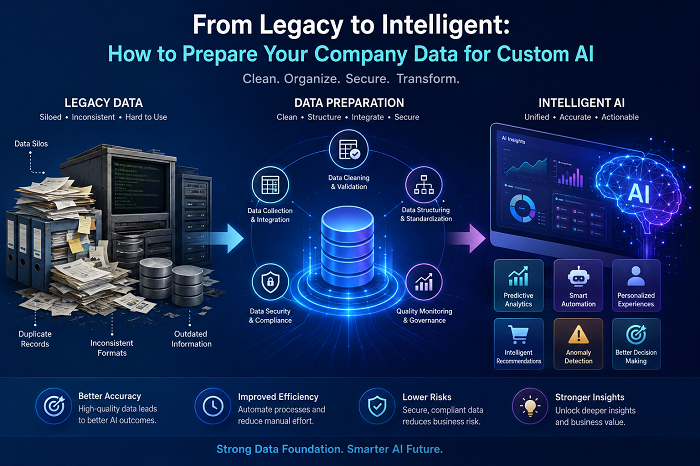
Many companies possess years of valuable business information stored across multiple systems. These legacy databases often contain customer records, operational data, financial transactions, product information, and communication histories. While this data represents a significant asset, it is frequently fragmented and inconsistent.
Custom AI models rely on clean, organized, and relevant datasets to generate accurate outcomes. Poor-quality data can lead to biased predictions, unreliable automation, and inefficient business processes. Before deploying AI technologies, organizations must establish a strong data foundation that supports intelligent analysis and learning.
Businesses working with a custom ai development company often discover that data preparation requires as much attention as model development itself. Without structured data, even advanced Custom AI algorithms may struggle to deliver meaningful results.
Understanding Legacy Data Challenges
Data Silos
One of the most common issues within established organizations is the existence of data silos. Different departments often use separate software systems that do not communicate effectively with one another. Sales teams, customer support departments, finance units, and operations groups may all store information independently.
As a result, businesses lack a unified view of their operations, making Custom AI implementation more difficult.
Inconsistent Data Formats
Legacy systems frequently store information in different formats. Customer names, addresses, product descriptions, and transaction records may follow varying standards across platforms. Custom AI systems require consistency to identify patterns and generate accurate insights.
Duplicate and Outdated Records
Years of business operations often produce duplicate entries and outdated information. These inaccuracies can negatively affect machine learning models and reduce prediction quality.
Conducting regular data audits helps organizations identify and remove redundant records before AI deployment.
Building a Data-First Mindset
Successful AI adoption begins with a data-first culture. Organizations should encourage departments to view data as a strategic business asset rather than simply a byproduct of daily operations.
This involves creating governance frameworks that define:
- Data ownership
- Quality standards
- Security policies
- Access permissions
- Compliance requirements
A well-defined governance strategy improves data reliability and supports long-term AI initiatives.
Data Collection Strategies for AI Readiness
Identify Valuable Data Sources
Not every dataset contributes equally to AI performance. Businesses should evaluate which information sources align with their objectives.
Examples include:
- Customer interaction data
- Product usage analytics
- Transaction histories
- Mobile application activity
- Website behavior metrics
- Support ticket records
Organizations involved in mobile and web app development often generate substantial user interaction data that can support future AI-driven personalization and automation efforts.
Centralize Information
Centralized data repositories simplify AI training and analysis. Modern cloud platforms allow businesses to combine information from multiple systems into a unified environment.
Centralization provides several benefits:
- Improved accessibility
- Enhanced collaboration
- Better reporting accuracy
- Simplified AI integration
Cleaning and Structuring Business Data
Remove Errors and Duplicates
Data cleansing is one of the most critical stages of AI preparation. Companies should identify:
- Missing values
- Duplicate records
- Invalid entries
- Formatting inconsistencies
Clean datasets help machine learning models recognize meaningful patterns without being influenced by irrelevant noise.
Standardize Data Formats
Consistency improves AI performance. Organizations should standardize dates, currencies, customer identifiers, product categories, and naming conventions across all systems.
Structured information enables algorithms to process large datasets more efficiently.
Label Data Appropriately
Many AI applications require labeled datasets for training. Labels help models understand relationships between different variables and improve prediction accuracy.
For example:
- Customer feedback can be categorized by sentiment.
- Support requests can be grouped by issue type.
- Product images can be tagged with relevant attributes.
The Role of Data Security and Compliance
As AI systems process increasing volumes of information, data privacy becomes a major concern. Organizations must ensure compliance with applicable regulations while preparing datasets for AI use.
Important considerations include:
Data Protection
Sensitive customer information should be encrypted and protected against unauthorized access.
Consent Management
Businesses should verify that collected data aligns with user consent agreements and privacy policies.
Regulatory Compliance
Depending on location and industry, organizations may need to comply with various data protection frameworks and regulations.
Establishing compliance procedures early reduces risks associated with future AI implementations.
Preparing Data for Machine Learning Applications
Once data is cleaned and organized, companies can begin preparing it for machine learning workflows.
Feature Selection
Feature selection involves identifying the variables most relevant to a specific business objective.
Examples include:
- Purchase frequency
- Customer lifetime value
- Product engagement rates
- Subscription renewal history
Selecting relevant features improves model efficiency and reduces computational complexity.
Data Segmentation
Segmenting data into meaningful categories enables AI systems to identify trends more effectively.
Businesses often segment information based on:
- Customer demographics
- Geographic locations
- Product categories
- Behavioral patterns
This approach supports more accurate predictions and personalized experiences.
Integrating AI into Modern Applications
As AI capabilities continue evolving, organizations increasingly integrate intelligent features into digital products and services.
Examples include:
- Predictive analytics dashboards
- Recommendation engines
- Intelligent search functionality
- Automated customer support
- Fraud detection systems
Companies exploring ai-powered business applications often focus on creating systems that leverage existing operational data to generate actionable insights.
The growing demand for intelligent software has also influenced modern software architecture, encouraging developers to build scalable systems capable of supporting advanced machine learning workloads.
Future-Proofing Your Data Strategy
Preparing data for AI should not be viewed as a one-time project. Data environments continuously evolve as businesses grow, launch new products, and expand into additional markets.
To maintain long-term AI readiness, organizations should:
- Perform regular data quality assessments
- Update governance policies
- Monitor data accuracy
- Improve integration processes
- Review security practices
- Adopt scalable storage solutions
Continuous improvement ensures that datasets remain valuable for future Custom AIinitiatives and emerging technologies.
Conclusion
The transition from legacy systems to intelligent Custom AI-driven operations begins with data preparation. While sophisticated algorithms often receive the most attention, the real foundation of successful Custom AIimplementation lies in clean, organized, secure, and accessible information.
Organizations that invest in data quality, governance, and integration create a stronger environment for machine learning and intelligent automation. As Custom AI continues reshaping app development and digital business strategies, companies with well-prepared data ecosystems will be better positioned to extract meaningful insights, improve operational efficiency, and support future innovation.
Building Custom AI readiness is ultimately a data journey. The more structured and reliable the data foundation becomes, the more effective and trustworthy Custom AI systems can be in delivering long-term business value.