



Dubai has built its reputation on making it simple to start a company, but “simple” does not mean “no decisions.” If you are planning to register a company in Dubai, the difference between a smooth launch and months of back-and-forth usually comes down to the choices you make before a single form is submitted. This guide walks through the full process: how to choose your structure, the documents you will need, what registration costs, how long it takes, and the steps that follow your licence. The aim is to give you a clear, realistic picture of company formation in Dubai in 2026, including the tax and compliance realities that older guides tend to skip.
Why entrepreneurs keep choosing Dubai
Foreign founders now own the vast majority of businesses here outright. Most mainland activities allow 100% foreign ownership, and free zones have offered full ownership for years. Add a strategic position between Europe, Africa and Asia, world-class infrastructure, and a government that has set out plans under the D33 agenda to double the size of the economy, and the appeal is obvious. What has shifted is the compliance side. Since 1 June 2023 the UAE has applied a federal corporate tax, and value-added tax has been in place since 2018. None of this makes Dubai a difficult place to do business. It simply means that setting up well, with the right structure, matters more than it used to. That mix of opportunity and order is why business setup in Dubai continues to attract founders from across the world. You can see the government’s own overview on the Invest in Dubai portal.
Start with three decisions, not paperwork

Before you look at application forms, settle three things. They shape everything that follows.
- Your business activity. The UAE licenses thousands of specific activities, and your choice determines the type of licence you need and which approvals apply. A consultancy, a trading firm and a restaurant each follow a different path.
- Your jurisdiction. Mainland, free zone or offshore. Each suits a different goal, and there is more on this below.
- Your ownership and structure. Sole establishment, limited liability company, branch, or a holding structure. Most founders choose an LLC for its flexibility; if your aim is to own and protect other businesses or assets, a holding company in Dubai may be the better fit.
Get these three right and the registration itself becomes largely administrative.
Mainland, free zone or offshore: matching the route to your goals

This single choice affects where you can trade, what you spend, and how you are taxed.
Mainland companies, licensed by the Dubai Department of Economy and Tourism (DET), can trade anywhere in the UAE and bid for government contracts. They suit businesses that want direct access to the local market or a physical retail or service presence. A mainland company setup generally requires a registered office.
Free zones, of which there are more than 40 across the UAE, offer 100% ownership, streamlined setup and sector focus. DMCC suits commodities and trade, DIFC is built for finance and professional services, and JAFZA is ideal for logistics and large-scale trade. The trade-off is that free zone companies face limits on selling directly into the mainland market.
Offshore structures, such as an offshore SPV, are not for operating a local business at all. They are used to hold assets, shares or intellectual property, and they cannot sponsor UAE residence visas. There is no universally best option, only the one that fits your customers, budget and growth plan.
The registration journey, step by step

While the details differ by jurisdiction, registering a business in Dubai follows a recognisable sequence.
- Confirm your activity and choose a legal structure. This anchors every later step.
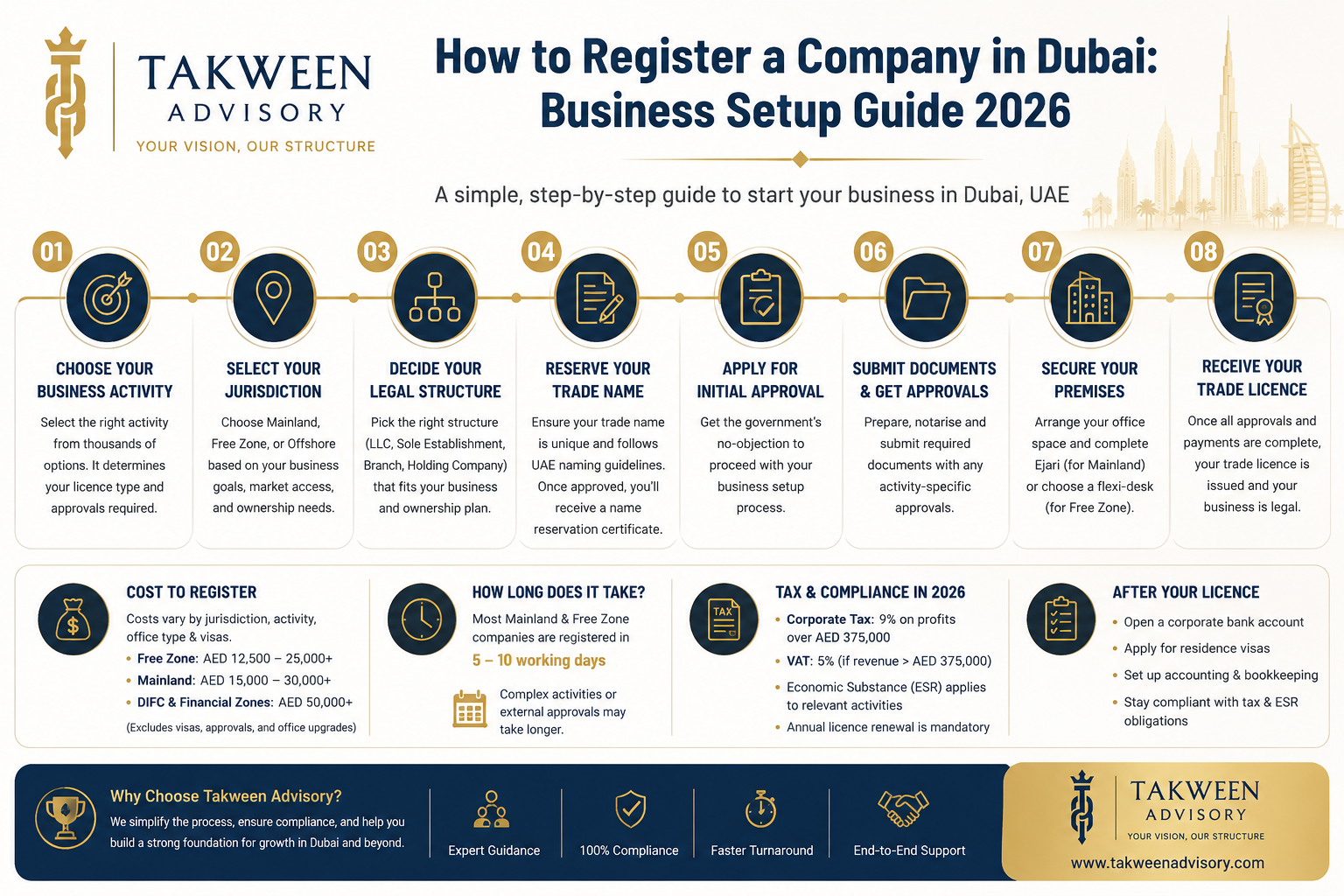
- Reserve your trade name. The name must be unique, follow the official naming rules and avoid restricted words. Once approved, you receive a name reservation certificate.
- Apply for initial approval. This is the government’s no-objection to you proceeding. It does not yet let you operate, but it unlocks the next stage.
- Prepare and notarise your documents. Depending on your structure, this includes the Memorandum of Association (or a local service agent agreement), passport copies, and any activity-specific approvals.
- Secure your premises. Mainland companies register their office tenancy through the Ejari system; many free zones offer flexi-desks or virtual offices that satisfy the requirement at a lower cost.
- Receive your trade licence. Once approvals and premises are in place, the authority issues your licence, and at that point your company legally exists.
For a deeper, mainland-specific walkthrough, see our guide on the mainland company formation process.
What does it actually cost to register a company in Dubai?
There is no single price, and any consultant who quotes one without asking questions should be treated with caution. The cost of company formation in Dubai depends on jurisdiction, activity, office type and how many visas you need. As a rough guide based on current market ranges, a straightforward free zone package often starts in the region of AED 12,500 to AED 25,000, while a mainland licence commonly falls between AED 15,000 and AED 30,000 once approvals and a basic office are included. Specialised financial free zones such as DIFC sit far higher, frequently from AED 50,000 upward, because of their regulatory framework. Visas, external approvals, document attestation and office upgrades all add to the base figure. Takween Advisory provides an itemised breakdown of government fees and service costs up front, so you are comparing like with like rather than reacting to a headline number.
How long will registration take?
Faster than most newcomers expect. When documents are in order, many mainland and free zone licences are issued within roughly five to ten working days. Some straightforward setups move quicker, while regulated activities, financial free zones or incomplete paperwork can stretch the timeline to several weeks. The single biggest cause of delay is rarely the government; it is missing or inconsistent documents, which is exactly why preparation matters.
What happens after your trade licence is issued
A licence is the start, not the finish. Several steps turn a registered company into an operating one.
- Establishment card and visas. This lets your company sponsor residence visas for owners and staff, followed by Emirates ID and medical checks.
- Corporate bank account. Opening an account usually requires the shareholders to attend in person and can take time, as banks apply their own due diligence.
- Tax registration. Almost every UAE company must register for corporate tax with the Federal Tax Authority through the EmaraTax portal, including free zone companies that expect a 0% rate. The federal corporate tax is 9% on taxable profits above AED 375,000 and 0% below that threshold, and it has applied to financial years beginning on or after 1 June 2023. Qualifying free zone companies can keep a 0% rate on qualifying income, but only if they meet the Qualifying Free Zone Person conditions, including genuine substance in the zone. Small Business Relief, available to businesses with revenue up to AED 3 million, can ease the burden for early-stage companies and is currently available for tax periods up to the end of 2026.
- VAT. If your taxable supplies exceed AED 375,000 a year, VAT registration at 5% is mandatory. The current rules are published by the Ministry of Finance.
Treating these as afterthoughts is where many new businesses run into trouble.
Mistakes that quietly delay your setup
A handful of recurring errors cost founders time and money.
- Choosing a jurisdiction on price alone, then discovering it limits the customers they can serve.
- Selecting the wrong business activity, which forces a costly amendment later.
- Underestimating substance and compliance, especially free zone companies that assume the 0% tax rate is automatic.
- Leaving banking to the last minute, when it is often the slowest part of the whole process.
- Forgetting that licences, establishment cards and visas all need timely renewal.
Avoiding these is less about insider knowledge and more about planning the sequence properly from day one.
Where Takween Advisory fits in
Most of the friction in company formation in Dubai comes from not knowing which step triggers which requirement. Takween Advisory works through the full journey with founders, covering activity selection, jurisdiction, licensing, documentation, banking, visas and ongoing compliance, so the process is predictable rather than improvised. If you want a clear, costed plan for your business setup in Dubai, that is the place to start.
Disclaimer: This article is for general information only and is not legal, tax or financial advice. Fees, thresholds and procedures change and vary by activity and jurisdiction. Confirm current requirements with the relevant authority, such as the Department of Economy and Tourism or the Federal Tax Authority, or with a qualified advisor before making decisions.
Frequently asked questions
Can a foreigner register a company in Dubai with 100% ownership?
Yes. Most mainland business activities now allow full foreign ownership, and free zone companies have always offered it. A small number of strategically sensitive activities may still require an Emirati partner or agent.
Do I need to be in Dubai to register my company?
Many steps, including licensing, can be handled remotely with a power of attorney. However, opening a corporate bank account and completing Emirates ID usually require the shareholders to be physically present.
How much does it cost to register a company in Dubai?
It depends on jurisdiction, activity, office and visas. Free zone packages often start around AED 12,500 to 25,000 and mainland licences commonly run AED 15,000 to 30,000, while financial free zones such as DIFC cost considerably more.
How long does company registration take?
With complete documents, many licences are issued within five to ten working days. Regulated activities or missing paperwork can extend this to a few weeks.
Is Dubai still tax-free for companies?
No. Since 1 June 2023 the UAE applies a 9% federal corporate tax on taxable profits above AED 375,000, with 0% below that. Qualifying free zone income can still be taxed at 0% under specific conditions, and there is no personal income tax.
Which is better, mainland or free zone?
Neither is universally better. Mainland suits businesses serving the local UAE market, while free zones suit full ownership, sector focus and cost efficiency, with some limits on direct mainland trade.
Conclusion
Registering a company in Dubai is rarely the hard part. The licence itself is mostly administrative once the groundwork is done. Successful business setup Dubai starts with making the right decisions from the beginning-choosing the correct business activity, selecting the jurisdiction that matches your customers, establishing a structure you won’t have to change later, and understanding the tax and compliance requirements that follow your licence. Prepare your documents carefully, follow the correct sequence, and your Dubai business setup journey becomes far smoother, allowing you to focus on growing your business instead of resolving avoidable delays.




















Leave a Reply