Preparing for JEE 2027 can quickly become confusing when you see long lists of books, coaching modules, online lectures, test series and study apps. The problem is not finding study material. There is too much of it.
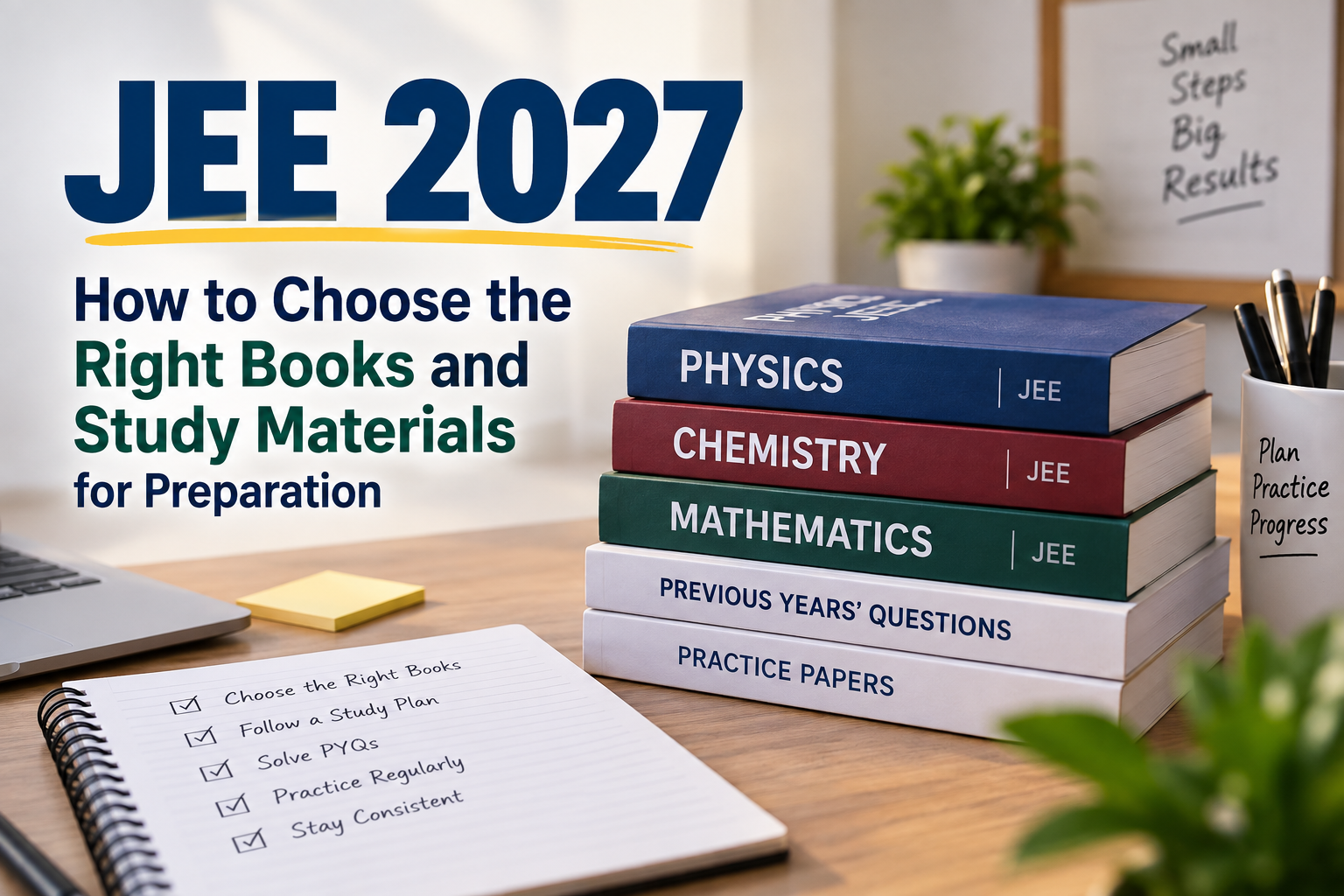
For JEE preparation, you usually need a small set of reliable resources used properly rather than collecting every book recommended online. Your starting point should be the NCERT textbooks, the official JEE syllabus and previous years’ JEE Main and JEE Advanced questions. After that, choose one good practice source for each subject and add higher-level material only when your basics are strong.
The right material should help you understand concepts, practise questions and identify your weak areas. It should not make your study schedule harder to manage.
Quick Answer
For JEE 2027, start with NCERT textbooks, your coaching or school study material, the official syllabus and previous years’ question papers. Once your concepts are clear, add selected books for Physics, Chemistry and Mathematics based on your current level.
You do not need ten books per subject. One good theory source, one reliable question source and regular mock tests are often more useful than a large pile of unfinished books.
Why Does Choosing the Right JEE Study Material Matter?
JEE preparation is a long process.
One common mistake students make is changing books whenever they struggle with a chapter.
For example, a student may study Chemical Bonding from one book, watch three different YouTube lectures and then solve questions from another source. After a few weeks, the student has spent a lot of time studying but still feels unsure about the topic.
The issue may not be a lack of resources.
It may be a lack of revision and practice.
Good study material should help you move through three stages:
- Understand the concept
- Practise questions
- Test yourself under time pressure
If a resource does not help with any of these, ask yourself whether you really need it.
What Should You Check Before Buying a JEE Book?
Before purchasing a book, check a few basic things.
1. Does It Match the Current Syllabus?
JEE syllabus and exam patterns can change.
Before buying older books, compare their contents with the current official syllabus and information released by the National Testing Agency for JEE Main and the relevant JEE Advanced authorities.
Don’t assume that an older edition automatically covers everything you need.
2. Is the Difficulty Level Right for You?
A book can be excellent and still be wrong for your current level.
If your basics are weak, jumping directly into very difficult problems can become frustrating.
Start with:
- Basic concept questions
- Standard JEE-level problems
- Mixed and application-based questions
- Higher-level problems after your foundation improves
The goal is progress, not proving that you can solve the hardest question on page one.
3. Does It Have Enough Practice?
JEE is not an exam where reading alone is enough.
You need to solve questions regularly.
Look for books with:
- Worked examples
- Topic-wise questions
- Different difficulty levels
- Previous year questions
- Answers or reliable solutions
Which Books Are Useful for JEE Physics?
Physics can feel difficult because it requires both conceptual understanding and problem-solving.
Start with your basic textbooks and class or coaching notes. Once your foundation is comfortable, you can add a recognised JEE Physics reference book.
Some commonly used resources include:
- NCERT Physics
- Concepts of Physics by H.C. Verma
- A trusted coaching module
- JEE Main and JEE Advanced previous year questions
H.C. Verma is widely used by JEE aspirants for developing problem-solving skills.
Don’t try to finish every Physics book you hear about.
If you have a good coaching module and are solving previous year questions properly, adding another five books may not improve your preparation.
Which Books Are Useful for JEE Chemistry?
Chemistry needs a slightly different approach because Physical, Organic and Inorganic Chemistry require different study methods.
Physical Chemistry
Focus on:
- Understanding formulas
- Learning the underlying concepts
- Solving numerical problems
- Practising calculations regularly
Organic Chemistry
Focus on:
- Understanding reaction concepts
- Learning important mechanisms
- Connecting related reactions
- Solving application-based questions
Inorganic Chemistry
NCERT is particularly important for many areas of Inorganic Chemistry.
Read the relevant sections carefully rather than relying only on short notes.
A useful approach is:
NCERT → Class or coaching notes → Practice questions → Previous year questions
This keeps your preparation manageable.
Which Books Are Useful for JEE Mathematics?
Mathematics requires regular problem-solving.
You cannot become comfortable with JEE Mathematics by simply reading solutions.
Start with:
- NCERT Mathematics for Foundation
- School or coaching material
- A recognised JEE Mathematics reference book
- Previous year’s questions
Popular reference books can be useful, but choose based on your level.
If you are still struggling with quadratic equations, spending hours on advanced calculus problems may not be the best use of your time.
Strengthen the basics first.
How Important Are Previous Year JEE Questions?
Very important.
Previous years’ questions show you how concepts are actually tested.
They can help you understand:
- Question patterns
- Frequently tested concepts
- Difficulty levels
- Time requirements
- Common traps
- Your weak chapters
Don’t just solve a question and check the answer.
Ask:
Why did I get it wrong?
Was it because:
- Didn’t you understand the concept?
- You forgot a formula?
- Did you make a calculation mistake?
- You misunderstood the question?
- You ran out of time?
Keep a small mistake notebook.
This sounds simple, but it can become one of the most useful parts of your preparation.
Should You Use Coaching Material for JEE 2027?
Yes, if the material is well-structured and matches your preparation.
Good coaching material can save you time because theory, examples, exercises and tests are usually arranged according to a study plan.
If you are attending JEE Classes in Nagpur, ask your teachers how they expect you to use the provided modules.
Don’t solve every additional book just because someone else is doing it.
Your preparation should be based on your own level.
Online Study Material: What Should You Use?
Online resources can be helpful when used carefully.
You can use them for:
- Revising difficult concepts
- Watching a lecture when you are stuck
- Taking online tests
- Solving practice questions
- Revising formulas
- Tracking preparation
The problem starts when online learning becomes endless video watching.
You watch one lecture.
Then another teacher explains the same chapter differently.
Then you find another “complete strategy” video.
Three hours later, you have consumed a lot of information but solved very few questions.
That is not productive preparation.
Use online resources to solve a specific problem.
How Many Books Do You Actually Need?
There is no fixed number.
For many students, a practical setup can look like this:
| Resource | Purpose |
| NCERT | Foundation and core reading |
| School or coaching notes | Concept learning |
| Coaching module or one reference book | Practice |
| Previous year’s questions | Exam-focused practice |
| Mock tests | Speed and accuracy |
| Error notebook | Track mistakes |
That’s enough to build a strong study system.
You can add more resources later if you have genuinely completed the material you already use.
Common Mistakes Students Make With JEE Books
Buying Books Based on Toppers’ Lists
A book that worked for one student may not suit your learning style or current level.
Switching Resources Too Often
Changing books every few weeks breaks continuity.
Give a useful resource enough time before deciding it isn’t working.
Collecting Instead of Solving
Having ten books does not mean you are well prepared.
A completed book with carefully reviewed mistakes is worth much more than a shelf full of untouched material.
Ignoring NCERT
This is particularly risky in Chemistry.
Don’t treat NCERT as something you read once and forget.
Skipping Previous Year Questions
JEE preparation should include real exam questions, not just questions from reference books.
How Can You Build a JEE 2027 Study Material Plan?
Try this simple approach.
Step 1: Download the Current Syllabus
Keep the official syllabus nearby while planning your preparation.
Step 2: Choose Your Main Theory Source
This could be your school textbook, coaching notes or a trusted reference source.
Don’t keep changing it.
Step 3: Select One Main Practice Source
Choose a coaching module or a suitable reference book.
Step 4: Add Previous Year Questions
Solve them chapter by chapter after completing the relevant concepts.
Step 5: Start Mock Tests
As your syllabus coverage improves, introduce timed tests.
Step 6: Review Your Mistakes
Don’t just count your marks.
Find out where those marks were lost.
How Should Students in Nagpur Choose JEE Classes?
If you are considering JEE Classes in Nagpur, don’t choose a centre only because it has a large number of students or impressive advertisements.
Visit the centre if possible.
Ask:
- Who teaches Physics, Chemistry and Mathematics?
- How are doubts handled?
- How often are tests conducted?
- Are previous years’ questions included?
- How much homework is given?
- Is there individual performance tracking?
- What happens if a student falls behind?
- Are classes focused on JEE Main, JEE Advanced or both?
Also ask current students about their experience.
That can tell you things a brochure won’t.
A Simple Weekly Study Material Routine
Your resources become useful only when they fit into your daily routine.
A simple weekly structure could be:
Monday to Friday
- Learn concepts
- Revise previous topics
- Solve the chapter questions
- Review mistakes
Saturday
- Solve mixed questions
- Revise formulas and important reactions
- Work on weak topics
Sunday
- Take a timed test
- Analyse mistakes
- Plan the following week
You don’t need a complicated timetable.
You need one you can actually follow.
Frequently Asked Questions
What are the best books for JEE 2027 preparation?
There is no single best book for every JEE student. Start with NCERT, school or coaching material and previous year questions. For extra practice, choose recognised subject-specific books based on your level. A smaller set of books that you complete and revise is usually more useful than collecting many resources.
Is NCERT enough for JEE 2027?
NCERT is an important foundation, especially for Chemistry, but it is generally not enough by itself for complete JEE preparation. JEE requires extensive problem-solving and exam practice. Combine NCERT with suitable coaching material, reference books where needed and previous-year JEE questions.
Should I solve JEE Main and JEE Advanced questions separately?
Yes. They serve different purposes. JEE Main questions help you build speed, accuracy and familiarity with its question style. JEE Advanced questions can require deeper application and more complex reasoning. Your practice should reflect the level of examination you are preparing for.
How many books should I solve for each JEE subject?
There is no fixed number. One reliable theory source, one main practice source and previous year questions can provide a strong base. Add another book only when you have a clear reason, such as needing more practice in a weak area or preparing for a higher difficulty level.
Are online lectures useful for JEE preparation?
Yes, when you use them to understand a specific concept or clear a doubt. Watching multiple lectures on the same topic without solving questions can waste study time. After watching a lecture, close the video and try solving problems yourself. That is where you find out whether you actually understood the topic.
How can I choose good JEE Classes in Nagpur?
Compare teachers, class size, doubt support, test frequency, study material and student feedback. Ask whether the programme covers JEE Main and JEE Advanced according to your goals. If possible, speak with current students and attend a trial class before making your decision.
Final Thoughts
Preparing for JEE 2027 does not require a huge collection of books.
It requires the right resources to be used consistently.
Start with your syllabus and basic textbooks. Pick a reliable source for learning and a focused source for practice. Solve previous years’ questions regularly. Take mock tests. Most importantly, review your mistakes.
If you are joining JEE Classes in Nagpur, let the coaching material support your preparation instead of adding more and more resources on top of it.
At some point, you have to stop collecting books and start solving them.
That is where real preparation begins.