

Key Takeaways
- Strong programs begin with a clear work or school need, not a list of popular topics.
- Practice, feedback, coaching, and real projects help leadership skills become daily habits.
- Culture, trust, fairness, and manager support shape whether learning lasts.
- Simple measures can track behavior, team results, confidence, and future readiness.
- A balanced mix of teaching, reflection, mentoring, and follow-up creates steady growth.
Introduction
Leadership is not limited to a job title. It appears when a person helps a group choose wisely, solve a problem, or reach a shared goal. Strong leadership improves trust, focus, learning, and results in many settings.
Well-designed Leadership development programs help people build those skills in a planned and practical way. They may include classes, coaching, mentoring, team projects, feedback, and reflection. However, a useful program does more than share ideas. It gives people safe chances to practice new actions and apply them to real work.
This guide explains how strong programs are designed, how they support organizational culture, and how results can be measured. It also explores the roles of a Leadership Strategist, a Leadership development consultant, an Organizational culture consultant, and several kinds of speakers and trainers.
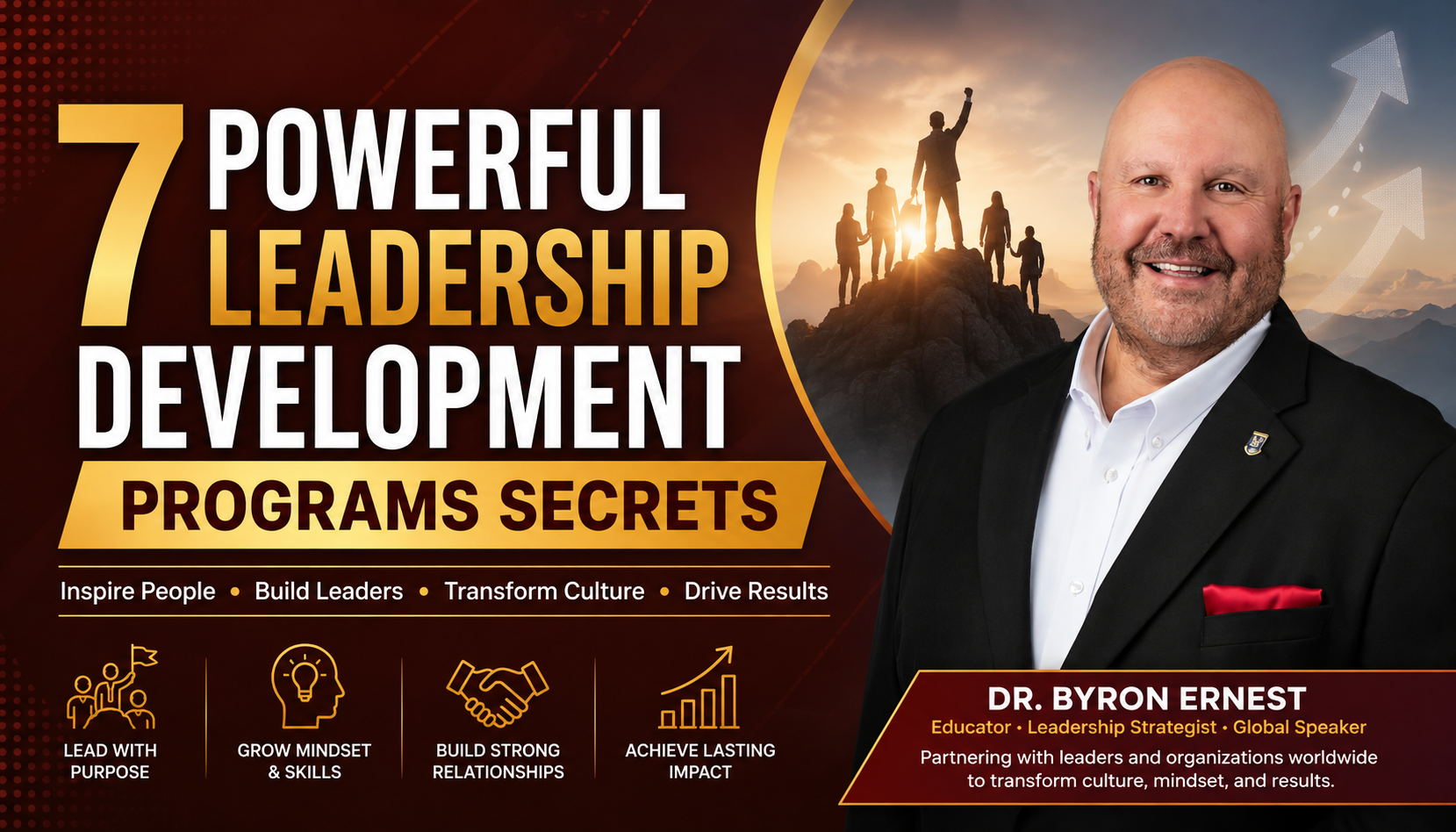
In addition, the guide covers leadership training for educators, common program mistakes, useful learning methods, and key questions that buyers often ask. People researching the Dr. Byron Ernest leadership course can use these points to judge whether any option supports practical, fair, and lasting growth.
Why Leadership Development Programs Matter
A leadership program is a planned path that helps people lead with greater skill and care. Some programs prepare first-time managers. Others support senior leaders, school principals, team leads, or employees who may guide others in the future. The best design depends on the group, the setting, and the results that matter most.
Leadership growth matters because people often receive a new role before they receive enough training. A skilled worker may become a manager because of strong technical work. However, the new role may require listening, coaching, planning, conflict management, and decision making. Those duties are different from the work that earned the promotion.
A clear program closes that gap. It helps a new leader understand what good leadership looks like in daily action. For example, a manager may learn how to set a clear goal, explain why it matters, check progress, and support a team member who is stuck.
Programs also create a shared language. When leaders use the same simple ideas for feedback, meetings, goals, and problem solving, teams face less confusion. Moreover, shared methods make it easier for one department to work with another.
A Leadership Strategist often connects leadership growth to wider goals. That expert may study future needs, business plans, talent risks, and culture gaps. People comparing Byron Ernest leadership training with other options should look for this clear link between learning and real goals. It prevents a program from becoming a loose set of interesting talks.
A Leadership development consultant may design and deliver the program through interviews, surveys, workshops, coaching, and measurement. A strong consultant studies the setting instead of copying one plan for every client.
An Organizational culture consultant looks closely at the habits and beliefs that guide behavior. Culture appears in what leaders praise, allow, question, or ignore. A course may teach honest feedback, for example, but the culture may punish people who speak openly. In that case, the course and the workplace send opposite messages.
This link between learning and culture is vital. People rarely keep using a skill when the local system blocks it. Therefore, leaders above the learners must support the new behavior. Policies, rewards, meeting rules, and manager actions should point in the same direction.
Leadership development also supports future planning. Organizations need people who can take on larger roles when others leave, retire, or move. This process is often called succession planning. A good program identifies possible future leaders and gives them fair chances to grow before a role becomes empty.
However, a program should not select people only because they are visible, confident, or similar to current leaders. Quiet employees, remote workers, educators, technical experts, and people from less represented groups may also have strong leadership ability. Fair selection uses clear standards and more than one source of information.
Strong programs support results and human needs. They help leaders give direction with respect, notice stress, invite useful ideas, and handle mistakes without blame. These actions build psychological safety, so people can ask questions and raise concerns.
The Core Parts of a Strong Program
The first part is a needs review. Program designers study what is happening now and what should happen later. They may examine strategy, employee surveys, customer comments, school goals, performance data, or interviews. The purpose is to find a real gap, not to prove that training is always the answer.
For example, slow decisions may appear to be a skill problem. A closer review may show that approval rules are unclear. Training alone would not fix that system. A sound review separates skill gaps from process, staffing, tool, or policy problems.
The second part is a clear skill model. This model lists the behaviors leaders need most. A plan may include leadership presence training for calm speech, careful listening, confident body language, and clear action in difficult moments. Each skill should be written as behavior people can see.
“Communicates well” is too broad. A clearer behavior states that a leader explains decisions, checks understanding, and invites questions. Observable language makes practice and feedback easier.
The third part is active learning. Adults learn leadership by doing, not only by listening. Workshops can introduce a tool, but role-play, case studies, group tasks, and real projects help the tool become useful. Reflection then helps learners study what worked, what felt hard, and what should change next time.
The fourth part is feedback. People often cannot see their own habits clearly. Feedback from a manager, peer, coach, or team member can reveal strengths and blind spots. Some programs use 360-degree feedback because it gathers views from several directions.
Feedback must be handled with care. Reports should be private, language should be respectful, and the purpose should be growth rather than shame. Moreover, learners need help choosing one or two actions instead of trying to fix everything at once.
Coaching and mentoring add personal support. Coaching uses questions, practice, and reflection to improve a chosen goal. Mentoring often shares advice and lessons from someone with more experience. A coach may help a manager prepare for a difficult talk, while a mentor may explain how leadership changes at a higher level.
Finally, strong programs include real work, manager support, and follow-up. Learners may improve a customer handoff, design a better staff meeting, or solve a school communication problem. Managers provide time and feedback, while peer circles, reminders, and later coaching keep the learning alive.
Together, these parts create a system linking purpose, teaching, practice, support, and proof. This link separates a pleasant course from a program that changes daily leadership.
Building a Program That Fits Real Needs
Program design should begin with a clear question. What result needs to improve, and what leader behavior could help create that result? This question keeps the work focused. It also gives decision makers a fair way to judge whether the program deserves time and money.
The design team may include human resources staff, senior leaders, learners, managers, and subject experts. Schools may also include teachers, principals, district staff, and family or student voices when appropriate. Different views reveal needs that one group may miss.
The team should define the audience carefully. First-time supervisors need different support from experienced executives. School leaders face different duties from sales leaders. A mixed group can still learn together, but the examples and practice must connect to each role.
Leadership training for educators deserves special care because education has a clear public purpose. Educators guide learning, support families, manage change, and protect student well-being. Their decisions may affect classrooms, staff trust, school safety, and access to learning.
A strong education program may cover instructional leadership, staff coaching, family communication, fair discipline, team planning, and change management. It may also help leaders use student information responsibly without reducing children to numbers.
An Education keynote speaker can open a program by giving a clear message and a shared sense of purpose. A keynote can help people see a challenge in a fresh way. However, a speech should connect to later practice. Without that connection, the message may fade after the event.
A Leadership development speaker can also support a larger learning path. The speaker may tell stories, explain a simple model, and invite reflection. The strongest speakers avoid acting as though one method solves every problem. They name limits, respect the audience’s experience, and connect ideas to real action.
Program length should match the goal. A short workshop may be enough for one narrow skill, such as running a better check-in meeting. Someone reviewing a Leadery Global leadership course should compare its length and learning methods with the size of the goal. Preparing future principals or senior managers may require several months of coaching, practice, and project work.
Delivery should match access needs. In-person sessions support practice and relationships, while online sessions reduce travel. A blended plan can combine both, with recordings for review and live discussion for complex skills.
The schedule should protect learning time. Adding a program to a full workload can create stress and weak attendance. Leaders should pause or reduce other work, showing that development is part of the job.
The content should reflect real moments. A school leader may need to respond to family concern, support a struggling teacher, or guide staff through a policy change. A business leader may need to set priorities after a budget cut or repair trust after a missed promise.
Inclusion belongs in the design from the start. Materials should use varied names, roles, family types, abilities, and work settings. Sessions should allow different ways to take part. Facilitators should watch who speaks, who gets interrupted, and whose ideas receive credit.
Trust is another design need. Learners may discuss mistakes, fears, or feedback. Clear privacy rules help people take part honestly. Program leaders should explain what information will be shared, with whom, and for what purpose.
A Practical Design Process
A useful design process can follow seven connected steps. A leadership communication course can fit within this process when clearer listening, feedback, meetings, or difficult conversations are part of the main need.
- Define the result
The team states the outcome in plain language. A school may want stronger teacher coaching. A company may want faster decisions across departments. - Study the current state
Interviews show stories and concerns. Surveys show patterns. Work data shows where results change. Direct observation may reveal habits that people forget to mention. - Choose key behaviors
Designers select a small group of actions that can influence the result. For faster decisions, leaders may name the decision owner, set a deadline, invite needed views, and explain the final choice. - Create the learning path
The path mixes short teaching, guided practice, real work, coaching, and reflection. Each part should prepare learners for the next part. - Prepare managers and facilitators
Managers learn how to support practice. Facilitators study the audience, examples, goals, access needs, and likely group challenges. - Run a pilot and improve it
A small group tests the plan and shares what helped or caused trouble. Designers improve timing, examples, activities, and support before a larger launch. - Measure and continue
The team checks learning, behavior, and results over time. It then decides what should continue, stop, or improve.
A simple example shows the process. A district notices that new teachers receive uneven support. Interviews reveal that some school leaders avoid classroom feedback because they fear conflict. The district chooses three behaviors: observe fairly, name clear evidence, and agree on one next step.
The district builds a program with demonstration videos, practice talks, peer review, and monthly coaching. Principals use the method during real teacher meetings. After a pilot, the district shortens one lesson and adds more practice with emotional responses.
Making Leadership Learning Last
Knowledge does not always become action. A person may understand a feedback model during class and still avoid a hard talk on Monday. Daily pressure, fear, old habits, and local culture can pull behavior back to the old pattern.
For that reason, transfer matters. Transfer means that learning moves from the program into real work. Strong transfer begins before the first session. Learners should know why they were selected, what they are expected to practice, and how managers will support them.
Goals should be small enough to use. “Become a better leader” is too wide. A stronger goal might be “ask two open questions before offering advice” or “end each project meeting with owners and dates.” Small actions are easier to remember and observe.
Practice should happen soon after learning. A long delay allows the idea to fade. A program might ask learners to use one skill within two days and record what happened. The record can be brief, but it creates attention and responsibility.
Peer groups can make practice less lonely. A person taking a Mere Leadership course may benefit from a small group that meets every two weeks to discuss progress, barriers, and next steps. Each member can share one action and one result, while peers offer ideas without taking control.
Managers play a major role in transfer. A manager can ask what skill is being practiced, provide a suitable task, observe one meeting, and give focused feedback. However, the manager should not turn every practice attempt into a high-stakes test.
Safe practice supports courage. Learners need room to make small mistakes and try again. When every error affects a rating, people may hide weakness instead of learning. A fair system separates development from punishment whenever possible.
Culture can either support or block transfer. An Organizational culture consultant may study whether daily rules match the program message. For example, a course may teach careful listening, while leaders reward only speed. The culture then teaches that listening is less important than finishing quickly.
Senior leaders should model the program openly. A senior leader might share a personal growth goal, ask for feedback, or admit a changed decision. Such actions show that learning is not only for junior staff.
Tools should be simple. A one-page meeting guide may support action better than a long manual. Checklists, question cards, planning sheets, short videos, and calendar reminders can give help at the moment of need.
Habits grow through cues, actions, and rewards. A calendar note can serve as a cue before a weekly check-in. The leader then asks a coaching question instead of giving an immediate answer. The team member offers a solution, which builds ownership and rewards the new habit.
Setbacks are normal. A leader may return to an old habit during stress. A good program treats the setback as information. The learner can study the trigger, plan a better response, and practice again.
Measuring Progress With Care
Measurement should answer useful questions. Did participants learn the skill? Did behavior change at work? Did teams notice a difference? Did an important result improve? Each question needs a different kind of evidence.
The first level is reaction. This includes whether learners found the program clear, useful, and relevant. Reaction matters because poor design can block learning. However, high satisfaction does not prove that behavior changed.
The second level is learning. A short quiz may check knowledge, while a role-play may show skill. For leadership, practice tasks often reveal more than memory questions alone.
The third level is behavior. Managers, peers, direct reports, or trained observers may notice whether new actions appear at work. Checks should focus on a few clear actions and allow enough time for practice.
The fourth level is results. A program may connect to stronger retention, faster decisions, safer work, better teacher support, improved customer service, or more ready future leaders. Results should match the original need.
Cause should be handled carefully. Many factors affect business and school outcomes. A rise in results may relate to staffing, market changes, policy, tools, or leadership growth. Trustworthy reports avoid claiming that the program caused every positive change.
Numbers and stories work well together. Numbers show size and pattern, while stories show how change happened. A review of Mere Leadership human centered leadership may examine both caring behavior and useful team results. For example, surveys may show clearer goals, while interviews explain the daily actions behind that change.
Measures should not create fear. If employees believe honest feedback will harm a leader’s job, they may stay silent. Anonymous surveys, private coaching reports, and clear data rules can support trust.
Useful measures may include attendance, practice quality, confidence, observed behaviors, team trust, project progress, promotion readiness, retention, and manager support. A simple scorecard can show the goal, starting point, current result, evidence, and next action.
Choosing Experts and Avoiding Mistakes
Outside experts can add skill, focus, and an independent view. However, the title of an expert does not prove quality. Buyers should study experience, methods, fit, ethics, and evidence.
A Leadership Strategist should connect development to future direction. A Leadership development consultant should explain needs, methods, practice, manager support, privacy, and measurement in simple terms. An Organizational culture consultant should study real habits, systems, stories, and rewards rather than slogans alone.
A Leadership development speaker or Education keynote speaker can create energy and shared focus. Buyers considering a Mere Leadership online course should also ask how lessons connect with real work, guided practice, feedback, and follow-up. A strong provider adapts examples and offers a clear next step.
Evidence should be specific and honest. Useful examples explain the starting need, the work completed, the measures used, and the limits of the result. Claims that promise total change for every leader deserve caution.
Several mistakes weaken programs. One mistake is choosing popular content before studying the need. Another is teaching too many skills at once. A third is using only lectures without practice or feedback.
A careful buyer can ask what problem the program will address, which behaviors should change, how people will practice, what managers will do, how privacy will be protected, and how progress will be measured.
The best program is not the loudest, newest, or most complex. It is the one that fits the need, respects people, supports practice, and shows honest evidence of progress.
FAQs
What are leadership development programs
Leadership development programs are planned learning journeys that help people guide teams, make decisions, communicate clearly, and handle change. They may serve new managers, experienced leaders, educators, future leaders, or whole leadership teams.
Common parts include workshops, coaching, mentoring, feedback, peer learning, and real work projects. The exact mix should match the group and the result the organization wants to improve.
A strong program focuses on visible behavior. It does not stop at broad ideas such as confidence or vision. It shows what leaders should do, gives them practice, and supports them when they return to work.
How long should a leadership program last
The right length depends on the goal. A narrow skill may improve through one short workshop with practice and follow-up. A larger goal, such as preparing future executives or principals, may require six months, one year, or longer.
Time alone does not create quality. A long program with weak practice may achieve less than a shorter program with clear goals, manager support, real projects, and useful coaching.
A good schedule gives learners time to apply one idea before learning the next. It also respects workload. Learning sessions, practice tasks, and review meetings should fit the real calendar of the organization.
What is the difference between a consultant and a speaker
A Leadership development speaker usually supports a focused event. The speaker may share a strong message, explain a model, tell useful stories, and create energy. An Education keynote speaker often performs this role for teachers, school leaders, or education groups.
A Leadership development consultant usually works across more stages. The consultant may study needs, design a program, train facilitators, support coaching, and measure results. Some professionals do both kinds of work, but the duties should still be clear.
A speaker can be valuable at the start or middle of a longer journey. However, a speech should connect to practice and follow-up when lasting behavior change is the goal.
How can organizations know whether a program works
Organizations should begin with a clear starting point and a small set of expected behaviors. They can gather evidence from practice tasks, manager observations, team surveys, interviews, project results, and work measures.
The review should look at reaction, learning, behavior, and wider results. It should also consider other factors that may have affected the outcome. Honest measurement avoids giving the program credit for every positive change.
Progress may appear in several ways. Leaders may hold clearer meetings, give better feedback, solve conflict earlier, or prepare more people for future roles. Teams may report stronger trust, focus, or support.
The most useful review ends with action. Leaders decide what to keep, improve, expand, or stop. In that way, measurement strengthens the next version of the program.
Conclusion
Leadership development is strongest when it is treated as a system rather than an event. The system begins with a real need, defines clear behaviors, and gives people repeated chances to practice. It also connects learning with managers, culture, tools, and daily work.
Leadership development programs can support new managers, senior leaders, educators, and future talent. However, the same design should not be used for every group. Each audience has different duties, pressures, and goals.
A Leadership Strategist can connect development with future direction. A Leadership development author can shape the learning path. An Organizational culture consultant can examine whether workplace habits support the message. Speakers can create focus and energy when their work leads into action.
Strong design remains simple at its core. People need to understand what good leadership looks like, try it in a safe setting, receive useful feedback, and apply it to a real challenge. They also need enough time and support for new actions to become habits.
Organizations should expect progress, not instant perfection. Leadership involves people and difficult choices, so growth may include setbacks, reflection, and another attempt.
Trust should guide every stage. Selection must be fair, feedback must protect dignity, personal information must stay private, and claims must match the evidence.
The work needs visible support from senior leaders and direct managers. When they model learning, protect practice time, and reward behavior, participants know development matters.
Practical action can begin with one focused question. Which leadership result matters most during the next year? The answer may involve stronger coaching, clearer decisions, better teamwork, safer communication, or future leader readiness.
The next step is a small needs review. Interviews, surveys, work data, and observation can reveal the gap between current behavior and needed behavior. Designers can then choose a few actions that leaders can practice and others can see.
A pilot offers a careful starting point. It allows the organization to test content, timing, access, coaching, and measures with a small group. Honest feedback can improve the design before wider use.
The final goal is not a certificate or a full training calendar. The goal is better leadership in moments that matter. A clearer conversation, a fairer decision, a stronger team, or a well-supported teacher can show that learning has reached real life.
When purpose, practice, culture, and evidence work together, leadership growth becomes more than a promise. It becomes a steady part of how an organization learns, serves people, and prepares for the future with lasting value.




















Leave a Reply