Key Takeaways
- Personal Memoir Books help readers understand real life through memory, emotion, struggle, and change.
- A strong memoir usually focuses on one main lesson instead of every event in a person’s life.
- Memoir writing works best when the author connects honest scenes with clear meaning.
- Stories about failure, fear, addiction, healing, and redemption can help readers feel less alone.
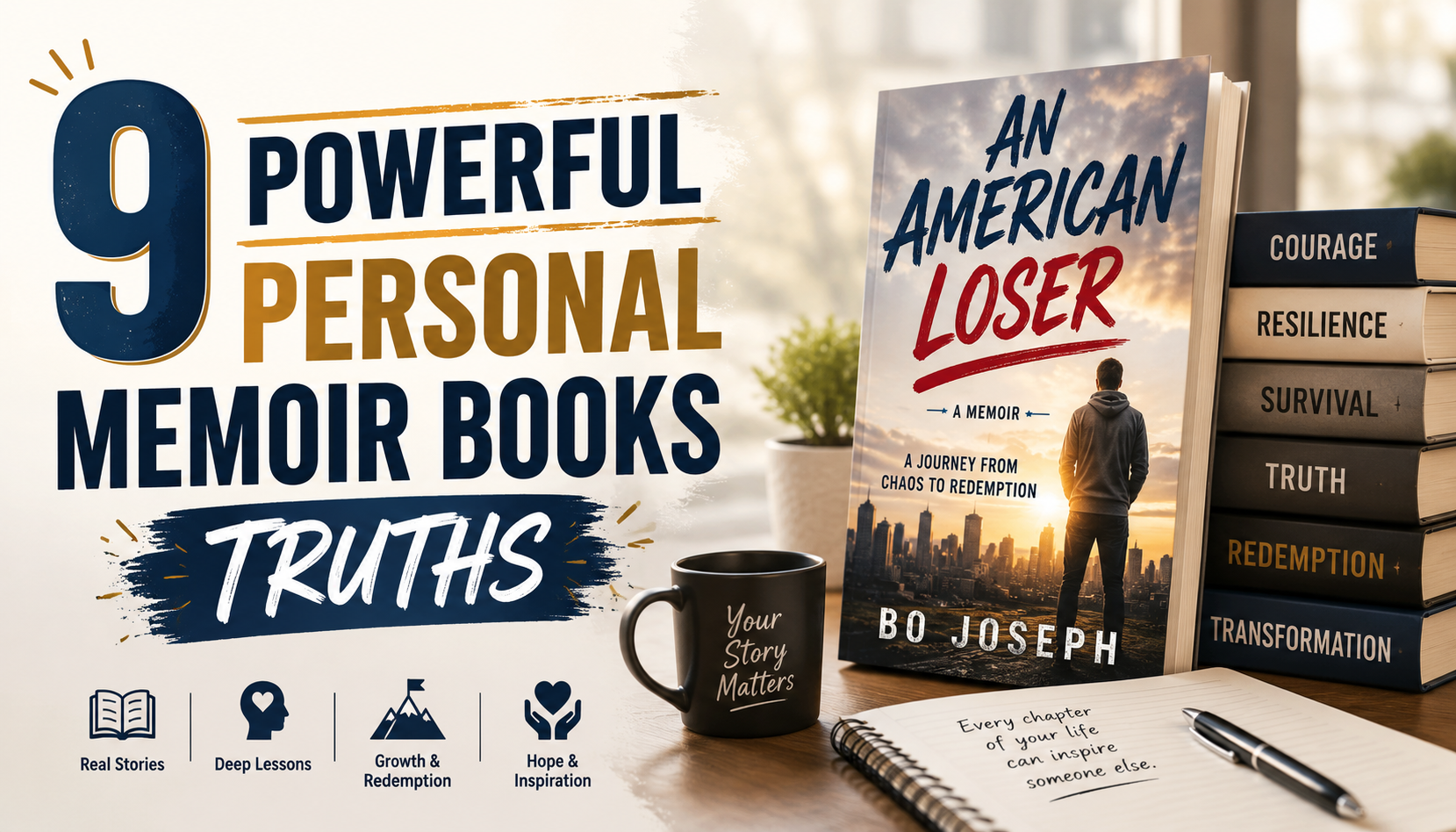
- Books such as An American Loser show how personal pain can become a message of hope.
- Readers can choose better memoirs by looking for honesty, strong themes, and emotional growth.
Introduction
Real life can become a powerful story.
It can show fear, pain, hope, failure, courage, and change in a way that fiction sometimes cannot.
That is why many readers search for Personal Memoir Books when they want truth with meaning.
These books do more than tell what happened.
They help readers understand why it mattered.
A memoir can show how one person faced hard moments and kept moving forward.
It can also help another person feel seen, understood, and less alone.
This guide explains what memoirs are, why they matter, how they are written, and how readers can choose meaningful memoirs.
It also explores memoir writing, memoir-vs-autobiography differences, Biography Memoir Books, Memoir Ghostwriters, and stories about failure and redemption.
What Personal Memoir Books Reveal
Personal Memoir Books reveal life from the inside.
They are not simple lists of dates, places, and events.
Instead, they show how a person remembers life, understands pain, learns from mistakes, and grows over time.
A memoir often begins with a question.
Why did a person change?
How did a person survive?
What lesson came from loss, fear, or failure?
These questions help shape the story.
They also help the reader understand the deeper purpose behind each chapter.
A personal memoir book usually focuses on one part of life.
It may explore childhood, family, addiction, grief, success, illness, faith, career, failure, or healing.
However, it does not need to explain every year from birth to old age.
That is one major reason memoirs feel focused.
They choose meaning over full history.
For example, a memoir author may write about growing up in a difficult home.
The book may include parents, school, money struggles, shame, or fear of disappointment.
However, the real point may not be childhood itself.
The real point may be how that child learned to survive, forgive, and build a different future.
This is what makes memoir writing so personal.
It is built around memory, but it is also built around meaning.
A memoir is not only about facts.
It is about emotional truth.
This does not mean facts are ignored.
A trustworthy memoir should still be honest.
Names, places, events, and timelines should be handled with care.
However, the power of a memoir comes from the way real events are shaped into a clear human message.
Readers often enjoy personal memoirs because they show real people facing real problems.
A person may read about addiction and recovery.
Another reader may connect with a story about divorce, failure, grief, or family pain.
Someone else may look for best memoirs about overcoming failure because disappointment feels heavy in their own life.
In each case, the reader is searching for more than information.
The reader is searching for connection.
A memoir can say that broken moments do not have to become the end of the story.
It can also show that healing is rarely quick or simple.
Growth can be slow.
Redemption can take time.
A strong memoir respects that process.
It does not make life look easy.
It shows the hard parts with honesty.
However, it also leaves room for courage, wisdom, and change.
This is why inspirational authors often use memoir as a way to share lessons from personal experience.
They do not only tell readers what to believe.
They show what happened, what hurt, what changed, and what became possible afterward.
A personal memoir book can also help readers understand people who live different lives.
A reader may never experience the same kind of loss, career path, addiction, or family crisis.
However, the emotions inside those events can still feel familiar.
Fear, shame, hope, love, regret, and courage are deeply human.
That shared emotional ground gives memoirs their lasting value.
Memoirs can also help writers understand their own lives.
When a memoir author looks back, patterns often become clearer.
Small memories can reveal larger truths.
Old mistakes can become lessons.
Painful seasons can become proof of strength.
This is one reason many people search for how to write a memoir.
They may not want fame.
They may simply want to understand their own story.
What Is Memoir Writing
What Is Memoir Writing is a common question because memoirs can seem close to other true-life books.
Memoir writing is the process of turning personal memories into a focused story with a clear message.
It is not just writing down everything that happened.
It is choosing the moments that support one central idea.
That idea may be survival.
It may be forgiveness.
It may be failure and redemption.
It may be the search for identity, faith, courage, or peace.
A memoir writer must first decide what the book is really about.
For example, a book may include addiction.
However, the deeper theme may be recovery.
A book may include business failure.
However, the deeper theme may be humility and second chances.
A book may include family conflict.
However, the deeper theme may be love, truth, and healing.
This focus helps the writer choose what belongs.
Not every memory needs to appear in the book.
Some memories may be important to the author but not important to the reader.
Strong memoir writing asks a simple question again and again.
Does this scene help explain the main change?
If the answer is yes, the scene may belong.
If the answer is no, the scene may need to be cut or shortened.
This is where Memoir Ghostwriters can help some authors.
A person may have a powerful life story but may not know how to organize it.
A ghostwriter can help shape memories into chapters, scenes, and emotional movement.
However, the truth and voice should still belong to the memoir author.
The ghostwriter’s role is not to replace the person.
The role is to help the person tell the story clearly.
A memoir needs a voice that feels real.
Voice means the way the story sounds on the page.
Some memoirs sound gentle and reflective.
Others sound bold, funny, raw, or direct.
The voice should match the author’s life and personality.
A polished book should still feel human.
Readers do not expect perfect people in memoirs.
In fact, many readers trust memoirs more when the author admits mistakes.
A memoir that only shows success can feel flat.
A memoir that shows struggle, wrong turns, and honest lessons often feels more powerful.
This is especially true in books about addiction, failure, shame, or grief.
Best Addiction Memoirs often stand out because they show the cost of the struggle.
They may include denial, loss, relapse, treatment, family damage, and the long work of recovery.
However, the strongest ones do not use pain for shock.
They use painful truth to build understanding.
They show how a person changed, one hard step at a time.
The same idea applies to best memoirs about overcoming failure.
A failure story becomes meaningful when it does more than describe defeat.
It must show what the author learned.
It must show how failure changed values, choices, relationships, or purpose.
That is why a failure and redemption author often focuses on the turning point.
The turning point is the moment when the person begins to see life differently.
Memoir writing also uses scenes.
A scene lets the reader feel present inside a moment.
Instead of saying a person was afraid, the writer may show the shaking hands, the silent room, the hard phone call, or the empty bank account.
Instead of saying a person felt ashamed, the writer may show a family dinner, a courtroom, a hospital bed, or a quiet walk home.
Scenes help readers feel the story.
However, reflection helps readers understand the story.
A memoir needs both.
A scene shows what happened.
Reflection explains what it meant.
Without scenes, a memoir can feel like a report.
Without reflection, a memoir can feel like random events.
Together, they create a clear and moving life story.
Memoir and Autobiography Differences
Many readers search for memoir-vs-autobiography because the two forms seem similar.
Both are based on real life.
Both usually use personal facts, memories, and major events.
However, they are not the same.
An autobiography often covers a full life.
It may begin with birth, family background, childhood, education, career, public achievements, and later years.
It usually follows time in order.
It can be useful when readers want a broad record of a person’s life.
A memoir is usually more focused.
It does not have to tell everything.
It may focus on one season, one relationship, one struggle, one career shift, or one personal lesson.
Because of this, memoirs often feel more emotional and reflective.
Biography Memoir Books can sometimes blend these forms.
A biography is usually written about another person.
A memoir is usually written by the person who lived the story.
However, some books combine life history with emotional memory.
These books may include facts about a person’s life while still focusing on personal meaning.
This can be helpful for readers who enjoy both real-life detail and emotional depth.
For example, a Bo Joseph biography may interest readers who want to understand the life behind An American Loser.
However, the An American Loser book may also interest readers who want a deeper story about struggle, failure, and redemption.
Those two reader needs are close, but they are not exactly the same.
One seeks life background.
The other seeks emotional meaning.
This difference matters for writers.
A memoir author should not feel forced to include every job, every move, every relationship, or every childhood memory.
The better question is what the reader needs in order to understand the transformation.
If a scene does not support the main theme, it may distract from the heart of the book.
Readers also benefit from knowing the difference.
A person looking for a full record of a famous life may prefer an autobiography or biography.
A person looking for emotional truth, healing, and personal lessons may prefer a memoir.
Neither form is better.
They simply serve different purposes.
A personal memoir book is often stronger when it accepts its own limits.
It does not try to be everything.
It chooses one strong message and follows it deeply.
That focus helps the story feel clear, honest, and memorable.
Why Personal Memoir Books Connect Deeply
Personal Memoir Books connect deeply because they speak to common human feelings.
Many people carry private fears.
Some fear failure.
Some fear judgment.
Some carry grief, regret, shame, or a fear of disappointment.
A memoir can bring those hidden feelings into the open.
When a reader sees another person name the same fear, the reader may feel less alone.
This is one of the strongest gifts of memoir.
It can turn private pain into shared understanding.
A memoir does not need a famous author to matter.
Some of the most moving memoirs come from ordinary lives.
A teacher, parent, veteran, artist, business owner, athlete, caregiver, or survivor may have a story worth telling.
The value is not only in fame.
The value is in truth, change, and the ability to help others see life with more care.
Readers often look for biography inspirational content because they want real stories that offer hope.
They may want proof that people can face dark seasons and still grow.
They may want guidance without being lectured.
Memoir can provide that because it teaches through story.
A lesson feels stronger when it is connected to real experience.
For example, advice about forgiveness may sound simple.
However, a memoir can show how forgiveness feels after betrayal, loss, or family pain.
Advice about courage may sound easy.
However, a memoir can show what courage looks like during illness, poverty, addiction, or public failure.
Advice about rebuilding life may sound neat.
However, a memoir can show how messy rebuilding can be.
That honest messiness makes the lesson more believable.
Readers can trust a story more when it does not pretend life is easy.
This is also why memoirs about failure can be so powerful.
Failure is common, but many people hide it.
A person may hide a lost job, a broken dream, a failed marriage, an addiction struggle, or a bad choice.
When a memoir author writes honestly about failure, the story can reduce shame.
It can show that failure is not the same as worthlessness.
It can also show that redemption is possible.
How to Find Redemption is not always a simple question.
Redemption may mean making amends.
It may mean changing behavior.
It may mean accepting responsibility.
It may mean rebuilding trust after harm.
It may mean finding peace after years of regret.
A memoir can show this process with real weight.
It can show that redemption often begins with honesty.
A person must first face the truth.
Then the person must take action.
Change becomes more believable when it is shown through choices, not only words.
Memoirs also connect because they help readers understand cause and effect.
A person’s current life is often shaped by earlier wounds, family patterns, choices, and beliefs.
Memoir writing can trace those connections.
It can show how a child’s fear became an adult’s habit.
It can show how a mistake led to a lesson.
It can show how one kind person changed the direction of a life.
This kind of storytelling gives readers insight into human behavior.
In addition, memoirs can create empathy.
A reader may judge a person from the outside.
However, a memoir allows that reader to see the inside.
The reader learns what the person felt, feared, misunderstood, or hoped for.
This does not excuse every action.
However, it can deepen understanding.
That is part of the trust-building power of memoir.
Failure Growth and Redemption
Failure and redemption sit at the heart of many memorable memoirs.
A story without struggle may feel pleasant, but it may not stay with the reader.
A story with honest struggle can become unforgettable.
This is because readers often measure meaning by change.
A person begins in one place and ends in another.
The journey between those two points creates the emotional force of the book.
A failure and redemption author usually writes from a place of hard-earned understanding.
The writer may have faced addiction, poverty, prison, broken relationships, public shame, business collapse, or deep personal regret.
However, the memoir does not stop at the lowest point.
It moves toward awareness, responsibility, and growth.
The word redemption can have many meanings.
For some writers, it may be spiritual.
For others, it may be emotional, moral, or personal.
It may mean becoming a better parent.
It may mean telling the truth after years of hiding.
It may mean choosing sobriety.
It may mean helping others avoid the same mistakes.
Whatever form it takes, redemption must feel earned.
Readers can sense when a memoir skips the hard work.
A strong memoir does not jump from pain to peace too quickly.
It shows the middle.
That middle may include confusion, setbacks, doubt, apology, discipline, and patience.
This makes the ending more meaningful.
An American Loser is an example of a personal story connected to failure and second chances.
Author Bo Joseph’s work can appeal to readers looking for the An American Loser book, Bo Joseph biography, or books about struggle and hope.
The title itself suggests a direct look at failure, identity, and the way a person may be judged by the world.
However, stories like this often matter because they push beyond labels.
A person may be called a loser by others.
A person may even believe that label for a time.
Yet a memoir can ask a deeper question.
Is a person defined by failure, or by what happens after failure?
That question gives memoirs strong emotional value.
Many readers are not looking for perfect heroes.
They are looking for honest people.
They want stories that show fear, bad choices, painful lessons, and the chance to begin again.
This is why best memoirs about overcoming failure remain popular.
They do not promise that every wound disappears.
They show that a life can still hold meaning after disappointment.
Memoirs about addiction often follow a similar pattern.
Best Addiction Memoirs may show the early signs of struggle, the damage caused by addiction, the moment of crisis, and the slow path toward recovery.
The strongest addiction memoirs do not turn recovery into a simple finish line.
They show that recovery is ongoing.
They also show the importance of support, honesty, treatment, faith, community, or personal responsibility.
These books can help readers who are struggling.
They can also help families understand what addiction may feel like from the inside.
A memoir about failure or addiction must be careful.
It should not make harm look exciting.
It should not blame everyone else.
It should not turn pain into entertainment.
A trustworthy memoir accepts complexity.
It shows the cost of choices.
It respects people affected by the story.
It also protects the emotional truth of the journey.
This balance builds EEAT.
Experience appears through lived detail.
Expertise appears through clear reflection.
Authoritativeness appears through honest insight.
Trustworthiness appears through care, fairness, and responsibility.
That is why memoirs can become more than personal stories.
They can become guides for readers facing their own private battles.
How Memoir Authors Shape Honest Stories
A memoir author shapes an honest story by choosing truth, focus, structure, and emotional clarity.
The process can feel difficult because life does not happen in neat chapters.
Memories can be messy.
Some details may be unclear.
Some events may still hurt.
Some people in the story may remember things differently.
This is why memoir writing requires care.
The writer must be honest without being careless.
The writer must be clear without making life seem simpler than it was.
The first step is choosing the main message.
A memoir should have a central theme.
The theme may be survival, forgiveness, courage, addiction recovery, family healing, or self-worth.
Once the theme is clear, the author can choose scenes that support it.
This helps the story stay focused.
The second step is choosing the timeline.
Some memoirs move from past to present.
Others begin with a major crisis and then move backward.
Some memoirs use short memories around one theme.
There is no single correct structure.
However, the reader should never feel lost.
A clear structure helps the reader follow the emotional journey.
The third step is creating scenes.
Scenes are the building blocks of memoir.
They include people, setting, action, dialogue, and feeling.
A scene might take place in a kitchen, hospital, school hallway, jail cell, office, church, car, or quiet bedroom.
The place matters because it helps the reader enter the memory.
A strong scene does not need to be dramatic.
Sometimes a small moment carries great meaning.
A father’s silence may reveal years of distance.
A child’s packed suitcase may reveal fear.
A rejected phone call may reveal shame.
A simple apology may reveal growth.
Memoir writing often depends on noticing these moments.
The fourth step is adding reflection.
Reflection is the older, wiser voice looking back.
It explains what the author understands now.
Without reflection, readers may know what happened but not why it mattered.
Reflection turns memory into meaning.
For example, a writer may describe failing at school.
That is a fact.
However, reflection may explain that the failure created a deep fear of disappointment.
That fear may have shaped later choices, relationships, and goals.
This deeper meaning gives the scene power.
The fifth step is handling other people with care.
Memoirs often include family members, friends, partners, teachers, coworkers, or strangers.
These people are part of the author’s life, but they are also real humans.
A responsible memoir does not turn them into flat villains or simple heroes.
It gives enough context to be fair.
This does not mean the author must hide harm.
It means the author should write with truth and maturity.
Some writers work with editors or Memoir Ghostwriters to manage these choices.
A skilled professional can help organize the book, improve pacing, and protect the author’s voice.
A ghostwriter may ask questions the author has not considered.
What is the turning point?
What is the wound under the event?
What does the author know now that was not known then?
These questions help deepen the book.
However, a memoir should still feel like the author’s truth.
The sixth step is revision.
A strong memoir rarely appears in one draft.
The writer may need to cut repeated scenes, clarify timelines, strengthen chapter endings, and remove details that do not serve the main message.
Revision is not a sign of weakness.
It is part of shaping a life story into a readable book.
Many writers also ask how long should a memoir be.
There is no perfect length for every story.
Many memoirs are often long enough to develop a complete emotional journey but focused enough to avoid extra detail.
A personal memoir book should be as long as the story needs, but not longer than the reader needs.
In simple terms, the book should include the scenes that create understanding.
It should not include every memory simply because it happened.
Practical Ways Readers and Writers Can Use Memoirs
Readers and writers can use memoirs in practical ways.
Readers can use memoirs to learn from real lives.
Writers can use memoirs to understand story structure, emotional honesty, and personal meaning.
Both groups benefit when a memoir is read with attention.
A reader looking for Best Personal Memoir Books should start with purpose.
Some readers want hope.
Some want recovery stories.
Some want family stories.
Some want books about public figures.
Some want biography inspirational content.
Some want stories about failure, addiction, faith, or grief.
Knowing the purpose helps the reader choose the right book.
A reader can also look at the theme.
A good memoir usually has a clear promise.
It may promise a story of survival.
It may promise a journey through addiction.
It may promise a search for identity.
It may promise a look at failure and redemption.
If the theme is clear, the book is more likely to feel satisfying.
Readers should also look for honesty.
A memoir that feels too perfect may not offer much depth.
A strong memoir often includes mistakes, confusion, regret, and growth.
This does not mean every book must be dark.
It means the book should feel real.
Readers can also notice the balance between scenes and lessons.
If a memoir only gives advice, it may feel like a self-help book.
If it only lists events, it may feel empty.
The best memoirs often combine both.
They show the life and explain the meaning.
Writers can use memoirs as models.
A person learning how to write a memoir can study how other authors open chapters, introduce family members, describe pain, and show change.
This kind of reading can improve writing skill.
However, a writer should not copy another author’s voice.
The goal is to learn craft, not imitate.
A memoir author should ask several practical questions before writing.
What part of life will the book cover?
What is the main lesson?
Who is the reader?
What should the reader feel by the end?
What should the reader understand that may not be obvious at the start?
These questions help turn a personal memory into a clear book plan.
Writers should also think about privacy.
A memoir may include painful events involving other people.
Some names may need to be changed.
Some identifying details may need to be handled carefully.
Legal or editorial advice may help when a story includes serious accusations, private medical details, or sensitive family matters.
Trust matters.
A reader gives attention and emotion to a memoir.
The author should respect that trust by writing with care.
This includes fact-checking where possible.
It also includes admitting uncertainty when memory is unclear.
Phrases like memory suggests or the author remembers can help when exact details are not fully known.
Memoirs can also support healing, but they should not be treated as a quick cure.
Writing about pain can be helpful, but it can also reopen wounds.
Some writers may need support from trusted friends, counselors, editors, or writing groups.
A memoir can become a book, but the person behind the book still matters most.
For readers, memoirs can become quiet companions.
A person facing shame may read a redemption story and feel hope.
A person facing addiction may read a recovery memoir and feel courage.
A person facing failure may read An American Loser and think differently about labels, setbacks, and second chances.
This is the practical value of memoir.
It helps life feel less isolated.
It gives language to hard experiences.
It shows that pain can become wisdom when handled with honesty.
FAQs
What makes a personal memoir book different from a normal life story
A personal memoir book is different because it focuses on meaning, not only events.
A normal life story may include many facts in order.
It may tell where a person was born, where the person studied, where the person worked, and what happened next.
A memoir is more selective.
It chooses the memories that support one main lesson or emotional journey.
For example, a memoir may focus on addiction recovery.
Another may focus on family pain.
Another may focus on business failure, grief, faith, or redemption.
The memoir does not need to include every part of life.
It only needs to include the parts that help readers understand the main change.
This is why memoirs often feel deeper than simple timelines.
They show what happened, but they also show what the author learned.
How can a reader find the Best Personal Memoir Books
A reader can find the Best Personal Memoir Books by looking at theme, honesty, and emotional growth.
The best choice depends on the reader’s need.
A reader seeking hope may choose inspirational authors.
A reader interested in recovery may search for Best Addiction Memoirs.
A reader facing setbacks may look for best memoirs about overcoming failure.
A reader interested in true-life storytelling may explore Biography Memoir Books or memoirs by people who have lived through major change.
Reviews, summaries, author interviews, and sample pages can also help.
A strong memoir should feel clear from the beginning.
It should show what kind of journey the reader will enter.
It should also respect the reader’s time by offering insight, not only events.
Why do memoirs about failure and redemption matter
Memoirs about failure and redemption matter because many people carry disappointment quietly.
Failure can make a person feel ashamed, rejected, or stuck.
A memoir can show that failure is painful, but it does not have to be final.
A failure and redemption author can help readers see how mistakes become lessons.
The story may show bad choices, loss, fear, or regret.
However, it can also show responsibility, change, apology, healing, and new purpose.
Books like An American Loser can connect with readers because they explore struggle and second chances.
They can help readers think about labels, identity, and hope.
This kind of memoir does not erase pain.
It shows how a person can keep moving after pain.
Can Memoir Ghostwriters help tell a true story
Memoir Ghostwriters can help a person turn memories into a clear and readable book.
Some people have powerful stories but do not know where to begin.
Others may know the events but struggle with structure, pacing, or voice.
A ghostwriter can interview the memoir author, organize life events, shape chapters, and improve the flow of the story.
However, the story should still belong to the person who lived it.
The best ghostwriting keeps the author’s voice, values, and truth at the center.
A ghostwriter should not make the story sound fake or overly polished.
The goal is to help the real story become clear, honest, and meaningful.
Conclusion
Personal Memoir Books matter because they turn real life into useful understanding.
They help readers see how people face fear, failure, addiction, grief, shame, love, hope, and change.
They also show that a life does not need to be perfect in order to be meaningful.
A strong memoir does not simply report events.
It reveals the emotional truth beneath those events.
It shows what the author lived through, what the author misunderstood, what the author learned, and how the author changed.
That journey gives the book its value.
Readers often come to memoirs with quiet questions.
Can failure be survived?
Can pain become wisdom?
Can a person change after bad choices?
Can redemption still be possible?
A powerful memoir may not answer these questions in a simple way.
However, it can show a real person wrestling with them.
That is often more helpful than easy advice.
Memoirs also help readers build empathy.
They allow one person to step inside another person’s experience.
A reader may not share the same background as the author.
However, the reader may still understand fear, loss, regret, hope, or the wish to begin again.
This shared emotion creates connection.
For writers, memoirs offer a path toward clarity.
A memoir author can look at life and find patterns that were not clear before.
The process may reveal how childhood shaped adulthood.
It may show how failure became a turning point.
It may show how a painful season led to strength.
Writing a memoir is not always easy, but it can give shape to memories that once felt scattered.
The best memoirs are honest, focused, and respectful.
They do not need to tell everything.
They need to tell the right things with care.
They need scenes that feel real, reflection that adds meaning, and a theme that guides the reader from beginning to end.
That is why questions like how to write a memoir, what is memoir writing, how long should a memoir be, and memoir-vs-autobiography matter.
They help writers understand the craft behind the truth.
They also help readers understand what kind of book they are choosing.
Personal Memoir Books can include many types of stories.
Some are about addiction.
Some are about family.
Some are about public success.
Some are about private pain.
Some are biography inspirational stories.
Some focus on failure and redemption.
Some, like An American Loser, explore what it means to struggle, fall, and search for another chance.
These stories remain valuable because they remind readers that every life carries lessons.
Some lessons come from joy.
Others come from loss.
Some come from mistakes that once felt unbearable.
A memoir gives those lessons a place to live.
For any reader searching for truth, hope, or human connection, a personal memoir book can be a strong choice.
It can offer comfort without pretending life is simple.
It can offer insight without sounding cold.
Most importantly, it can show that a person’s hardest chapter does not have to be the final one.