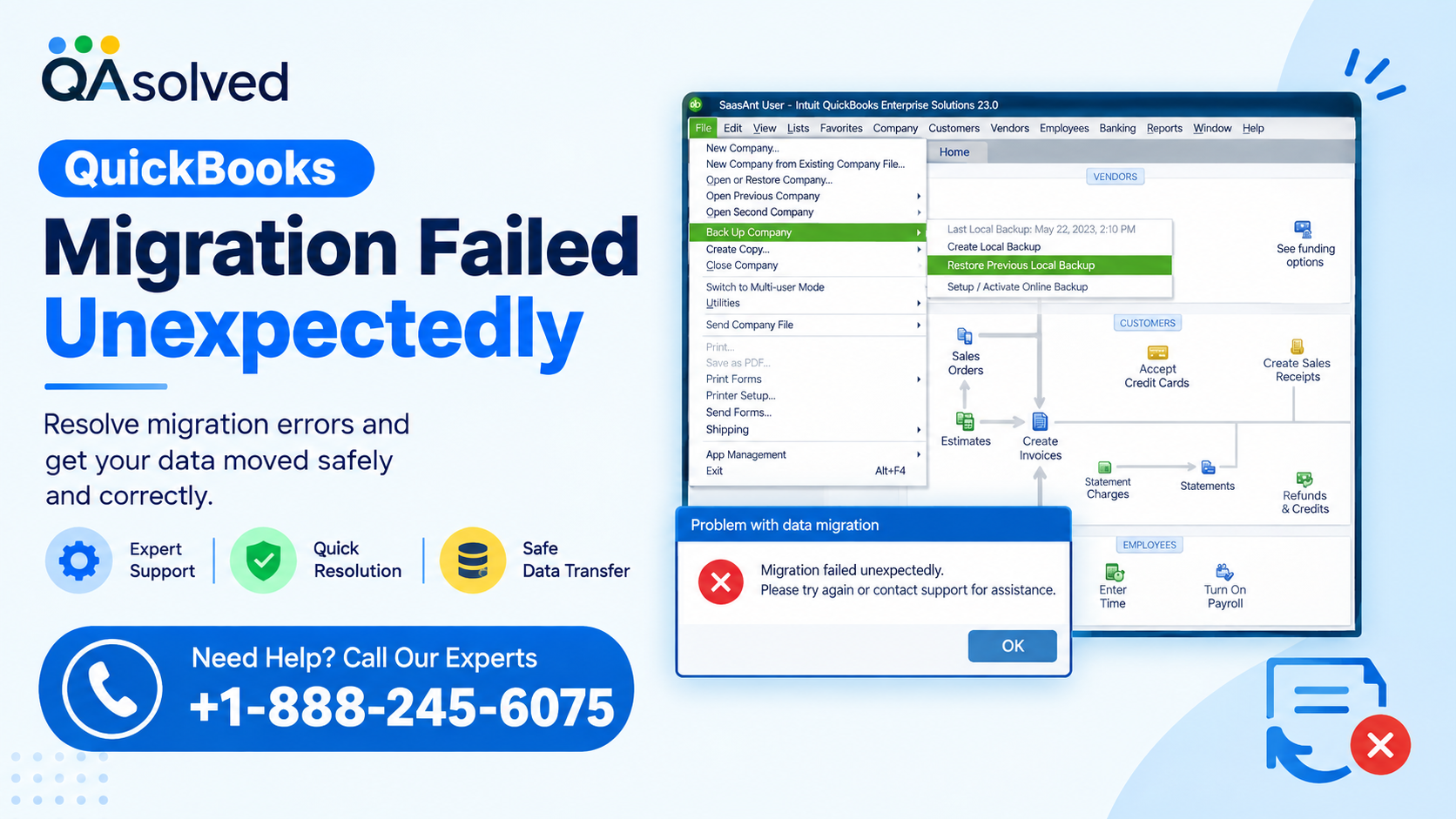
Moving QuickBooks to a new computer or transferring QuickBooks Desktop data to QuickBooks Online should make accounting easier, not create another problem. However, the QuickBooks Migration Failed Unexpectedly error can stop the transfer before the process finishes. A failed migration may interrupt access to company records, leave files partially transferred, and create unnecessary downtime.
QuickBooks users typically migrate their data when they purchase a new computer, upgrade their IT environment, or move from QuickBooks Desktop to QuickBooks Online. A successful migration can preserve important financial records, company files, lists, reports, templates, and supported settings.
The troubleshooting method depends on the type of migration. First, determine whether you are moving QuickBooks Desktop to another computer or converting QuickBooks Desktop to QuickBooks Online. The two processes use different tools and require different solutions.
Which QuickBooks Migration Failed?
The first step in resolving the QuickBooks Migration Failed Unexpectedly error is to identify where the migration stopped. QuickBooks migration can involve moving QuickBooks Desktop to a new computer or transferring QuickBooks Desktop data to QuickBooks Online. Since each process uses different tools and requirements, choosing the correct migration type will help you follow the right troubleshooting steps.
QuickBooks Desktop to a New Computer
Choose this troubleshooting path when you are moving QuickBooks Desktop, the company file, and related information to another Windows computer. You may use the QuickBooks Migration Tool, a migration USB drive, or the Move_QuickBooks.bat file during the transfer.
QuickBooks Desktop to QuickBooks Online
Use this path when you are converting a QuickBooks Desktop company file to QuickBooks Online. Problems can occur because of unsupported information, company-file complexity, data-format issues, authentication problems, or migration limitations.
Common Causes of QuickBooks Migration Failure
Several system and data problems can trigger the QuickBooks Migration Failed Unexpectedly message. Common causes include:
- An outdated QuickBooks Desktop version
- An unsupported or outdated Windows version
- A mismatch between 32-bit and 64-bit system architecture
- A damaged QuickBooks company file
- Missing Windows components or corrupted system files
- Insufficient RAM or free storage
- Antivirus or firewall interference
- Lack of Windows administrator permissions
- An unstable internet connection during QuickBooks Online migration
- Unsupported data formats or features
Before troubleshooting, check both the source and destination computers. The supplied migration guide recommends compatible 64-bit Windows environments, adequate storage and memory, administrator access, a stable internet connection, and security settings that allow QuickBooks processes to run.
Check QuickBooks Migration System Requirements
Before starting another migration attempt, make sure both computers meet the required environment.
Windows 10 and Windows 11 64-bit systems, along with supported Windows Server versions, are identified in the source as suitable environments. Both computers should use compatible system architecture. The guide also recommends at least 8 GB of RAM for single-user systems and additional memory for larger multi-user environments.
You should also have enough free storage for the QuickBooks installation and company data. If you are using a USB drive for migration, the supplied guide recommends an NTFS-formatted drive with enough available space.
Also confirm that the same QuickBooks Desktop year and edition are installed on the destination computer before beginning a Desktop-to-Desktop migration.
Fix QuickBooks Migration Failed Unexpectedly on a New Computer
When QuickBooks migration fails while moving the software and company data to a new computer, start with the basic checks before trying advanced solutions. Close QuickBooks, verify that both computers meet the required system specifications, and make sure you have administrator access. Then follow the methods below to repair the migration process and transfer your QuickBooks data successfully.
- Close QuickBooks and End Background Processes
Background QuickBooks processes can interfere with migration files.
- Close QuickBooks Desktop on both computers.
- Press Ctrl + Shift + Esc to open Task Manager.
- End QuickBooks-related processes that are still running.
- Restart the computer.
- Sign in with an administrator account on the new computer.
This gives the Migration Tool a cleaner environment for the transfer.
- Run the QuickBooks Migrator Tool
Install the appropriate QuickBooks Tool Hub on the new computer and open the Installation Issues section. Select the QuickBooks Migrator Tool and follow the on-screen instructions.
When prompted, enter the encryption password created during the migration process.
If the tool closes unexpectedly, check the system architecture. The supplied guide specifically warns about attempting to move supported 64-bit QuickBooks versions to an older 32-bit Windows environment.
- Run Move_QuickBooks.bat as Administrator
If the automated migration does not start correctly, manually run the migration script from the USB drive.
Insert the USB drive into the new computer and locate Move_QuickBooks.bat. If the file extension is hidden, enable File name extensions in Windows File Explorer.
Right-click the file and select Run as administrator. Enter your encryption password in the Command Prompt window.
If you see Access is Denied, administrator privileges may be missing. An Invalid Password message can indicate an incorrect encryption password, while Program too big to fit can point to an architecture mismatch.
- Restore QuickBooks Using a Local Backup
A local .qbb backup provides another way to move your company data.
On the old computer, open QuickBooks and create a Local Backup. Save the backup file to the USB drive.
On the new computer, install QuickBooks and select:
File > Open or Restore Company > Restore a backup copy
Choose the .qbb file and restore it to the desired folder. After restoration, press F2 to review your QuickBooks product and license information.
Recover QuickBooks Data From a Backup
Creating a verified backup before migration is one of the most important precautions you can take. To create one, switch QuickBooks to Single-user Mode, then go to:
File > Back Up Company > Create Local Backup
Select the local backup option, choose a storage location, configure your preferences, and save the backup.
If migration fails, restore the backup through:
File > Open or Restore Company > Restore a backup copy > Local Backup
Choose the .qbb file and restore it to a separate folder to avoid overwriting existing data.
Move QuickBooks Settings and Data Files
Some settings and templates may require separate handling. The supplied guide identifies items such as printer settings, QuickBooks letters, the Financial Statement Designer, Cash Flow Projector, and QuickBooks templates.
You can locate supported files on the old computer, copy them, and place them in the appropriate folder on the new system. This can help preserve saved settings and templates that do not automatically transfer through the migration process.
You can also locate the company file by pressing F2 in QuickBooks and checking the File Information section. Close QuickBooks, locate the company file folder, and copy it to the new location when appropriate.
Update QuickBooks and Windows
Outdated software can create compatibility problems during migration.
To update QuickBooks Desktop:
- Open QuickBooks.
- Select Help.
- Choose Update QuickBooks Desktop.
- Open the Update Now tab.
- Select Get Updates.
You should also check Windows Update and install available operating-system updates. Restart the computer after installing updates and try the migration again.
If the problem began immediately after a major Windows update, the supplied guide also describes using Settings > System > Recovery > Go back, when that option is available. Create a backup before attempting a Windows rollback.
Repair QuickBooks Installation With Clean Install Tool
If damaged installation files are preventing migration, use the QuickBooks Clean Install Tool through QuickBooks Tool Hub.
Open Tool Hub, select Installation Issues, and choose Clean Install Tool. Select your QuickBooks version and allow the tool to remove the installation files. Restart the computer and reinstall QuickBooks using your license information.
Create a company-file backup before using this method. The Clean Install Tool addresses program installation files; it does not replace or repair damaged company data.
Fix QuickBooks Desktop to QuickBooks Online Migration Failed
QuickBooks Online migration can fail for different reasons than a computer-to-computer transfer. Common causes include a large or complex company file, multi-user mode, files stored on network or cloud locations, outdated QuickBooks software, damaged data, unsupported features, security software, and insufficient permissions.
Before retrying, open QuickBooks Desktop as the primary administrator and update the software. Create a backup, review company-file information with Ctrl + 1, and confirm that you have administrator access to the correct QuickBooks Online company.
If the company file is stored on a network or cloud location, move it to a local drive before starting the conversion. After migration, review accounts, customers, vendors, transactions, inventory, and reports to confirm that the data transferred correctly.
Repair QuickBooks Online Migration Data Errors
If QuickBooks Online rejects the company file because of data-format or integrity problems, start by switching QuickBooks Desktop to Single-user Mode.
Run:
File > Utilities > Verify Data
If QuickBooks identifies data problems, run:
File > Utilities > Rebuild Data
After rebuilding, run Verify Data again. The supplied guide also recommends moving the company file to a local C: drive, updating QuickBooks, reviewing unsupported integrations and customizations, checking payroll and multi-currency settings, and cleaning imported spreadsheet data before another migration attempt.
Prepare a Large QuickBooks Company File for Migration
Large or complex company files can require additional preparation. Review the company file size and data complexity by pressing Ctrl + 1.
Remove unnecessary records, unused lists, and attachments where appropriate. If supported by your QuickBooks version, consider condensing older transactions. Disconnect unused third-party applications and move the company file to a local drive.
Run Verify Data, create a fresh backup, and then retry the QuickBooks Online migration.
Fix Migration Failed While Checking Destination Credentials
Credential errors usually require you to verify the QuickBooks Online account and destination company.
Make sure you:
- Sign in with the correct Intuit account.
- Use a QuickBooks Online Company Administrator account.
- Confirm that the subscription is active.
- Verify access to the selected destination company.
- Sign out and sign back in to refresh authentication.
- Clear browser cache and cookies if necessary.
- Update QuickBooks Desktop and your browser.
- Maintain a stable internet connection.
Then retry the migration.
QuickBooks Migration Best Practices
Prevent future migration problems by following a few basic precautions:
- Create and verify a backup before migration.
- Update QuickBooks Desktop and QuickBooks Tool Hub.
- Check Windows compatibility on both computers.
- Confirm compatible 64-bit architecture.
- Use an NTFS-formatted migration USB drive when following the USB method.
- Keep the company file on a local drive during migration.
- Use administrator access.
- Close QuickBooks and background processes.
- Do not remove the USB drive before the transfer finishes.
- Reconnect payroll, banking, and other services after migration when required.
- Verify company data after the transfer.
These steps can reduce the risk of incomplete transfers and make it easier to recover if the migration does not finish successfully.
Complete QuickBooks Post-Migration Checklist
After migration, do not assume everything transferred correctly. Open the migrated company file and review your records.
Check your license and product information, payroll subscription, tax tables, bank feeds, customer and vendor records, inventory, accounts, reports, printer settings, templates, and other important preferences.
If you use multiple users, configure Multi-User Mode again when necessary. Sign in to Intuit Data Protect and confirm that scheduled backups are working. Finally, create a new local and cloud backup of the migrated company file.
If information is missing, restore the verified backup and review the migration logs before attempting another transfer.
When Should You Get Professional QuickBooks Migration Help?
The QuickBooks Migration Failed Unexpectedly error can result from system incompatibility, permissions, damaged company data, unsupported features, installation problems, or migration-specific limitations. If standard troubleshooting does not resolve the issue, professional QuickBooks migration assistance can help identify the underlying problem.
A migration specialist can assist with damaged company files, inaccessible data, QuickBooks Desktop transfers, and QuickBooks Desktop-to-QuickBooks Online conversions while helping protect important financial information.
Final Thoughts
A failed QuickBooks migration does not necessarily mean your company data is lost. Start by identifying the migration type, checking system compatibility, updating QuickBooks, verifying the company file, and creating a reliable backup. For Desktop-to-Desktop transfers, review the Migration Tool, USB method, administrator permissions, and system architecture. For QuickBooks Online conversions, focus on company-file integrity, supported data, account credentials, file complexity, and migration requirements.
Taking time to prepare the source and destination environments can make the migration smoother and reduce the risk of unexpected interruptions.
Frequently Asked Questions
1. Why does QuickBooks Migration Failed Unexpectedly appear on a new computer?
The error can occur because of outdated QuickBooks software, incompatible Windows settings, insufficient permissions, damaged company data, security software, or problems with the migration files. Checking the system requirements and running the migration tool again can help resolve the issue.
2. How do I fix QuickBooks Migration Failed Unexpectedly?
Start by closing QuickBooks and related background processes. Then check your Windows version, update QuickBooks, run the QuickBooks Migrator Tool, and make sure you have administrator access. If the problem continues, try repairing or reinstalling QuickBooks.
3. Can I move QuickBooks Desktop to a new computer if migration fails?
Yes. You can try the QuickBooks Migrator Tool again or manually transfer your QuickBooks company files and restore a backup on the new computer. Make sure the new computer meets the required system specifications before starting the transfer.
4. What causes QuickBooks Desktop migration to fail?
Common causes include an outdated QuickBooks version, unsupported Windows configuration, damaged company files, insufficient storage or memory, missing Windows components, security software interference, and incorrect user permissions.
5. How can I use the QuickBooks Migrator Tool?
Open QuickBooks Tool Hub on the new computer and access the QuickBooks Migrator Tool under Installation Issues. Follow the on-screen instructions and enter the encryption password when requested. Keep the USB drive connected until the migration finishes.
6. Can a damaged QuickBooks company file cause migration problems?
Yes. Company-file damage can interfere with the migration process. Running the Verify Data and Rebuild Data utilities before migration can help identify and repair certain data problems.
7. Does an outdated QuickBooks version cause migration errors?
An outdated QuickBooks installation can create compatibility and migration problems. Updating QuickBooks to the latest available release before starting the migration can reduce these issues.
8. Why does QuickBooks migration stop during the transfer?
Migration may stop because of file conflicts, insufficient storage, security software, system compatibility issues, damaged data, or an interrupted connection to the migration media. Closing background applications and checking the computer’s available resources can help.
9. Can I migrate QuickBooks Desktop to QuickBooks Online if the process fails?
Yes. Before trying again, check the company file for data issues, review unsupported data or integrations, confirm the QuickBooks Online account credentials, and make sure the company file meets the migration requirements.
10. What should I do if QuickBooks Migration Failed Unexpectedly after trying all fixes?
Create a reliable backup of your QuickBooks company file before attempting additional troubleshooting. You can then try a clean installation of QuickBooks or restore the company file from a recent backup on the new computer.