

Introduction
If you’ve been putting off building a proper setup at home, let me tell you — the right strength training equipment changes everything. Not just your physique, but your energy, your discipline, and honestly the way you move through daily life.
The problem most people run into isn’t motivation. It’s not knowing where to start, what’s actually worth the money, and how to use what they buy without wasting half their sessions figuring things out. That’s what this is really about — cutting through the noise and giving you a clear picture of what works, why it works, and how to set yourself up properly.
Why Strength Training Actually Works
Strength training isn’t just about building muscle — though that’s a very welcome side effect. When you load your muscles consistently, your body responds by increasing muscle protein synthesis, improving bone density, and boosting your resting metabolic rate. You’re essentially teaching your body to be more efficient. That’s why people who lift regularly tend to look leaner even when they’re not doing hours of cardio — their bodies burn more at rest.
There’s also a neurological angle people don’t talk about enough. Your nervous system learns movement patterns. The first few weeks of any program, a lot of your strength gains aren’t even from muscle growth — they’re from your brain getting better at recruiting muscle fibers. That’s why beginners see fast results early on, and why consistency matters far more than intensity when you’re starting out.
Progressive overload — the practice of gradually increasing the stress placed on your body — is the single most important principle in all of resistance training. Every piece of equipment worth owning allows you to apply that principle, whether that’s adding weight plates, adjusting resistance, or increasing range of motion.
What Equipment to Buy First (And What to Skip)
This is where most people overthink it. You don’t need a fully stocked commercial gym in your spare room to get serious results. What you need is a handful of well-chosen pieces that cover the major movement patterns: push, pull, hinge, squat, and carry.
Barbells and weight plates are the foundation. A standard barbell lets you squat, deadlift, bench press, and overhead press — four movements that cover virtually every muscle group in your body. If budget allows, this is where to invest first. Paired with a solid power rack, you’ve got a setup that professionals train on.
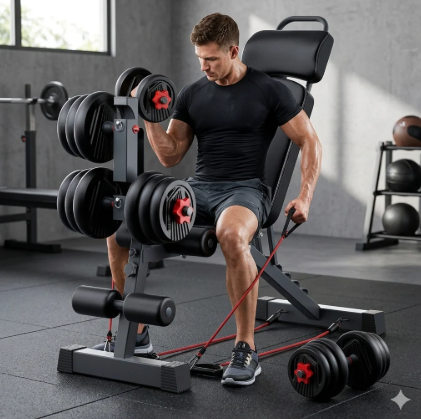
Dumbbells come next. Adjustable sets are practical for home use — they take up minimal space while giving you a wide range of resistance. They’re ideal for unilateral training (working one limb at a time), which helps correct imbalances that bilateral barbell work can sometimes mask. Exercises like dumbbell rows, lunges, and shoulder presses translate directly to real-world strength.
A leg press machine is worth mentioning for anyone who wants serious lower body development without the technical demands of the barbell squat. The Body-Solid SGLP500 Linear Bearing Commercial Leg Press available at Cipher Athletics is built to commercial-grade standards — the kind of equipment you’d find in a professional facility. Linear bearing systems reduce friction, meaning the movement stays smooth and joint-friendly across every rep.
Rowing machines deserve a spot in any strength-focused setup. Don’t let the cardio association fool you — a quality rowing movement hits your lats, rhomboids, rear delts, biceps, and core simultaneously. The Topiom Water Rowing Machine uses water resistance, which self-regulates with your effort — the harder you pull, the more resistance you create. It’s one of the most natural, joint-friendly ways to train your posterior chain.
A chest trainer or cable machine fills in the gaps that free weights sometimes leave. Cable movements maintain tension throughout the full range of motion, which barbells and dumbbells can’t always replicate. That constant tension is particularly valuable for chest, shoulders, and arms. A dedicated chest trainer allows you to isolate pecs effectively and vary angles in ways a flat bench simply can’t match.
Multifunctional all-in-one gym stations make sense for those with limited space who still want training variety. A well-designed unit covers chest press, lat pulldown, leg extension, and more — all in one footprint. The tradeoff is typically a fixed range of motion, so it works best as a complement to free weights rather than a replacement.
How to Actually Use This Equipment Without Wasting Time
Owning the gear is step one. Using it intelligently is where people either build real fitness or spin their wheels for months.
Start every session with a movement prep warm-up — not a five-minute treadmill walk, but actual dynamic movement that mimics what you’re about to do. If you’re squatting, do bodyweight squats, hip circles, and ankle mobility work. Your joints will thank you, and your first working sets will feel dramatically better.
When using a leg press, keep your feet shoulder-width apart and don’t lock your knees out at the top. Partial range of motion is a waste — full depth loads the quads, glutes, and hamstrings properly. Lower the platform until your knees hit roughly 90 degrees, then drive evenly through your whole foot.
On a rowing machine, the sequence matters: legs first, then lean back, then pull with your arms. Most people do it backwards — they pull their arms early and rob themselves of leg drive, which is where the real power comes from. Keep your core braced throughout and don’t round your lower back as you come forward.
With cable and chest machines, focus on controlling the eccentric — the lowering or returning phase of each rep. It’s tempting to let the weight stack fall back quickly, but that controlled lengthening under load is a huge driver of muscle growth. Slow it down. Three seconds on the way back, every rep.
For free weight movements, form trumps load every single time. Ego lifting with bad mechanics doesn’t build muscle faster — it just accelerates injury. A well-executed 60kg deadlift does more for your posterior chain than a sloppy 100kg pull that loads your lumbar spine wrong.
Recovery Is Part of the Program — Not Optional
Here’s something most beginners overlook: you don’t get stronger during training. You get stronger during recovery. Training is the stimulus; rest and nutrition are where adaptation actually happens.
Cipher Athletics carries a full range of recovery tools — from massage guns to cold plunge setups — because smart athletes know that managing soreness and inflammation directly affects how consistently you can train. You can’t hit your sessions hard if you’re still destroyed from two days ago.
Sleep is non-negotiable. Growth hormone is predominantly released during deep sleep, and protein synthesis runs at a higher rate overnight. Seven to nine hours isn’t a luxury for serious trainers — it’s part of the training plan.
Protein intake matters too. Aim for roughly 1.6–2.2 grams per kilogram of bodyweight daily if you’re training with any consistency. Spread it across meals rather than trying to hit it all at once — your body can only use so much per sitting.
FAQs
What’s the most important piece of strength training equipment for beginners?
A barbell and weight plates paired with a power rack covers the most ground for the least cost. If space is limited, a set of adjustable dumbbells and a multifunctional station are solid alternatives.
How often should I use strength training equipment each week?
Three to four sessions per week with at least one rest day between training the same muscle groups is the evidence-backed sweet spot for most people. More isn’t always better — recovery is where growth happens.
Is a leg press machine worth buying for home use?
Yes, if lower body development is a priority and you want a joint-friendly alternative to heavy barbell squats. Commercial options like the Body-Solid SGLP500 give you the same smooth, durable experience as a gym without the membership fee.
Do I need cardio equipment alongside strength training gear?
Not necessarily. Rowing machines deliver cardiovascular conditioning while also building back, arm, and leg strength simultaneously — making them one of the most efficient purchases for a home setup.
How do I know if I’m progressing?
Track your lifts. If you’re moving more weight, completing more reps, or recovering faster between sets over time, you’re progressing. A training log — even a simple notebook — is one of the most underrated tools you own.
Conclusion
Getting your home gym right doesn’t require a massive budget or a background in exercise science. It requires smart choices — equipment that covers the fundamental patterns, used with intentional technique, supported by real recovery.
A commercial-grade leg press, a smooth rowing machine, adjustable dumbbells, and a quality cable setup will take the vast majority of people further than they imagine. The work is yours to put in; the right gear just makes sure that work actually counts.





















Leave a Reply