

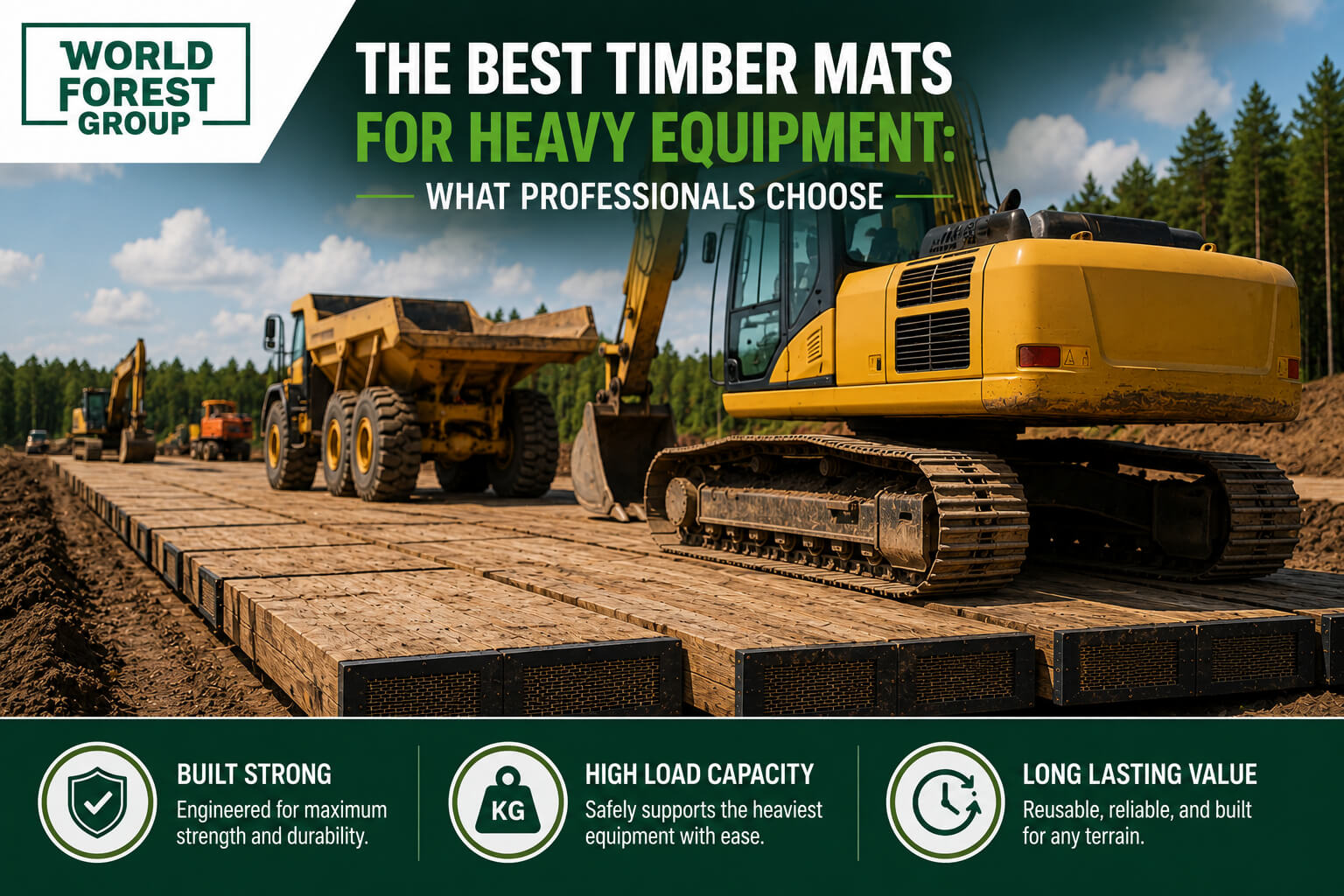
Buying timber mats for a heavy equipment project is not a decision that should be based on price or dimensions alone. The right matting system has to work with the soil, equipment, traffic patterns, weather, and duration of the job. A poor choice can lead to unstable access, damaged ground, equipment downtime, and additional restoration costs.
Contractors also need to think beyond the current project. Quality mats can become part of a company’s working inventory and be reused across several jobs, making durability and long-term performance just as important as the original purchase price.
Whether you’re preparing a temporary access road, supporting a crane, or creating a stable work area for excavators and loaders, this buying guide covers the factors worth considering before placing an order.
Start With the Job Site
Understand the Ground Conditions
The ground beneath the mats determines how much support the equipment will need.
Firm, compact ground may require less protection than wet clay, loose soil, wetlands, recently excavated areas, or recently backfilled trenches. A site can also contain several different ground conditions within the same project.
Walk the intended equipment routes before ordering mats. Look for drainage problems, low areas, soft shoulders, and sections where vehicles will turn or stop repeatedly. These areas may need more attention than a straight access route.
Ground conditions can also change during construction. Rainfall, excavation, grading, and repeated traffic can reduce soil strength over time, so planning around only the conditions present during the initial site visit can be risky.
Map Equipment Movement
Don’t look only at where the equipment will work. Look at where it will travel.
Temporary roads, entrances, staging areas, loading zones, and turning points often experience more traffic than the main work area. Repeated movement can gradually weaken the soil, especially when the same path is used throughout the project.
Mapping those routes before installation helps determine where mat coverage is most important.
Match the Mats to Your Equipment
Equipment Weight Is Only the Starting Point
A machine’s operating weight matters, but it doesn’t tell you everything about the load reaching the ground.
A tracked excavator distributes weight differently from a wheeled loader. A crane can place very high loads through its outriggers, while a loaded truck creates changing forces as it accelerates, brakes, and turns.
Consider how the equipment will actually operate. A stationary lifting operation has different requirements from a machine making hundreds of trips over the same temporary road.
For heavy-duty applications, contractors often choose Eucalyptus Timber Mats because dense eucalyptus hardwood provides the strength and durability needed for repeated equipment traffic.
Think About Dynamic Loads
Equipment doesn’t simply sit on the mat.
Turning, braking, lifting, and repeated movement can all create additional stress. Areas where machines change direction frequently deserve special attention because the ground can experience more disturbance there than on a straight travel route.
A good buying decision considers these operating conditions rather than relying on a single equipment weight figure.
Choose the Right Timber
Hardwood Quality Matters
Two mats can look similar while performing very differently.
Timber species, density, construction method, dimensions, and fastening all affect durability. When mats will support heavy equipment, the material needs to withstand repeated loading, handling, transportation, and exposure to changing site conditions.
Eucalyptus Timber Mats are particularly suited to demanding construction environments because eucalyptus is a dense hardwood with strong structural properties. Contractors use them across infrastructure, utilities, bridge construction, renewable energy, and other projects where dependable ground protection is needed.
Consider How Often the Mats Will Be Reused
A contractor buying mats for recurring work should evaluate expected service life rather than treating the purchase as a single-project expense.
If the mats are likely to move from a highway project to a utility installation and then to another infrastructure job, durability becomes a major part of their value.
Quality mats that remain serviceable through repeated projects can reduce replacement costs and provide a more predictable equipment inventory.
Select Appropriate Dimensions
Don’t Automatically Buy the Largest Mats
Larger mats aren’t always the most practical choice.
Oversized mats can increase transportation requirements, handling time, and lifting demands. On confined sites, they may also be harder to position accurately.
The objective is to select dimensions that provide enough coverage and support for the equipment and working area without creating unnecessary logistical problems.
Don’t Undersize the System
Using mats that are too small can create equally serious issues.
Insufficient coverage can leave gaps along access routes or fail to provide enough surface area for the loads being applied. Turning areas may also extend beyond the protected surface.
Consider equipment footprint, road width, turning radius, working platform requirements, and expected traffic when determining the appropriate dimensions.
Evaluate Project Duration
Short-Term Work Still Needs Reliable Protection
A project lasting only a few weeks can still create significant ground damage.
Heavy machinery can repeatedly travel over the same area dozens or hundreds of times. If the route fails, the short project schedule may leave little room for repairs or changes.
The shorter the schedule, the more important efficient mobilization and dependable access can become.
Long-Term Projects Require Durability
When mats will remain in service for several months, durability and maintenance become more important.
Exposure to weather, mud, continuous traffic, and repeated handling can wear poorly constructed products quickly. Long-term projects should therefore be evaluated based on expected service life rather than short-term purchase price.
Consider Buying, Leasing, and Reuse
Think About Your Future Workload
Contractors with regular demand for ground protection may benefit from owning their inventory.
If your company expects to use mats on several upcoming projects, purchasing can spread the original investment over multiple jobs. It also gives you greater control over availability.
Leasing may be more practical for a one-time project, unusual application, or temporary increase in workload.
Calculate the Total Cost
Don’t compare purchase price against lease price without considering everything else.
Include transportation, storage, maintenance, repair, handling, rental extensions, replacement, and future reuse. A slightly more expensive product can be financially attractive when it lasts longer and continues performing across multiple projects.
Inspect Before You Buy
Look at Construction Quality
If possible, inspect the mats before they are delivered to the job site.
Look for cracked or damaged timbers, loose fasteners, excessive wear, inconsistent construction, and damaged lifting areas. These problems can create delays once installation begins.
Ask the supplier how the mats are constructed, what applications they are intended for, and how they should be maintained between projects.
Ask About Handling and Storage
Good mats still require proper care.
Find out how they should be loaded, transported, installed, removed, and stored. Between projects, mats should generally be kept on firm, well-drained ground and inspected before being returned to service.
A simple maintenance process can significantly extend the useful life of a contractor’s inventory.
Don’t Overlook Weather and Drainage
Rain Can Change the Ground Quickly
Construction sites can change dramatically after heavy rainfall.
Soil that supported equipment during a dry period may soften quickly once saturated. Temporary access routes can develop ruts, water can collect between mat sections, and equipment traffic can make the situation worse.
Planning for expected weather conditions helps contractors identify where additional protection or drainage measures may be needed.
Work With the Site’s Natural Drainage
Mats should not be installed without considering how water moves across the property.
If a mat route blocks natural drainage, water may collect around the access road and weaken the surrounding ground. Evaluate drainage paths before installation and make adjustments where necessary.
Choose a Supplier That Understands the Application
Ask Better Questions
A supplier should want to understand the project before recommending a product.
Be prepared to provide information about equipment, soil conditions, expected traffic, project duration, access constraints, and environmental requirements. The more accurately the application is understood, the easier it is to select appropriate mats.
World Forest Group supplies Eucalyptus Timber Mats for contractors working in demanding construction and infrastructure environments where strength, durability, and reliable ground protection matter.
A contractor’s buying decision should ultimately come down to how well the mats match the real demands of the project. The strongest purchase is not necessarily the largest, cheapest, or most heavily advertised option. It is the one that provides adequate support, survives the conditions it will face, remains practical to handle, and delivers value beyond a single job. By assessing the site first, matching the mats to equipment and traffic, checking construction quality, and planning for reuse, contractors can make a purchase that supports safer operations and more predictable project costs.
Frequently Asked Questions
What should contractors look for when buying timber mats for heavy equipment?
Evaluate ground conditions, equipment loads, traffic frequency, mat dimensions, timber quality, project duration, weather exposure, durability, and future reuse.
Are Eucalyptus Timber Mats suitable for heavy construction equipment?
Yes. Eucalyptus Timber Mats are made from dense hardwood and are commonly selected for demanding construction applications involving heavy equipment and repeated traffic.
How do I determine the right mat size?
Consider the equipment footprint, ground conditions, access road width, turning areas, and working platform requirements rather than choosing a size based only on machine weight.
Should a contractor buy or lease timber mats?
Buying can make sense when mats will be used regularly across multiple projects. Leasing may be more practical for short-term or occasional requirements. Compare the complete costs of each option, including transportation, storage, maintenance, and future reuse.






















Leave a Reply