

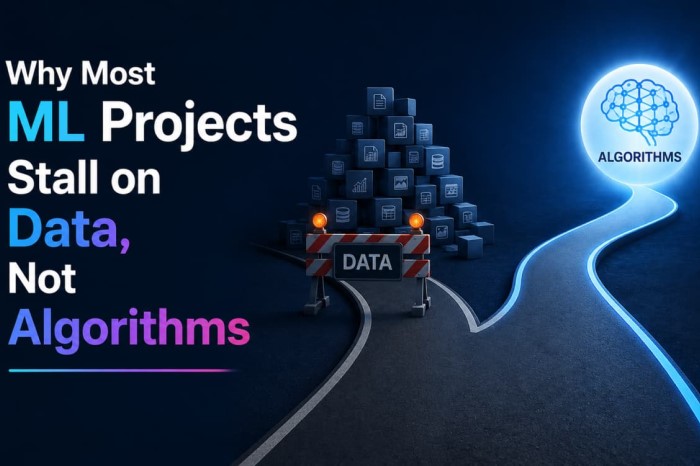
Teams pour months into model architecture, then watch the work stall before it reaches a single user. The cause is rarely the algorithm. Gartner expects organizations to abandon 60 percent of AI projects that are not supported by data ready for production use. That figure points straight at the bottleneck most analyses find: fragmented pipelines, undocumented features, and no plan for what happens after the model goes live.
The pattern repeats across industries. A data science group builds a promising classifier in a notebook, reports strong offline accuracy, and hands it off. Six weeks later, the model sits unused because nobody can feed it fresh, trustworthy data on a schedule. The math worked. The plumbing did not. Understanding that gap changes how you scope, staff, and buy ML development services.
The Real Bottleneck Sits Upstream of the Model
Algorithm selection is largely a solved problem for most business tasks. Gradient-boosted trees, well-tuned neural networks, and off-the-shelf foundation models cover the vast majority of demand forecasting, fraud detection, and document classification work. The differentiator is no longer which model you pick. It is whether clean, labeled, current data reaches that model reliably.
Consider a mid-sized insurer building a claims-triage model. The training data lived across three policy systems, a legacy mainframe, and a spreadsheet a single analyst maintained by hand. Joining those sources revealed mismatched customer identifiers, duplicate records, and dates stored in four formats. The modeling took two weeks. Reconciling the data took four months. This is the ratio real projects hit, and it is why data engineering, not model tuning, decides the timeline.
Data readiness has a specific meaning here: accurate, complete, timely, and governed data that arrives in a shape the model expects, every time it runs. When any of those properties breaks, accuracy degrades quietly. The model keeps returning predictions, so nothing looks broken, yet the numbers drift away from reality. Catching that decay requires instrumentation built before launch, not diagnostics bolted on after a business user complains.
What Machine Learning Development Services Actually Cover
The label spans far more than training a model. Mature ML development services carry a project from raw, scattered data through a monitored production system that keeps earning its cost. The scope usually breaks into a few connected stages:
- Data discovery and readiness assessment: cataloging sources, profiling quality, and quantifying the labeling and cleanup effort before anyone promises a delivery date.
- Pipeline and feature engineering: building repeatable ingestion, transformation, and feature-generation code that produces the same inputs in training and in production.
- Model development and validation: selecting, training, and rigorously testing models against business metrics, not just statistical scores.
- Deployment and integration: wiring the model into the systems where decisions actually happen, whether a claims console, a call-center screen, or a batch scoring job.
- Monitoring and retraining: watching data drift, performance, and cost, then refreshing the model on a defined cadence.
Read that list again and notice how little of it is modeling. A team shopping for machine learning development solutions should press hardest on stages one, two, and five, because that is where budgets overrun and value leaks. Vendors who demo only a clever model and skip the pipeline conversation are selling the easy 20 percent.
Where Data Readiness Breaks Down
Failure modes cluster in predictable places, and naming them helps you scope work honestly. Fragmented ownership tops the list: when four teams each own a slice of the data and none owns the whole path, no one can guarantee the model gets what it needs. Labeling gaps come next, especially for supervised tasks where the ground truth sits in someone’s head rather than in a system.
Training-serving skew deserves special attention. A feature computed one way in a research notebook and another way in production quietly poisons predictions, and it is one of the hardest bugs to spot because both pipelines look correct in isolation. A shared feature store, where features are defined once and reused everywhere, closes that gap. Without one, every model becomes a fresh opportunity for the same mistake.
Freshness is the third failure mode. A recommendation model trained on last quarter’s behavior misfires the moment customer preferences shift, and a fraud model trained on old patterns misses new attack methods within weeks. Data that was ready at launch stops being ready. Treating readiness as a one-time gate rather than a continuous property is the quiet assumption behind a large share of stalled projects. The organizations that avoid this build a standing feedback loop, where production predictions and their real outcomes flow back into the next training run automatically.
Pipelines, Monitoring, and Retraining Are the Product
The teams shipping durable value make a mental shift: the deliverable is not a model file, it is a system that keeps a useful model in production as the world changes. Machine learning operations, usually shortened to MLOps, gives that system its shape. The model becomes one swappable component inside a larger machine built for change.
That machine has recognizable parts. Automated pipelines move data from source to feature to prediction without manual steps. A model registry tracks every version, its training data, and its metrics, so a rollback takes minutes instead of a frantic afternoon. Monitoring watches three separate signals: input data quality, prediction distribution, and downstream business outcomes. Retraining triggers fire when drift crosses a threshold or on a fixed schedule, whichever comes first.
An experienced partner delivering machine learning development services will insist on this operational backbone before writing much model code, because it is cheaper to build the rails first than to retrofit them under a live system. The payoff is concrete. When a data source changes format at 2 a.m., a monitored pipeline flags the break and pages an engineer. An unmonitored one returns confident, wrong answers until quarterly review, and by then the trust is gone.
Where Machine Learning Earns Its Return
Abstract capability means little without a use case attached to a number, so ground the technology in work it does well. Demand forecasting is a reliable early win: a retailer that replaces manual spreadsheets with a trained model typically tightens inventory and cuts both stockouts and overstock, provided sales, weather, and promotion data feed the model cleanly. The value comes from the data feed as much as the forecast.
Risk and fraud detection reward the same discipline. Banks and insurers score transactions or claims in real time, flagging anomalies a rule-based system would miss. These models decay fastest, since adversaries adapt, which makes retraining and monitoring non-negotiable rather than optional polish. Process automation is a third proven area: document classification, extraction from unstructured forms, and routing tasks that once consumed analyst hours.
Across these cases, the winning pattern holds. The organizations getting a return are not the ones with the fanciest architecture. They are the ones whose machine learning development solutions treat the surrounding data flow and the post-launch operation as the main event.
A modest model on a reliable pipeline beats a brilliant model on a broken one every time. Notice too that each of these wins depends on a tight loop between the prediction and a measured business result. A forecast nobody acts on, or a fraud flag nobody reviews, produces no value regardless of model quality. Designing that human and system response into the project from the start is part of the work, not an afterthought for the business team to sort out later.
The Stack Behind Reliable ML Development Services
Technology choices should follow the operational goal, not fashion. Well-run ML development services standardize on a small, boring set of tools that the whole team understands, rather than chasing every new framework. Data infrastructure sits at the base: a warehouse or lakehouse such as Snowflake, BigQuery, or Databricks holds source data, and orchestration tools like Apache Airflow schedule the pipelines that feed it forward. A feature store, whether a managed service or an open-source option like Feast, enforces consistency between training and serving.
For modeling and tracking, frameworks such as scikit-learn, PyTorch, and XGBoost cover most needs, while experiment trackers like MLflow record what was trained on which data with which result. Deployment leans on containers and Kubernetes for services that scale with demand, or on serverless functions for lighter batch jobs. Monitoring closes the loop through tools that watch data drift and model quality, feeding alerts back to the team that owns the system.
None of these tools rescue a project on its own. Naming them matters less than wiring them into one accountable path from source data to business decision. Sprawling tooling with no clear ownership produces an expensive collection of dashboards nobody reads. The stack is a means; the reliable prediction is the end.
Governance, Compliance, and Security as Engineering
For regulated industries, data readiness and compliance are the same conversation. A model that consumes personal, financial, or health data inherits every obligation attached to that data. Lineage tracking answers the questions auditors ask: where did this training record come from, who touched it, and can a customer’s data be removed on request. Building that lineage into pipelines from the start is far cheaper than reconstructing it after a regulator calls.
Access controls, encryption in transit and at rest, and audit logs belong in the pipeline design, not in a separate security review at the end. Bias and fairness testing deserve the same standing as accuracy testing, particularly for models that touch lending, hiring, or claims decisions. A strong ML development company documents these controls as engineering artifacts, so the compliance story is verifiable rather than asserted. Machine learning services & solutions that skip this work create liability that surfaces at the worst possible moment, usually during an audit or after a public failure.
What to Look for in an ML Development Company
Evaluate a partner on operations, not demos. Ask how they assess data readiness before quoting a timeline, and treat a fixed date offered without a data audit as a warning sign. Ask to see their monitoring and retraining approach, since a vendor who cannot describe how they detect drift has not run models in production for long.
Press on ownership and handoff. The best engagements leave your team able to operate and extend the system, with documented pipelines, versioned models, and runbooks for common failures. Weak ones leave a black box that breaks the day the contractor leaves. Judge references by what happened six months after launch, not by launch-day accuracy. Quality ML development services are measured in sustained production performance, not in a single impressive notebook.
Machine learning stalls on data, not algorithms, and the fix is unglamorous engineering done in the right order. Teams that treat pipelines, monitoring, and retraining as the product ship models that keep working long after the launch demo. As data volumes grow and models touch more regulated decisions, that operational discipline stops being a nicety and becomes the deciding factor between projects that pay off and projects that quietly stall. Choosing ML development services built around data readiness and lifecycle operations is the surest way to turn a promising prototype into a system your business can count on next year and the year after.



























Leave a Reply