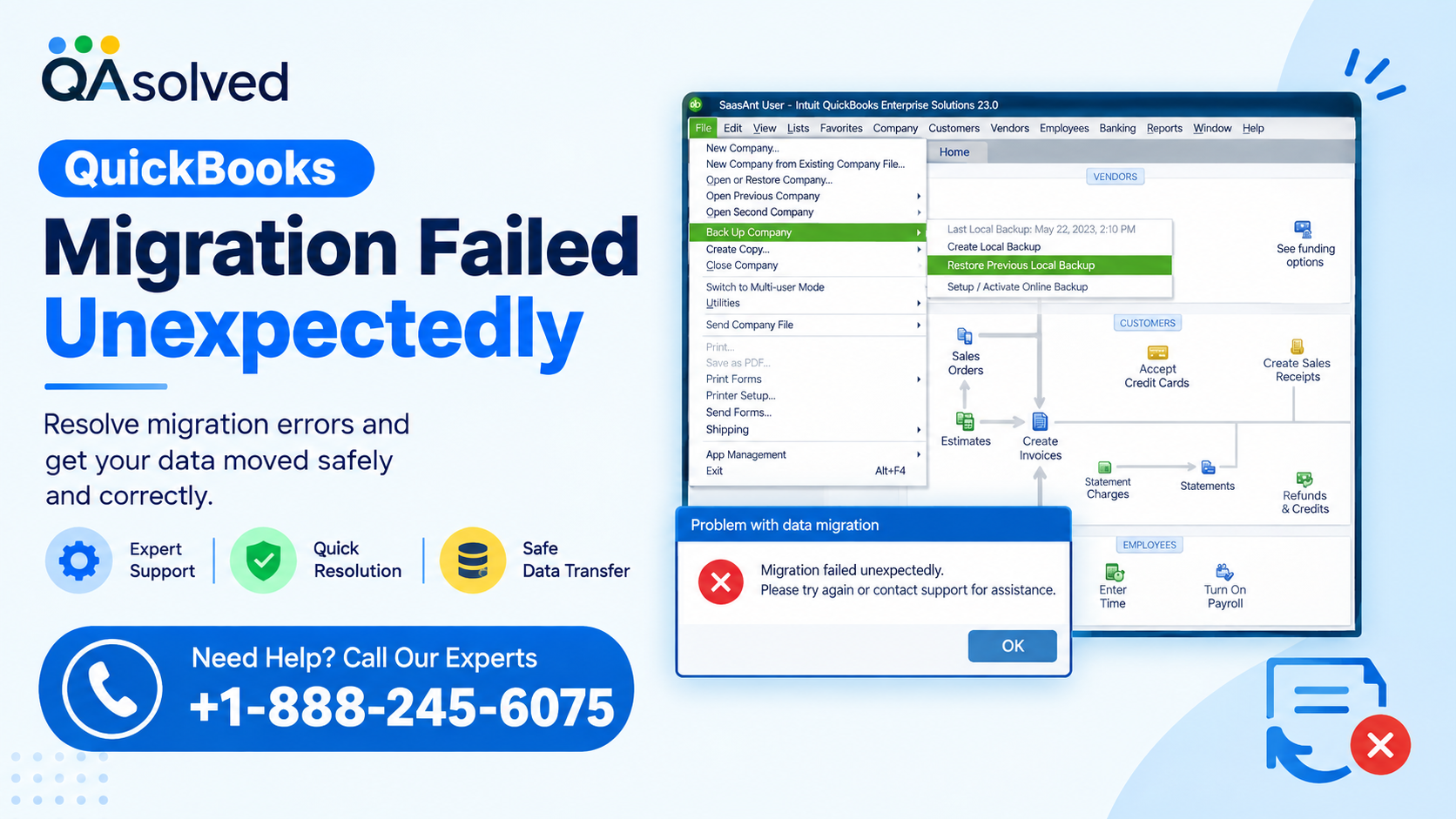
QuickBooks Migration Failed Unexpectedly
QuickBooks Migration Failed Unexpectedly is an error that can appear when moving QuickBooks data to another computer, transferring a company file, or migrating QuickBooks Desktop data to QuickBooks Online. The problem may occur because of an outdated version, damaged company data, insufficient storage, permission restrictions, or an interrupted migration process.
The good news is that you can often resolve the issue by checking the source company file, creating a fresh backup, and following the correct migration steps.
Quick Answer
QuickBooks Migration Failed Unexpectedly usually occurs when QuickBooks cannot complete the data transfer or conversion. Check your company file, update QuickBooks, verify available storage, confirm Windows permissions, and create a fresh backup before trying the migration again.
Why Does QuickBooks Migration Fail Unexpectedly?
There are several possible reasons for a failed QuickBooks migration. Identifying the cause can help you choose the right solution.
Common causes include:
- Damaged QuickBooks company data
- Outdated QuickBooks Desktop
- Incompatible QuickBooks versions
- Insufficient disk space
- Unstable internet connection
- USB transfer problems
- Windows permission restrictions
- Antivirus or firewall interference
- Large company files
- Incomplete backup files
- Incorrect migration method
- Interrupted file transfer
- Network connection problems
If the error started after changing computers, first confirm that the original company file is still available.
How to Fix QuickBooks Migration Failed Unexpectedly
1. Create a New Company File Backup
Before making changes, create a fresh backup of the original QuickBooks company file.
For QuickBooks Desktop, you can keep a separate .QBB backup along with the original .QBW file.
Do not replace your only backup with a newly created copy.
2. Check Whether the Original Company File Opens
Open QuickBooks Desktop on the old computer.
Then open the company file you want to migrate.
If the file opens normally, review a few important transactions and reports. If it does not open, the migration problem may be related to the company file itself.
3. Update QuickBooks Desktop
An outdated QuickBooks version can create compatibility problems during migration.
Open QuickBooks Desktop and check for available updates. Install the applicable update, restart QuickBooks, and then try the migration again.
If you are moving between different QuickBooks versions, also check whether the source and destination versions are compatible.
4. Check Available Storage
A migration may need additional temporary storage during the transfer.
Check free space on both computers. If you are using a USB drive, check its available capacity as well.
Delete unnecessary files or use another storage device if space is limited.
5. Check the USB Drive
If your migration uses a USB drive, make sure Windows can read it correctly.
Try these steps:
- Disconnect the USB drive.
- Connect it to another USB port.
- Confirm that the drive appears in File Explorer.
- Check available space.
- Create a fresh migration package.
- Safely eject the drive before moving it.
A damaged or unreliable USB drive can interrupt the transfer.
6. Run QuickBooks as Administrator
Windows permissions can sometimes prevent QuickBooks from accessing files or folders required during migration.
Close QuickBooks Desktop. Right-click its shortcut and select Run as administrator.
Then retry the migration process.
7. Check Antivirus and Firewall Settings
Security software can sometimes interfere with QuickBooks processes or file transfers.
Check whether Windows Security or another antivirus application is blocking QuickBooks.
Do not permanently disable security protection. Instead, review the relevant settings and make appropriate changes only when necessary.
8. Verify the Company File
If QuickBooks Migration Failed Unexpectedly occurs repeatedly with the same company file, check the company data for problems.
QuickBooks Desktop includes Verify Data and Rebuild Data utilities that can identify and address certain data issues.
Create a backup before using data-repair utilities.
9. Use QuickBooks Tool Hub
QuickBooks Tool Hub can help troubleshoot certain QuickBooks Desktop program and installation problems.
Depending on the cause, Quick Fix My Program and other applicable tools may help repair problems affecting QuickBooks.
After completing the diagnostic process, restart the computer and test the migration again.
10. Create a Fresh Migration Package
If the migration package was interrupted or became incomplete, create a new one.
Do not continue using a package that may have been damaged during the first migration attempt.
Start the migration again from the original computer and carefully follow each step.
11. Check the Company File Location
A company file stored on a network drive, external drive, or synchronized folder may not be accessible during migration.
Search for the original .QBW file and confirm its location.
For troubleshooting, a stable local copy may be easier to work with than a file stored in an unavailable network or actively synchronized folder.
12. Try Backup and Restore
If the Migrator Tool continues to fail, a backup-and-restore method may be appropriate depending on your migration situation.
Use a valid .QBB backup and restore it on the destination QuickBooks Desktop installation when the applicable workflow supports it.
Keep the original company file unchanged until you confirm that the restored company works correctly.
QuickBooks Migration Failed Unexpectedly After Moving to a New Computer
If the error started after purchasing a new computer, verify the following:
- QuickBooks is installed on the new computer.
- The QuickBooks versions are compatible.
- The destination computer has enough storage.
- The original company file is available.
- The migration package is complete.
- Windows permissions allow access to the required folders.
- The new computer has a stable internet connection when required.
Installing QuickBooks on a new computer does not automatically transfer your existing company data.
QuickBooks Migration Failed Unexpectedly From Desktop to Online
A migration from QuickBooks Desktop to QuickBooks Online follows a different process from moving QuickBooks between two computers.
If the migration fails:
- Open the Desktop company file.
- Check that the company data is accessible.
- Create a backup.
- Confirm the Desktop product and version.
- Review the applicable migration requirements.
- Sign in to the correct QuickBooks Online company.
- Retry the migration using the appropriate workflow.
- Compare important balances after migration.
Some Desktop information may require separate handling when moving to QuickBooks Online.
QuickBooks Migration Failed Unexpectedly During Conversion
Conversion problems can happen when changing between QuickBooks products or platforms.
Before trying again, verify the source and destination versions. Keep a copy of the original company file and create a new backup.
Also, make sure you are using the correct conversion process.
Do not manually change a QuickBooks file extension and expect the file to convert automatically.
What If QuickBooks Migration Keeps Failing?
If the migration fails several times, determine whether the problem occurs with one company file or every company file.
For example:
| Test | Possible Indication |
|---|---|
| One company file fails | Company data may have an issue |
| Every company file fails | QuickBooks installation may be involved |
| One USB fails | USB or storage problem |
| Different USB works | Original USB may be unreliable |
| Old computer works | Destination setup may need attention |
| Both computers fail | Migration package or compatibility issue |
This simple comparison can help narrow down the cause.
How to Prevent QuickBooks Migration Errors
A few precautions can reduce the possibility of another migration failure:
- Create a backup before migrating.
- Keep the original company file.
- Update QuickBooks before starting.
- Verify the company data.
- Check available storage.
- Use a reliable USB drive.
- Confirm QuickBooks version compatibility.
- Avoid interrupting the migration.
- Keep security software configured correctly.
- Verify the company after migration.
QuickBooks Migration Checklist
| Migration Task | Status |
|---|---|
| Backup created | ☐ |
| Original QBW file verified | ☐ |
| QuickBooks updated | ☐ |
| Storage checked | ☐ |
| USB checked | ☐ |
| Migration requirements reviewed | ☐ |
| Fresh migration package created | ☐ |
| Destination QuickBooks installed | ☐ |
| Company file transferred | ☐ |
| Data verified | ☐ |
Frequently Asked Questions
Why does QuickBooks Migration Failed Unexpectedly appear?
The error can occur because of damaged company data, outdated software, incompatible versions, insufficient storage, permissions, security settings, or an interrupted transfer.
How do I fix QuickBooks Migration Failed Unexpectedly?
Start by creating a backup and checking that the original company file opens. Then update QuickBooks, check storage and permissions, create a fresh migration package, and retry the process.
Can a damaged company file cause migration failure?
Yes. Problems within the source company file can interfere with migration or conversion. Use the appropriate QuickBooks data verification and repair tools after creating a backup.
Why did QuickBooks migration fail on my new computer?
The new computer may have an incompatible QuickBooks version, insufficient storage, incorrect permissions, or an incomplete migration package.
Can I use a QBB file if QuickBooks migration fails?
A .QBB backup can provide an alternative way to restore QuickBooks Desktop company data when the applicable QuickBooks version and workflow support it.
Should I delete the old company file after migration?
No. Keep the original company file and a separate backup until you have confirmed that the migrated company contains the expected accounting information.
Final Thoughts
QuickBooks Migration Failed Unexpectedly can be frustrating, but the error does not necessarily mean that your accounting data is lost. Start with a reliable backup, confirm that the original company file works, and check QuickBooks compatibility, storage, permissions, and the migration package.
If the problem continues, avoid deleting the original company file. Keeping the source data and backup intact gives you a safer way to retry the migration or use an alternative transfer method.