A competitor can change a product price today and leave your pricing team reacting tomorrow.
That delay can matter. A lower competitor price may affect conversion, marketplace visibility, sales volume, or how customers perceive your offer. But matching every price change immediately is not a strategy either. It can gradually reduce margins without addressing why the competitor changed its price in the first place.
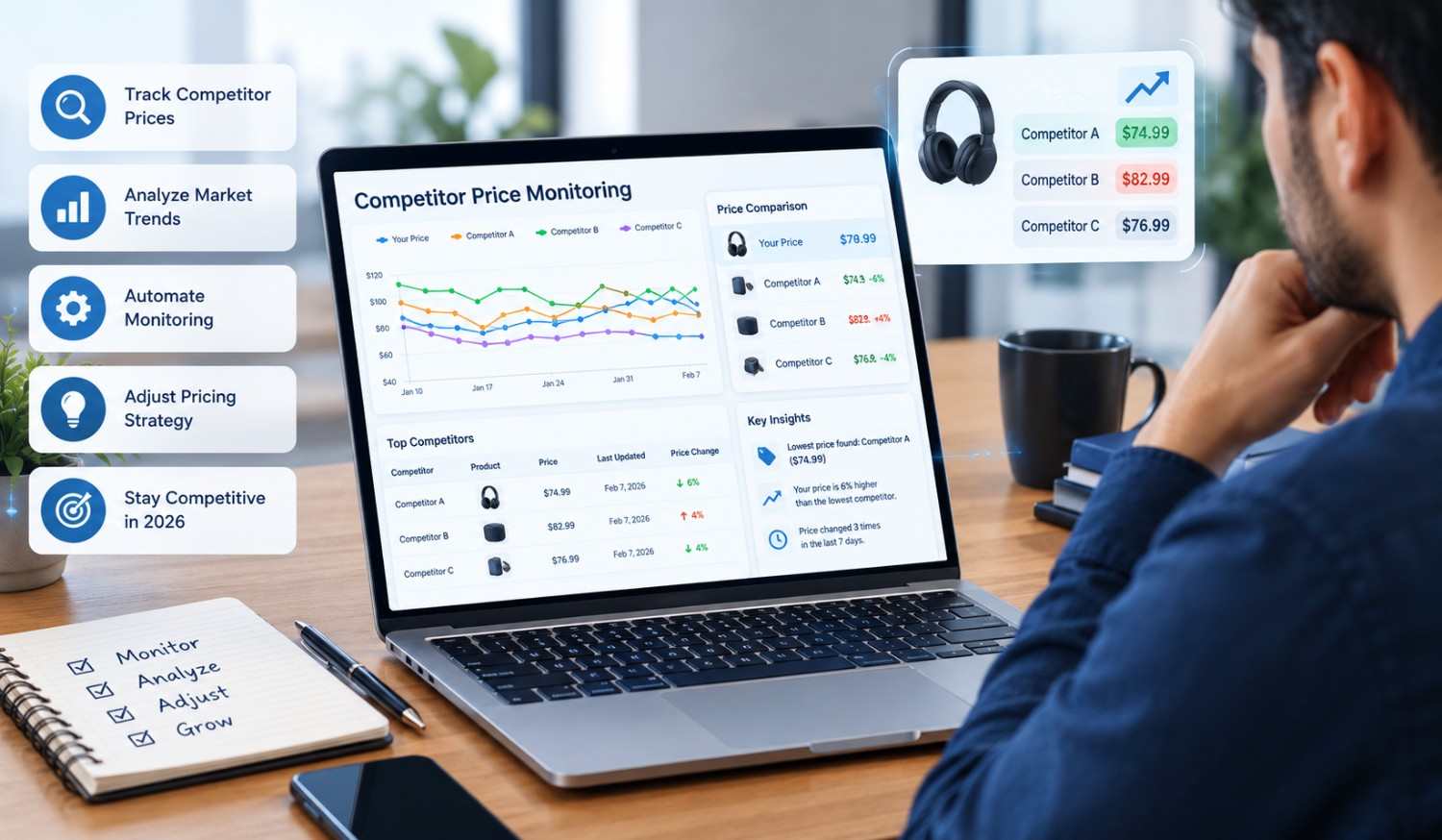
Competitor price monitoring gives businesses a structured way to track market prices, promotions, product availability, and other pricing signals. Instead of relying on occasional manual checks, companies can collect pricing data at defined intervals, compare equivalent products, identify meaningful changes, and use those insights to support pricing decisions.
In 2026, the focus is moving beyond simply asking, “What is my competitor charging?”
The more useful questions are:
- How often is the competitor changing prices?
- Is the product actually comparable?
- Is the competitor temporarily discounting it?
- Is the product in stock?
- How does shipping affect the final customer price?
- How does the competitor’s price compare with our margin requirements?
- Which changes require action and which can be ignored?
This article explains how modern competitor price monitoring works, the strategies businesses can use, common implementation mistakes, and how automation and AI are changing pricing intelligence.
Quick Answer: What Is Competitor Price Monitoring?
Competitor price monitoring is the process of systematically collecting and analyzing competitors’ product or service prices to understand market pricing changes. Businesses can use automated data collection, product matching, price histories, alerts, dashboards, and analytics to identify meaningful pricing movements and support decisions about pricing, promotions, positioning, and margins.
Competitive pricing intelligence is most useful when price data is combined with context such as product availability, promotions, shipping costs, and historical changes rather than treated as an isolated number.
What Is Competitor Price Monitoring?
At its simplest, competitor price monitoring means regularly observing what competing businesses charge for comparable products or services.
A mature monitoring system goes further. It can collect:
- Product name and SKU
- Current price
- Original or list price
- Discount percentage
- Promotional pricing
- Product availability
- Stock status
- Shipping information
- Marketplace or sales channel
- Seller information
- Product ratings and reviews
- Timestamp of the observation
- Historical price changes
The collected information can then be normalized and connected to your own product catalog.
This distinction matters because a raw price feed does not automatically create useful competitive intelligence.
Suppose an electronics retailer sees a competitor selling a laptop for $899 while its own price is $949. The obvious response might be to reduce the price.
But what if the competitor’s product has less RAM? What if the $899 price applies only to a limited promotion? What if the competitor is out of stock? What if your product includes accessories or a longer warranty?
The correct response depends on the context.
Why Competitor Price Monitoring Matters in 2026
Digital pricing changes quickly across eCommerce stores, marketplaces, and other online channels. Pricing teams therefore need timely market information rather than occasional snapshots.
McKinsey describes competitive-response pricing systems that use competitor prices alongside other analytical inputs to support pricing decisions. Its current pricing work also highlights AI-enabled workflows that can monitor competitive signals, synthesize market information, recommend actions, and update pricing under defined controls.
For businesses, this creates several practical advantages.
1. Faster visibility into market changes
Manual research can tell you what competitors charge when someone checks.
Automated monitoring can show what changed, when it changed, and which products were affected.
This makes it easier to distinguish a one-time observation from an actual pricing trend.
2. Better pricing decisions
A pricing team can compare competitor prices with:
- Cost of goods
- Target margin
- Historical selling price
- Demand
- Inventory
- Promotions
- Product positioning
The goal is not necessarily to become the cheapest seller. It is to understand the market well enough to make deliberate pricing decisions.
3. Reduced manual work
Checking hundreds or thousands of product pages manually is difficult to maintain.
Automation allows teams to spend less time collecting numbers and more time interpreting them.
4. Improved promotion analysis
Price monitoring can reveal whether competitors repeatedly discount certain products during weekends, holidays, product launches, or seasonal events.
Historical data makes these patterns easier to identify.
5. Better marketplace visibility
Marketplaces often have their own competitive pricing dynamics. Amazon, for example, provides automated pricing rules that can respond to competitive reference prices while allowing sellers to establish minimum and maximum price limits.
That illustrates an important principle: automated price changes should operate within business rules rather than blindly chase the lowest market price.
Key Strategies for Competitor Price Monitoring in 2026
1. Monitor the Right Competitors
More data is not automatically better data.
Start by defining the competitors that genuinely influence your market.
You may want to separate them into:
| Competitor type | Why monitor them? |
|---|---|
| Direct competitors | Sell highly similar products |
| Marketplace sellers | Compete for the same marketplace demand |
| Premium competitors | Help establish upper-market positioning |
| Low-price competitors | Reveal aggressive pricing movements |
| Emerging competitors | Identify new market pressure |
Monitoring every business in a category can create unnecessary noise.
A focused competitor set makes alerts and analysis more useful.
2. Match Products Before Comparing Prices
This is one of the most important parts of a reliable monitoring system.
A price comparison is meaningful only when the products are genuinely comparable.
Product matching may consider:
- SKU
- UPC/EAN/GTIN
- Brand
- Model number
- Product specifications
- Size
- Color
- Pack quantity
- Variant
- Category
- Product attributes
For manufacturers and distributors, competitive intelligence systems may need to match equivalent products across different resellers and channels. McKinsey specifically identifies like-for-like product matching as part of online market intelligence.
For example:
Your product: 12-pack, 500 ml bottles
Competitor product: 6-pack, 500 ml bottles
Comparing their displayed prices directly would produce a misleading result.
The monitoring system should normalize the products or flag the comparison for review.
3. Track Price History, Not Just Current Prices
A current price tells you where the market is.
A price history can tell you what is happening.
Consider this pattern:
- Monday: $100
- Tuesday: $100
- Wednesday: $85
- Thursday: $85
- Friday: $100
Reacting immediately to Wednesday’s price may be unnecessary if the competitor runs short promotional campaigns every week.
Historical data can help identify:
- Frequent discounting
- Seasonal patterns
- Promotional cycles
- Long-term price reductions
- Sudden price increases
- Pricing stability
- Competitor response patterns
This turns monitoring from a simple alert system into a source of market intelligence.
4. Monitor Availability Alongside Price
Price without availability can be misleading.
A competitor may list a product at a very low price but have limited stock or no immediately available inventory.
For that reason, a useful monitoring system should capture availability where the data is publicly observable and relevant.
A pricing dashboard might therefore show:
Competitor A: $89 — In stock
Competitor B: $84 — Out of stock
Competitor C: $92 — In stock
The lowest displayed price is not necessarily the strongest competitive signal.
5. Track Promotions Separately
A discounted price should not always be treated as the competitor’s normal price.
Monitor signals such as:
- Coupon discounts
- Flash sales
- Bundle offers
- Buy-one-get-one promotions
- Seasonal discounts
- Membership pricing
- Limited-time offers
Separating base pricing from promotional pricing helps prevent unnecessary reactions.
6. Use Price Alerts With Thresholds
An alert for every one-dollar change quickly becomes useless.
Instead, create rules based on business importance.
For example:
Alert the pricing team when a monitored competitor changes a priority SKU by more than 5%.
Other useful triggers include:
- Competitor becomes cheaper than your minimum competitive threshold
- Competitor enters a defined price band
- Multiple competitors change prices within a short period
- A competitor changes the price of a high-revenue product
- Your price moves outside a target market position
The best alert is not the one that detects everything. It is the one that identifies changes worth investigating.
Build a Competitor Price Monitoring Workflow
A practical monitoring architecture can follow this sequence:
Data Sources → Collection → Product Matching → Validation → Price Database → Analytics → Alerts → Pricing Workflow
Step 1: Define the monitoring scope
Determine:
- Which competitors?
- Which products?
- Which marketplaces?
- Which countries?
- Which currencies?
- How frequently should data be collected?
Not every product requires the same refresh frequency.
Step 2: Collect pricing data
Depending on the source, businesses may use APIs, structured feeds, or automated web data extraction.
For websites without suitable data feeds, web scraping can collect publicly available product information into a structured dataset.
Production-grade collection needs to account for changing page structures, JavaScript-rendered content, failed requests, duplicates, and data-quality problems.
Step 3: Normalize the data
Standardize:
- Currency
- Units
- Product identifiers
- Price formats
- Discount formats
- Availability values
- Timestamps
Without normalization, comparisons across countries, stores, and marketplaces can become unreliable.
Step 4: Match equivalent products
Connect competitor listings to the correct internal SKU or product record.
This may use deterministic identifiers first, followed by attribute-based or AI-assisted matching where exact identifiers are unavailable.
Step 5: Validate the data
Before sending pricing information to decision-makers, check for:
- Missing prices
- Unexpected values
- Duplicate products
- Incorrect product matches
- Broken page extraction
- Currency errors
- Stale records
Data validation is particularly important when pricing decisions are automated.
Step 6: Store historical observations
Each observation should ideally retain its timestamp.
A historical database makes it possible to answer questions such as:
“When did Competitor A first move below our price?”
or:
“How often does Competitor B discount this product?”
Step 7: Turn data into actions
The final layer is decision support.
A dashboard might show:
| Signal | Example | Possible action |
|---|---|---|
| Competitor price drop | $120 → $105 | Review competitive position |
| Competitor stockout | Product unavailable | Avoid unnecessary price reduction |
| Repeated promotion | Weekly discount | Monitor pattern |
| Multiple competitors reduce price | Category-wide movement | Review category strategy |
| Competitor price increase | $90 → $110 | Evaluate whether your price position can change |
The action should depend on business rules rather than the data alone.
AI and Competitor Price Monitoring in 2026
AI is becoming more useful in pricing workflows, but it should support controlled decision-making rather than operate without boundaries.
McKinsey’s 2026 discussion of AI-enabled B2B pricing describes workflows where AI can process market signals, synthesize competitive information, recommend pricing actions, and support dynamic updates with escalation rules, human oversight, and audit trails.
For competitor monitoring, AI can help with:
Product matching
AI can compare product titles and attributes when competitors use different naming conventions.
Anomaly detection
Models can flag unusual price movements instead of sending alerts for every normal fluctuation.
Trend analysis
AI can summarize patterns across thousands of historical observations.
Action recommendations
A system might identify that a competitor has reduced a priority product by 8% and recommend reviewing the current price.
The recommendation should still consider cost, margin, inventory, demand, and business rules.
Natural-language reporting
Instead of reviewing hundreds of rows, a pricing manager could ask:
“Which competitors changed prices for our top 100 SKUs this week?”
A well-designed system can return a concise summary backed by the underlying data.
Competitor Price Monitoring vs. Dynamic Pricing
These concepts are related but not identical.
Competitor price monitoring focuses on collecting and understanding market pricing information.
Dynamic pricing uses rules, models, or algorithms to determine how your own prices should change.
| Area | Competitor Price Monitoring | Dynamic Pricing |
|---|---|---|
| Main purpose | Understand competitor pricing | Adjust your own pricing |
| Primary output | Data, alerts, insights | Price recommendations or changes |
| Automation level | Can be automated | Usually highly automated |
| Main inputs | Competitor and market data | Competitor, demand, cost, inventory, and other data |
| Main risk | Poor or stale data | Incorrect automated price changes |
Monitoring can therefore be the foundation for a broader pricing system, but the two should not be treated as the same thing.
Common Mistakes to Avoid
Monitoring too many competitors
A huge dataset can become difficult to interpret.
Focus on competitors that actually affect customer decisions.
Matching products incorrectly
This can create false price gaps and lead to poor decisions.
Product identity and attributes need to be validated.
Reacting to every price change
Competitors can make temporary adjustments.
A threshold and historical context can prevent unnecessary reactions.
Ignoring margins
Being cheaper than a competitor is not useful if every sale destroys profitability.
Pricing systems should incorporate minimum margin or price boundaries where appropriate.
Treating scraping as a one-time project
Websites change.
Page structures, APIs, rendering behavior, and product catalogs can change over time. Monitoring systems therefore need error detection, maintenance, and validation.
Automating without safeguards
A system that automatically changes prices without minimum and maximum limits can create serious commercial problems.
Amazon’s own automated pricing tools, for example, allow sellers to define pricing parameters and minimum or maximum boundaries.
How to Measure a Price Monitoring Program
The value of monitoring should not be measured only by how much data the system collects.
Useful operational metrics include:
- Product matching accuracy
- Data freshness
- Successful collection rate
- Price-change detection time
- Alert relevance
- Percentage of monitored SKUs with usable competitor matches
- Number of false alerts
- Margin impact after pricing actions
- Revenue impact
- Conversion changes
- Time saved by pricing teams
The exact business metrics will depend on the company’s pricing model.
A good system should make pricing decisions more informed, not simply produce a larger spreadsheet.
When Should a Business Build Custom Price Monitoring Software?
A ready-made tool may be sufficient when you have a relatively simple catalog, a limited number of competitors, and standard marketplace requirements.
Custom software becomes more relevant when you need:
- Thousands or millions of products
- Multiple marketplaces
- Country-specific monitoring
- Custom product matching
- Complex pricing rules
- Integration with ERP or CRM systems
- Internal dashboards
- Historical price databases
- Custom APIs
- AI-assisted analysis
- Specialized alerts
- Full control over collected data
The architecture might include a collection layer, queue-based processing, product-matching services, a database, analytics services, an alert engine, and a dashboard.
The important part is designing the system around the business decision—not simply building a scraper.
For companies considering this approach, Kanhasoft’s custom web scraping capabilities include structured extraction for eCommerce pricing and delivery through formats such as JSON, CSV, APIs, or databases.
Legal, Data Quality, and Operational Considerations
Price monitoring should be designed responsibly.
Before collecting data, businesses should review applicable laws, website terms, access restrictions, licensing requirements, and the nature of the information being collected. Avoid accessing private accounts, bypassing authentication, or collecting information that you are not authorized to access.
From a technical perspective, also consider:
- Request frequency
- Website stability
- Data retention
- Security
- Access controls
- Audit logs
- Error handling
- Source reliability
- Data freshness
A monitoring system is only as useful as the quality and reliability of the information it produces.
Best Practices for Competitor Price Monitoring in 2026
A practical strategy can be summarized into eight principles:
- Monitor strategically, not indiscriminately.
- Match equivalent products before comparing prices.
- Store historical price observations.
- Track promotions and availability alongside price.
- Use thresholds to reduce alert noise.
- Connect pricing data with cost and margin information.
- Use AI for analysis and recommendations with appropriate controls.
- Continuously validate and maintain the data pipeline.
The broader direction is clear: pricing intelligence is moving from static spreadsheets toward connected, automated, and increasingly AI-assisted systems. But automation does not remove the need for pricing judgment. It makes good data and well-defined rules even more important.
Conclusion
Competitor price monitoring is most valuable when it moves beyond collecting prices and starts explaining what those prices mean.
In 2026, an effective system should connect competitive pricing data, product matching, historical trends, promotions, availability, analytics, and controlled automation. AI can make the analysis faster, but reliable data and clear business rules remain the foundation.
The practical objective is not to win a race to the lowest price. It is to understand the market quickly enough to make deliberate decisions about where your products should sit—and why.
For businesses with complex catalogs or specialized monitoring requirements, a custom data pipeline can connect competitor pricing information with dashboards, analytics, APIs, ERP systems, or internal pricing workflows. Kanhasoft provides custom web scraping and data extraction solutions for pricing intelligence and other business data use cases.
Frequently Asked Questions
What is competitor price monitoring?
Competitor price monitoring is the systematic collection and analysis of competitors’ pricing information. It can include current prices, historical changes, discounts, product availability, and marketplace information. Businesses use the resulting data to understand market positioning and make better-informed pricing decisions.
How does competitor price monitoring work?
A typical system collects pricing data from selected competitors or marketplaces, matches competitor products with internal products, validates the data, stores historical observations, and generates dashboards or alerts. More advanced systems can use analytics or AI to identify trends, anomalies, and potential pricing actions.
How often should competitor prices be monitored?
There is no universal frequency. High-volume eCommerce products or rapidly changing marketplaces may require frequent monitoring, while stable products may only need periodic checks. The right interval depends on price volatility, sales volume, inventory, competitive intensity, and the cost of collecting and processing the data.
Is competitor price monitoring the same as dynamic pricing?
No. Competitor price monitoring collects and analyzes market pricing information. Dynamic pricing determines how a company’s own prices should change based on defined rules or models. Monitoring can provide an important input to dynamic pricing, but it does not automatically mean that prices should change.
Can AI automate competitor price monitoring?
Yes. AI can assist with product matching, anomaly detection, trend analysis, summarization, and pricing recommendations. Modern pricing workflows increasingly combine automated data processing with human oversight and defined controls.
What data should be monitored besides competitor prices?
Useful signals can include product availability, stock status, promotions, shipping costs, seller information, ratings, product specifications, and historical price changes. The appropriate data depends on the market and the decisions the pricing team needs to make.
Should every competitor price change trigger a price change?
No. A competitor’s price movement is a signal, not automatically an instruction. Businesses should consider product comparability, costs, margins, inventory, promotions, demand, and the duration of the competitor’s change before deciding whether to respond.