AI is no longer something that lives only inside research labs or futuristic product demos. Today, businesses are adding AI capabilities to customer portals, SaaS platforms, CRM systems, recommendation engines, document-processing tools, and internal business applications.
But here is the interesting part — an AI model alone does not make an AI-powered web application.
Think of the AI model as the brain. It may be very smart, but without a user interface, backend logic, databases, APIs, authentication, and infrastructure, there is not much it can actually do for a business.
This is where full stack development fits into the picture.
We see modern AI applications as a combination of traditional software engineering and intelligent capabilities. The frontend gives users a way to interact with AI, the backend connects AI with business logic, databases provide relevant information, and APIs connect everything together.
In other words, AI may provide the intelligence, but full stack development provides the structure that allows that intelligence to become useful.
What Is an AI-Powered Web Application?
An AI-powered web application is a web-based software product that uses artificial intelligence to perform tasks that traditionally required manual effort, fixed rules, or basic automation.
For example, an application might use AI to:
- Answer customer questions
- Analyze documents
- Recommend products or content
- Summarize information
- Predict business trends
- Generate reports
- Categorize data
- Automate repetitive workflows
- Provide personalized recommendations
A traditional web application might receive a request, apply predefined business rules, query a database, and return a result.
An AI-powered application can add another layer of intelligence to that process.
However, that intelligence still needs to work inside a properly engineered application. Users still need login screens. Data still needs to be stored. APIs still need to be protected. Business rules still need to be followed.
AI does not get a free pass from software engineering — unfortunately, neither do developers.
Where Does Full Stack Development Fit?
Full stack development connects the different parts of an AI-powered application into one working system.
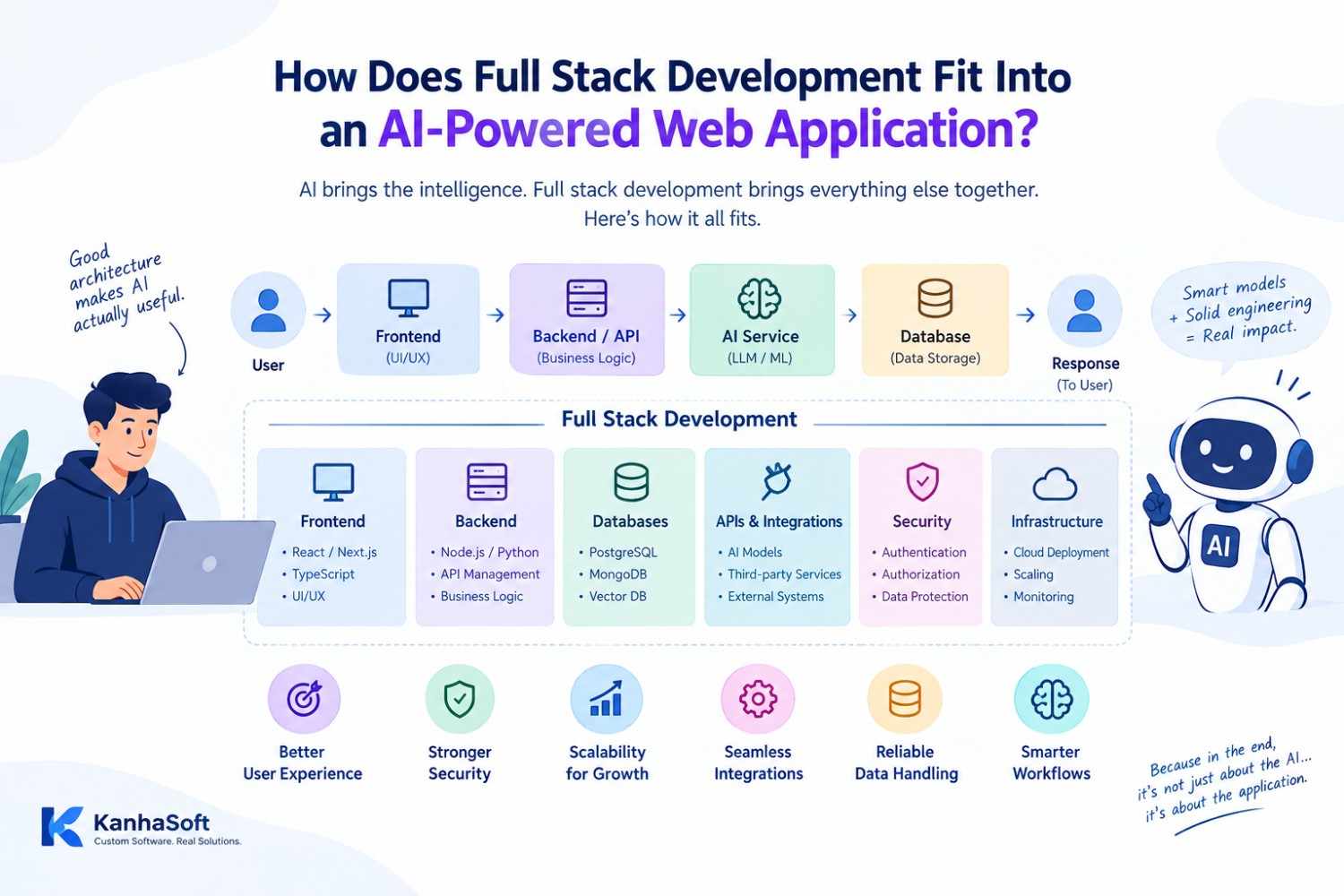
A simplified architecture can look like this:
User → Frontend → Backend/API → AI Service → Database/Business Logic → Response → User
Each layer has a specific responsibility.
The frontend provides the user experience. The backend manages application logic and communication. APIs connect different services. Databases store application information. The AI layer handles intelligent processing.
Full stack developers work across these layers and help ensure they communicate correctly.
This becomes particularly valuable when an AI feature needs access to real business data.
For example, a company may want to build an AI assistant that answers questions about its CRM data. The AI model may be capable of generating excellent responses, but it still needs a secure way to retrieve customer information, understand permissions, process the request, and return the result through a usable interface.
That entire process requires more than an AI model.
1. The Frontend: Where Users Interact With AI
The frontend is where users actually experience the AI functionality.
A well-designed AI application might include:
- AI chat interfaces
- Smart search
- Recommendation panels
- Predictive forms
- Intelligent dashboards
- AI-generated reports
- Content-generation tools
The frontend also needs to handle AI-specific behavior.
AI responses may take longer than a standard database query. A good interface can therefore display streaming responses, loading states, progress indicators, error messages, and conversation history.
For example, an AI customer-support application should not simply display a blank screen while waiting for a response. Users should understand that their request is being processed.
This sounds like a small detail, but small details often determine whether an AI feature feels useful or frustrating.
The goal is not simply to put an AI chatbot on a page and call the application intelligent. The experience needs to make sense from the user’s perspective.
2. The Backend: Connecting AI With Business Logic
If the frontend is where users interact with AI, the backend is where much of the serious coordination happens.
The backend can manage:
- AI API requests
- Authentication
- Authorization
- Business rules
- Data validation
- Database operations
- Third-party integrations
- Prompt and context management
- Error handling
Suppose a company builds an AI assistant for its sales team.
A sales employee asks:
“Which customers have not received a follow-up this month?”
The AI model should not simply guess the answer.
The backend can authenticate the employee, determine what data they are allowed to access, query the CRM database, retrieve the appropriate records, provide relevant context to the AI system, and return the processed result.
This is where full stack architecture becomes particularly important.
The AI generates intelligence, but the backend determines how that intelligence interacts with the actual application.
3. Databases Still Matter in AI Applications
AI may be the exciting part of the application, but databases remain one of the foundations.
An AI-powered application may need to store:
- User accounts
- Customer records
- Product information
- Conversation history
- Documents
- AI-generated results
- Application settings
- Usage information
Traditional databases such as PostgreSQL, MySQL, or MongoDB can handle many of these requirements depending on the application’s architecture.
AI applications may also use vector databases when semantic search or Retrieval-Augmented Generation (RAG) is required.
The important point is that AI does not remove the need for good data architecture.
In fact, it often makes data architecture more important.
An AI system working with inaccurate, incomplete, outdated, or poorly structured information can produce equally impressive-looking nonsense — which is still nonsense.
4. APIs Connect AI With the Application
APIs act as communication channels between different parts of the system.
An AI-powered web application may communicate with:
- AI model providers
- Payment gateways
- CRM platforms
- ERP systems
- Email services
- Analytics platforms
- Internal databases
- External data services
For example, the frontend may send a request to the backend.
The backend validates the request and communicates with an AI service.
The AI service processes the request and returns a response.
The backend then processes that response and sends the appropriate information back to the frontend.
This separation gives developers greater control over security, validation, logging, and business rules.
It also makes the architecture easier to maintain as the application grows.
5. How Full Stack Developers Integrate AI Models
Businesses do not necessarily need to build an AI model from scratch.
Depending on the project, developers may integrate:
- Third-party AI APIs
- Pre-trained models
- Open-source AI models
- Fine-tuned models
- RAG-based systems
- Specialized machine learning services
The right approach depends on the business problem.
For example, a company building an internal document assistant may not need to train a massive model. It may need a strong language model combined with secure document retrieval.
Similarly, an eCommerce application may need recommendation capabilities rather than a conversational AI system.
Full stack development helps connect the selected AI capability with the rest of the application.
This can include prompt handling, API communication, context management, response processing, authentication, database access, and frontend presentation.
The model is important, but how the model is used inside the product is equally important.
6. RAG and Full Stack Architecture
Retrieval-Augmented Generation, commonly called RAG, is an important architecture for applications that need AI responses based on specific information.
A simplified RAG workflow looks like this:
- The user submits a question.
- The application receives the request.
- Relevant information is retrieved from a data source.
- The retrieved information is provided as context.
- The AI model generates a response.
- The application displays the response to the user.
This can be useful for:
- Company knowledge bases
- Customer-support systems
- Legal document search
- Product documentation
- Internal business information
- Healthcare information systems
- Enterprise search
A RAG application typically requires several components working together — frontend, backend, database, vector database, embedding services, retrieval logic, and an AI model.
That is a full-stack problem with an AI layer added to it.
7. Security Becomes More Important With AI
AI-powered applications introduce additional security considerations.
An application may process sensitive customer information, internal documents, financial information, or proprietary business data.
Therefore, developers need to consider:
- Authentication
- Authorization
- Encryption
- Secure API key storage
- Access controls
- Data privacy
- Prompt injection
- Input validation
- Output validation
- Logging and monitoring
One important principle is simple: an AI system should not automatically have access to everything.
Permissions should still apply.
If an employee cannot access a particular customer record through the normal application, the AI assistant should not become a secret backdoor to that information.
This is another reason why AI functionality should be integrated through a secure application architecture rather than connected directly to everything.
8. Performance and Scalability in AI Web Applications
AI requests can require more processing and may take longer than traditional application requests.
As usage increases, developers may need to consider:
- Caching
- Asynchronous processing
- Request queues
- Streaming responses
- Load balancing
- Database optimization
- API optimization
- Usage monitoring
Imagine an AI application with ten users.
Almost any reasonable architecture may appear to work.
Now imagine ten thousand users sending AI requests at the same time.
Suddenly, architecture matters.
A scalable full-stack approach helps businesses move from an early prototype toward a production-ready application without rebuilding everything from scratch.
Planning for scale does not mean building the world’s largest infrastructure on day one. It means making sensible architectural decisions that leave room for growth.
9. Choosing the Right Technology Stack
There is no universal technology stack for every AI-powered web application.
A possible modern stack might include:
Frontend
- React
- Next.js
- TypeScript
Backend
- Node.js
- Python
- Other backend technologies based on project requirements
Databases
- PostgreSQL
- MySQL
- MongoDB
- Vector databases when required
AI Layer
- AI APIs
- Open-source models
- RAG frameworks
- Embedding services
Technology selection should depend on the application rather than trends.
A technology can be popular and still be the wrong choice for a particular product.
We typically look at factors such as scalability, development complexity, integrations, security, team expertise, maintenance requirements, and budget before deciding on an architecture.
Because “everyone is using it” is not exactly a technical requirement.
10. When Should Businesses Use Full Stack Development for AI Apps?
Full stack development can be particularly useful when AI is part of a larger business application.
Examples include:
- AI-powered SaaS platforms
- AI customer-support applications
- Intelligent CRM systems
- AI recommendation engines
- Document-processing applications
- Business automation platforms
- Internal AI knowledge bases
- AI-powered dashboards
For simpler applications, integrating an existing AI API into a web application may be enough.
For more advanced projects, businesses may also need dedicated AI/ML expertise.
The important thing is that these roles can complement one another.
AI specialists can focus on models, machine learning, data science, and AI-specific optimization.
Full stack developers can focus on the application that makes those capabilities accessible, secure, scalable, and useful.
11. A Practical Architecture for an AI-Powered Web Application
A typical architecture could look like this:
Frontend
↓
Backend / API Layer
↓
Authentication + Business Logic
↓
AI Integration Layer
↓
AI Model / RAG System
↓
Database + Vector Database
↓
External Services
The frontend manages interaction.
The backend manages application logic.
The AI integration layer manages communication with AI services.
The database stores application information.
The vector database can support semantic retrieval when required.
External services provide additional functionality.
This modular approach can also make future changes easier.
For example, if a business changes its AI provider later, the entire frontend may not need to be redesigned. A properly separated AI integration layer can reduce the impact of such changes.
12. Common Mistakes to Avoid
AI projects can become complicated quickly, particularly when businesses focus heavily on the model and overlook the application around it.
Some common mistakes include:
Adding AI Without a Clear Business Purpose
AI should solve a meaningful problem rather than exist simply because it is fashionable.
Ignoring Data Quality
Poor data can reduce the usefulness of AI responses.
Exposing API Keys
Sensitive credentials should never be exposed through frontend code.
Giving AI Unlimited Data Access
Access should follow application permissions and security rules.
Ignoring Scalability
A prototype and a production application have very different requirements.
Choosing Technology Only Because It Is Trending
Technology decisions should follow project requirements.
Forgetting Monitoring
AI usage, response quality, failures, latency, and costs should be monitored after deployment.
These mistakes are avoidable when AI development begins with application architecture rather than jumping straight into model integration.
13. How a Web Application Development Company Can Approach AI Projects
AI development works best when technical implementation starts with a clear understanding of the business problem.
A structured approach can include:
- Requirement analysis
- AI use-case identification
- UI/UX planning
- Technical architecture
- AI model selection
- Database planning
- API integration
- Application development
- Security and testing
- Deployment
- Monitoring and maintenance
A web application development company working on an AI product also needs to consider how the application will evolve.
The first version may use one AI provider and a simple database. Later, the business may require RAG, multiple AI models, advanced analytics, or enterprise integrations.
A flexible architecture makes these changes easier to manage.
14. The Future of Full Stack Development in AI Applications
AI is gradually becoming a standard capability inside modern software rather than a separate technology category.
We can expect more applications to include:
- AI agents
- Intelligent search
- Automated workflows
- Personalized experiences
- AI-powered business dashboards
- Real-time AI assistance
- RAG-based enterprise knowledge systems
- AI features inside CRM and ERP platforms
As this happens, the boundary between traditional application development and AI development will continue to become less obvious.
The successful applications will not simply have the best AI model.
They will combine useful AI capabilities with good user experience, reliable backend architecture, secure data handling, scalable infrastructure, and clear business workflows.
Conclusion
AI can make a web application smarter, faster, and more capable — but it cannot replace solid software architecture.
The frontend still needs to provide a useful experience. The backend still needs to manage business logic. Databases still need to store reliable information. APIs still need to communicate securely. Authentication still needs to protect users and data.
Full stack development brings these pieces together.
When AI is integrated into a well-designed application, businesses can move beyond impressive demonstrations and build products that actually solve problems.
That is ultimately where the real value lies.
Because an AI model can be incredibly intelligent — but without a well-built application around it, it is still waiting for someone to give it a job.
FAQs
1. What is full stack development in an AI-powered web application?
Full stack development covers the frontend, backend, databases, APIs, authentication, and infrastructure required to build a complete web application. In an AI-powered application, these components also connect with AI models and related services.
2. Can full stack developers build AI-powered web applications?
Yes. Full stack developers can build the application architecture and integrate AI models, APIs, databases, and user interfaces. Projects involving advanced machine learning may also benefit from specialized AI/ML engineers.
3. What technologies are commonly used for AI-powered web applications?
Common technologies include React, Next.js, TypeScript, Node.js, Python, PostgreSQL, MongoDB, vector databases, AI APIs, and RAG-related technologies. The appropriate stack depends on the application’s requirements.
4. How does RAG work in a full stack AI application?
RAG retrieves relevant information from an application’s data sources and provides that information to an AI model as context. The model then generates a response based on the retrieved information.
5. Why is backend development important for AI applications?
The backend manages business logic, authentication, authorization, database access, API communication, AI integration, validation, and security. It acts as an important control layer between the user interface and AI services.
6. Is a database necessary for an AI-powered web application?
Most production applications require some form of data storage. The specific database depends on the application. Traditional databases may handle structured information, while vector databases can support semantic search and RAG workflows.
7. How can AI be added to an existing web application?
Businesses can identify a suitable AI use case, select an AI model or service, create secure API integrations, connect relevant application data, build the required frontend experience, test the functionality, and deploy it with appropriate monitoring and security controls.
8. How much does it cost to build an AI-powered web application?
The cost varies based on application complexity, AI model usage, integrations, database requirements, security, infrastructure, development time, and expected scale. A simple AI feature can require significantly less investment than a complete AI SaaS platform.