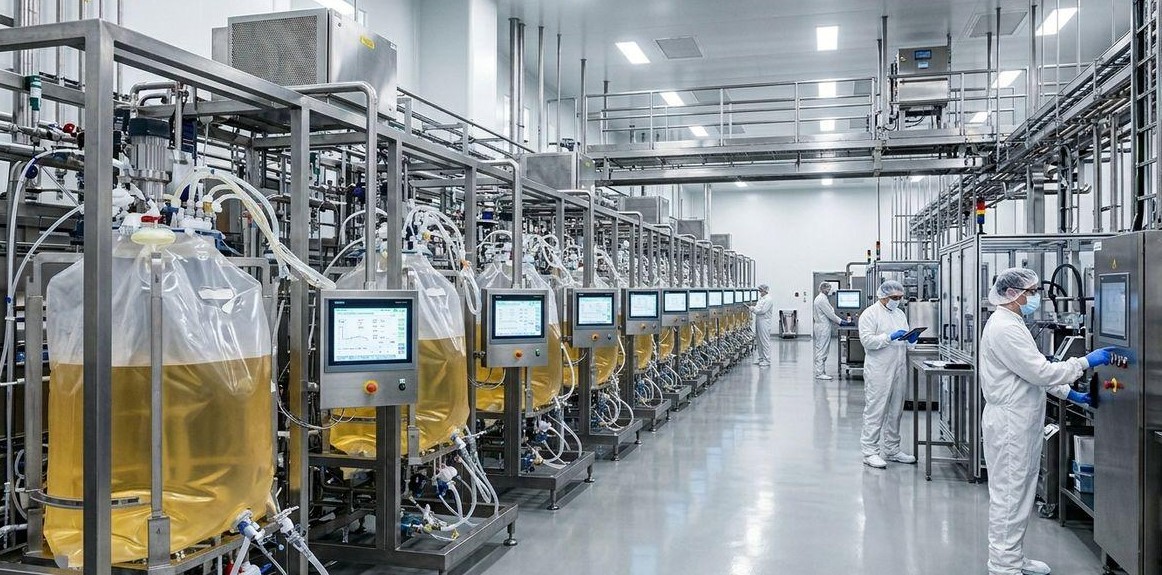
Allogeneic cell therapies use cells from a donor to treat multiple patients, creating opportunities for more standardized production than patient-specific approaches. Instead of manufacturing a separate product for every individual, developers can potentially produce larger batches from selected donor material and distribute doses across multiple patients.
This model can improve manufacturing efficiency, but it also introduces significant technical and operational requirements. Successful allogeneic cell therapy manufacturing depends on controlling biological variability, maintaining product quality, achieving reproducible processes, and developing a manufacturing model that can support increasing demand.
For developers moving from research or clinical development toward larger-scale production, manufacturing strategy should be considered early. Process design, raw material selection, automation, quality control, and facility planning can all influence the scalability of an allogeneic cell therapy.
Understanding the Allogeneic Manufacturing Model
Allogeneic therapies require a carefully controlled starting material because donor-derived cells become the foundation of the manufacturing process. Donor selection, collection, qualification, and material handling can therefore influence downstream production.
Unlike an autologous model, where the starting material is associated with an individual patient, an allogeneic approach can potentially support multiple doses from a single manufacturing campaign. This creates an opportunity to develop standardized production processes, but it also places greater emphasis on consistency between batches.
A robust allogeneic manufacturing process should therefore define critical process parameters, material requirements, quality attributes, and appropriate controls from the earliest development stages.
1. Design the Process for Scalability
Scalability should not be treated as a final-stage manufacturing problem. Developers should consider commercial production requirements while establishing the initial process.
A process that performs well at laboratory scale may become difficult to manage when production volume increases. Changes in mixing, oxygen transfer, nutrient availability, cell density, equipment configuration, and process duration can affect performance.
For scalable cell therapy manufacturing, developers should identify which process steps are most sensitive to scale changes and evaluate appropriate equipment early. Process characterization can help determine which parameters require tighter control as production expands.
The objective is not simply to produce more cells. It is to increase output while preserving critical product characteristics.
2. Establish Consistent Starting Materials
Starting-material variability can create downstream manufacturing challenges. For allogeneic products, developers should establish clear criteria for donor material and associated processing steps.
Depending on the therapy, relevant considerations may include donor qualification, cell characteristics, collection procedures, storage conditions, and transportation requirements.
Standardized sourcing and material handling can reduce unnecessary variation. Establishing defined specifications also helps manufacturing teams identify deviations before they affect later stages of production.
A well-designed material strategy is particularly important when a single donor-derived starting material is expected to support multiple manufacturing batches.
3. Optimize Cell Expansion and Process Conditions
Cell expansion is often a central component of cell therapy process development. Manufacturers must create conditions that encourage appropriate cell growth while maintaining the characteristics required for the final therapeutic product.
Process conditions can include culture media, supplements, temperature, gas conditions, cell density, feeding strategy, and culture duration. Small changes can sometimes influence cell phenotype, viability, functionality, or yield.
For this reason, developers should use structured process development and characterization rather than relying solely on trial-and-error optimization.
The selected expansion strategy should also be compatible with future manufacturing requirements. A process that depends heavily on manual intervention may become difficult to scale efficiently.
4. Use Automation and Closed Processing
Automation can play an important role in improving reproducibility and reducing manual handling. Advanced manufacturing platforms can standardize repetitive operations and support more consistent process execution.
Closed or functionally closed systems can also help reduce contamination risks and minimize unnecessary environmental exposure. These approaches may be particularly valuable as manufacturers increase production volumes or operate multiple batches.
However, automation should support a clearly understood process rather than replace process knowledge. Manufacturers need to define appropriate controls, monitoring strategies, and acceptance criteria before introducing automated equipment into a GMP environment.
5. Build Quality Into the Manufacturing Process
Quality should be designed into the process rather than evaluated only at the end of production. A strong allogeneic cell therapy quality control strategy connects raw materials, process parameters, in-process testing, and final product testing.
Depending on the product, manufacturers may evaluate attributes such as identity, purity, viability, potency, sterility, and other product-specific characteristics.
Critical quality attributes should be linked to the biological and clinical characteristics of the therapy. This relationship helps manufacturers determine which process parameters require the greatest control.
A quality-by-design mindset can also make future process changes easier to evaluate because teams have a clearer understanding of how manufacturing conditions influence product quality.
6. Plan for GMP Manufacturing Early
Transitioning from development into GMP production can create challenges if manufacturing requirements are considered too late.
GMP cell therapy manufacturing requires controlled facilities, qualified equipment, documented procedures, trained personnel, appropriate environmental monitoring, and robust quality systems.
Developers should therefore consider GMP expectations while designing early processes. Materials, equipment, analytical methods, and manufacturing procedures may eventually need to support validation or qualification activities.
Early planning can reduce the need for major process changes later and create a smoother pathway toward clinical manufacturing.
7. Develop a Practical Scale-Up and Scale-Out Strategy
There is no single approach to increasing allogeneic cell therapy production. Some platforms may benefit from larger-capacity systems, while others may use multiple standardized manufacturing units.
Scale-up increases production capacity within a process or system, whereas scale-out can involve running additional parallel units. The appropriate strategy depends on the biology of the product, equipment capabilities, facility design, batch requirements, and commercial demand.
Manufacturers should evaluate these options using measurable criteria such as yield, process consistency, labor requirements, equipment utilization, contamination risk, and cost.
8. Strengthen Supply Chain and Manufacturing Logistics
Scalable manufacturing also requires a reliable supply chain. Media, reagents, single-use components, raw materials, analytical supplies, and other manufacturing inputs must be available at the required quality and quantity.
Supply interruptions can affect production schedules and increase operational risk. Manufacturers should therefore identify critical materials, establish appropriate supplier controls, and evaluate potential alternatives where scientifically and operationally feasible.
Inventory planning becomes especially important as production expands because the consequences of a material shortage can increase with batch size and manufacturing complexity.
Building a Future-Ready Manufacturing Strategy
The most effective approach to scalable allogeneic cell therapy manufacturing combines process understanding with operational planning. Developers should evaluate scalability, automation, quality systems, analytical methods, supply chain requirements, and facility needs as interconnected components.
Technology selection should follow process requirements rather than drive them. At the same time, manufacturing teams should maintain enough flexibility to accommodate process improvements as scientific knowledge develops.
Early collaboration between research, process development, manufacturing, quality, regulatory, and supply chain teams can help identify potential bottlenecks before they become costly problems.
Conclusion
Allogeneic cell therapies offer an opportunity to develop more standardized manufacturing models, but achieving reliable large-scale production requires careful planning. Starting-material consistency, process optimization, automation, quality control, GMP readiness, scalability, and supply chain resilience all contribute to manufacturing success.
A strong allogeneic cell therapy manufacturing strategy begins with scalability in mind. By designing reproducible processes, selecting appropriate technologies, controlling critical quality attributes, and preparing manufacturing infrastructure early, developers can create a stronger foundation for clinical and commercial production.
As the cell therapy field continues to mature, manufacturing strategies that prioritize consistency, flexibility, and process understanding will remain essential for translating promising allogeneic therapies into practical, scalable products.