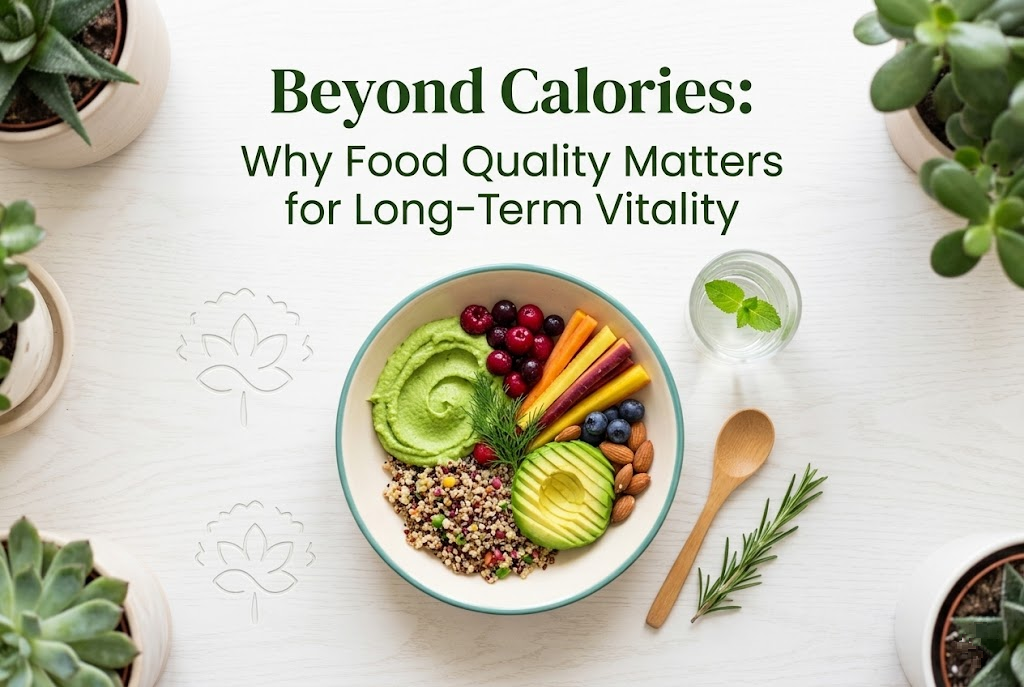
Food quality determines long-term health outcomes by influencing metabolic pathways, hormonal signals, and cellular repair, whereas calorie counting merely tracks energy volume. Prioritising nutrient-dense whole foods ensures the body receives the essential vitamins, minerals, and phytonutrients required for peak biological function and disease prevention.
The Biological Reality of Food Quality
Food quality is the nutritional value and chemical composition of a substance relative to its impact on human physiology. While a calorie is a unit of energy, the body does not process all energy units in the same manner. The source of those calories dictates how the body stores fat, regulates hunger, and maintains energy levels.
The “calorie in, calorie out” model is an oversimplification of human metabolism. Metabolism is a complex chemical factory, not a simple furnace. For instance, 100 calories of broccoli and 100 calories of refined sugar trigger vastly different biological responses. The broccoli provides 3 grams of fibre, which slows glucose absorption, whereas the sugar causes an immediate insulin spike that promotes fat storage.
3 Key Functions of High-Quality Nutrition
Nutrient-dense foods perform specific tasks that empty calories cannot replicate. These functions are essential for maintaining “Homeostasis,” the state of steady internal physical and chemical conditions maintained by living systems.
-
Hormonal Regulation: Quality fats and proteins provide the building blocks for hormones like Oestrogen, Testosterone, and Thyroid hormones.
-
Cellular Repair: Antioxidants found in colourful vegetables neutralise free radicals, preventing DNA damage.
-
Metabolic Efficiency: B vitamins found in whole grains act as co-factors that allow the mitochondria to convert food into usable cellular energy (ATP).
The Hormonal Impact of Macronutrient Sources
Hormones dictate hunger, satiety, and fat distribution based on the quality of food consumed. Two primary hormones, Insulin and Leptin, respond specifically to the type of carbohydrate or fat entering the system.
When an individual consumes highly processed carbohydrates, such as white bread, pastries, or sweetened cereals, the pancreas releases high levels of insulin. Persistent high insulin levels lead to insulin resistance, a condition where cells no longer respond to the hormone, resulting in systemic inflammation. Conversely, consuming high-quality fats, such as those found in avocados, walnuts, and extra virgin olive oil, promotes the release of Cholecystokinin (CCK). This hormone signals the brain that the body is full, preventing overeating.
Comparing Hunger Signals: A Quantitative View
| Food Type | Primary Hormone Triggered | Duration of Satiety | Impact on Blood Sugar |
| Processed Carbs | Insulin | 60–90 Minutes | High Spike/Crash |
| Lean Protein | Glucagon/PYY | 3–4 Hours | Stable |
| Healthy Fats | CCK/Leptin | 4–5 Hours | Minimal Impact |
Micronutrients: The Hidden Drivers of Vitality
Micronutrients are the vitamins and minerals required by the body in small amounts to orchestrate various physiological functions. While calories provide the fuel, micronutrients provide the tools for the “engine” to run smoothly.
A diet high in calories but low in quality often leads to “hidden hunger,” a state where an individual is overweight but malnourished. There are 13 essential vitamins and 14 essential minerals that the body requires for survival. Deficiencies in these nutrients lead to specific health failures. For example, a lack of Magnesium results in poor sleep and muscle cramps, while a deficiency in Vitamin D impairs immune function and bone density.
By choosing whole foods, you consume a synergy of nutrients. Water Grass Wellness emphasizes this gentle, bespoke approach to nutrition, focusing on how supportive rhythms and whole-food choices create a sustainable mindset for health.
The Role of Fibre in Disease Prevention
Fibre is a non-digestible carbohydrate found in plant foods that regulates the digestive system and feeds the gut microbiome. High-quality diets contain a minimum of 25 to 30 grams of fibre per day.
There are 2 main types of fibre:
-
Soluble Fibre: Found in oats, beans, and apples; it dissolves in water to form a gel-like material, lowering blood cholesterol and glucose levels.
-
Insoluble Fibre: Found in whole-wheat flour, nuts, and cauliflower; it promotes the movement of material through the digestive system and increases stool bulk.
A diet rich in diverse fibres supports a healthy gut microbiome. A flourishing microbiome consists of trillions of bacteria, such as Lactobacillus and Bifidobacterium, which produce short-chain fatty acids. These acids reduce inflammation and strengthen the intestinal barrier.
Thermic Effect of Food: Why Protein Wins
The Thermic Effect of Food (TEF) is the amount of energy required to digest, absorb, and process nutrients. Not all calories are burned with the same efficiency during digestion.
Protein has the highest TEF, requiring 20% to 30% of its energy content just for processing. In contrast, carbohydrates require 5% to 10%, and fats require 0% to 3%. This means that if you consume 100 calories of lean protein, like grilled chicken or tempeh, your body effectively nets only 70 to 80 calories. Choosing high-quality protein sources increases your metabolic rate and preserves lean muscle mass during weight loss.
Avoiding Pro-Inflammatory “Low-Calorie” Traps
Marketing labels often use the term “Low-Calorie” to mask poor food quality. Many diet products contain artificial additives, such as aspartame, maltodextrin, and emulsifiers, which disrupt gut health and trigger inflammation.
Inflammation is the root cause of 7 out of 10 leading causes of death, including heart disease and Type 2 diabetes. High-quality foods are naturally anti-inflammatory. These include:
-
Cruciferous vegetables: Broccoli, kale, and Brussels sprouts.
-
Omega-3 rich seeds: Chia seeds, flaxseeds, and hemp seeds.
-
Allium vegetables: Garlic, onions, and leeks.
Pros and Cons: Calorie Counting vs. Quality Focus
| Approach | Pros | Cons |
| Calorie Counting | Precise energy tracking; Useful for short-term weight loss. | Ignores hunger signals; Can lead to nutrient deficiencies; Often stressful. |
| Quality Focus | Naturally regulates appetite; High energy levels; Improves skin and sleep. | Requires more meal preparation; Can be more expensive initially. |
Target Audience and Situational Relevance
Focusing on food quality is particularly relevant for women navigating hormonal shifts, busy professionals requiring sustained cognitive focus, and athletes looking for efficient recovery.
In situations of high stress, the body depletes Vitamin C and Magnesium at an accelerated rate. During these times, eating 500 calories of nutrient-dense berries and nuts is infinitely more beneficial than 500 calories of “diet” snack bars. The former provides the chemical support the adrenal glands need to manage cortisol, while the latter adds chemical stress to the liver.
Summary of Long-Term Benefits
Transitioning from a quantity-based mindset to a quality-based mindset yields 4 major long-term advantages:
-
Stable Moods: Blood sugar stability prevents the irritability and “brain fog” associated with glucose crashes.
-
Enhanced Longevity: High-quality phytonutrients slow the biological aging process at a cellular level.
-
Automatic Weight Management: When the body is nourished, the brain naturally suppresses hunger signals.
-
Stronger Immunity: 70% of the immune system resides in the gut, which thrives on high-quality, fibrous foods.
Vitality is the result of consistent, high-quality inputs. By prioritising the source and integrity of your food over the mere number on a label, you empower your body to function as it was designed—with energy, clarity, and resilience.