
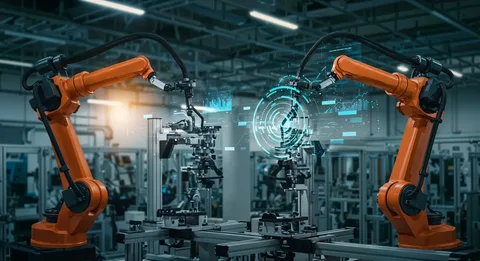
Robotics manufacturing is transforming modern industries by improving precision, reducing production time, and increasing overall efficiency. As companies adopt automation technologies, they are experiencing fewer errors, lower operational costs, and higher product consistency. The integration of intelligent machines into production lines is no longer optional—it has become a competitive necessity in today’s fast-paced industrial world.
In this article, we will explore how robotics manufacturing enhances quality and efficiency across different sectors, and why businesses are increasingly investing in automated systems.
Enhanced Precision and Product Quality
One of the biggest advantages of robotics manufacturing is its ability to deliver extremely high precision. Unlike human workers, robots do not suffer from fatigue or distractions, which allows them to perform repetitive tasks with consistent accuracy. This results in fewer production errors and improved product quality across large-scale manufacturing processes.
Moreover, robotics systems can be programmed to follow exact specifications, ensuring that every product meets strict quality standards. Industries such as automotive, electronics, and aerospace heavily rely on this precision to maintain safety and performance requirements.
Key benefits of precision in robotics manufacturing:
- Consistent product quality with minimal variation
- Reduced human error in repetitive tasks
- High accuracy in complex assembly processes
- Improved compliance with industry standards
- Better customer satisfaction due to reliable products
Increased Production Speed and Efficiency
Robotics manufacturing significantly accelerates production cycles by operating continuously without breaks. Unlike human labor, robots can work 24/7, which leads to higher output within shorter timeframes. This continuous operation helps businesses meet growing market demand efficiently.
In addition, robots streamline workflow by performing tasks faster and more efficiently than manual processes. This reduces bottlenecks in production lines and ensures smoother operations from start to finish.
How robotics improves production speed:
- 24/7 continuous operation without downtime
- Faster execution of repetitive manufacturing tasks
- Reduced production bottlenecks
- Optimized assembly line workflows
- Higher output in less time
Cost Reduction and Resource Optimization
Another major advantage of robotics manufacturing is cost efficiency. While initial investment in automation systems may be high, long-term savings are significant. Companies reduce labor costs, material waste, and production inefficiencies by implementing robotic systems.
Robots are also highly efficient in resource utilization. They are programmed to minimize waste, use materials precisely, and operate at optimal energy levels, which further reduces overall production costs.
Cost-saving advantages of robotics manufacturing:
- Lower long-term labor costs
- Reduced material waste during production
- Improved energy efficiency
- Fewer production errors and rework costs
- Higher return on investment over time
Improved Workplace Safety and Risk Reduction
Robotics manufacturing plays a crucial role in improving workplace safety. Many industrial tasks involve hazardous environments, heavy lifting, or exposure to dangerous materials. Robots can take over these high-risk tasks, reducing the chances of workplace injuries.
By assigning dangerous operations to machines, companies create safer working conditions for human employees. Workers can then focus on supervision, maintenance, and quality control instead of physically risky tasks.
Safety improvements in robotics manufacturing:
- Reduced exposure to hazardous environments
- Lower risk of workplace injuries
- Automation of heavy lifting and dangerous tasks
- Improved compliance with safety regulations
- Safer overall production environment
Flexibility and Smart Manufacturing Integration
Modern robotics manufacturing systems are highly flexible and can be reprogrammed for different tasks. This allows manufacturers to quickly adapt to changing market demands without redesigning entire production lines. Such flexibility is essential in industries with rapidly evolving product requirements.
Additionally, robotics manufacturing is a key part of smart factories, where machines are connected through IoT and AI systems. This integration enables real-time monitoring, predictive maintenance, and data-driven decision-making for improved efficiency.
Flexibility and smart system advantages:
- Easy reprogramming for different production tasks
- Quick adaptation to market changes
- Integration with AI and IoT technologies
- Real-time production monitoring
- Predictive maintenance to reduce downtime
Conclusion
Robotics manufacturing is revolutionizing the industrial landscape by enhancing quality, speed, cost efficiency, safety, and flexibility. Businesses that adopt automation technologies gain a strong competitive advantage through improved productivity and reduced operational risks.
As technology continues to evolve, robotics manufacturing will become even more intelligent and accessible, making it a core component of future industrial growth. Companies that invest early in automation will be better positioned to lead in innovation and efficiency in the years ahead.