1. Why the Counter Still Matters in Modern Retail
The counter is one of those retail areas people sometimes overlook. That’s a mistake. Customers naturally spend time there, especially when they are checking out, asking questions, or waiting for staff. A smart retail counter display can turn that ordinary space into a useful merchandising area without making the store feel crowded.
The goal isn’t to throw products everywhere. Nobody wants that. The goal is to place the right product, message, or brand detail directly in front of the customer at the right moment. A well-designed counter display can support impulse purchases, highlight new products, reinforce branding, and make the checkout experience more interesting. Small space, but it can do a lot.
2. Good Displays Should Work, Not Just Look Good
There are plenty of attractive retail displays that simply sit there. They look nice in photographs, but they don’t really help the store sell anything. That’s where practical design becomes important.
A useful display needs to consider product visibility, customer movement, staff access, durability, and the actual size of the merchandise. If employees have to move the display every few minutes just to complete a transaction, it isn’t doing its job.
The best retail fixtures feel like part of the store rather than an object dropped onto a counter. They support the shopping experience quietly. That matters more than flashy design.
3. Turning Small Counter Space Into Selling Space
Not every retailer has a huge showroom. Some stores are working with tight floor plans where every inch needs to earn its place. Countertops can help solve that problem.
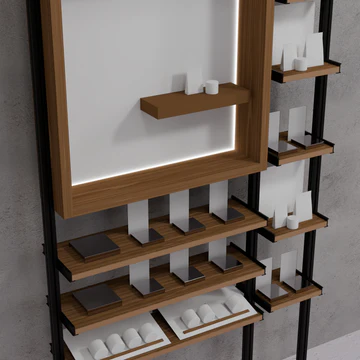
A compact display stand can introduce another merchandising opportunity without taking over valuable floor space. Products can be positioned at eye level, grouped around a particular campaign, or presented alongside related merchandise. Even packaging information can become part of the display experience.
This is especially useful for retailers carrying smaller products. Instead of keeping everything behind the counter or packed onto shelves, selected products can be presented where customers naturally look. It makes the merchandise easier to notice, and sometimes that little bit of visibility is all a customer needs.
4. Where a Dispensary Display Case Fits In
In cannabis retail, presentation has an even bigger role. Customers often want to understand products, packaging, brands, and differences before making a purchase. A dispensary display case gives retailers a controlled and organized way to present merchandise while keeping the store looking professional.
It also helps create separation between different product categories and brands. That can make the shopping process less confusing. Instead of customers staring at rows of products and trying to figure everything out, thoughtful merchandising gives them some visual direction.
For dispensaries, security and accessibility also matter. A display needs to fit the operational side of the business, not just the visual side. Staff should be able to manage products easily while customers can still get a clear look at what is being presented.
5. Branding Needs More Than a Logo
Putting a logo on a fixture doesn’t automatically make it a strong brand display. Real branding comes from the complete presentation.
Materials, graphics, spacing, product positioning, lighting, and even the shape of the fixture can influence how a customer sees a company. A retailer selling premium products probably doesn’t want a cheap-looking fixture sitting underneath them. It sends the wrong message before anyone says a word.
This is where custom retail displays can make sense. They allow businesses to build a merchandising setup around their actual products and brand personality instead of forcing everything into a generic format. Sometimes standard works fine. Other times, it really doesn’t.
6. Flexibility Is Becoming More Important
Retail changes fast. A promotion runs for a few weeks. Packaging gets updated. A new product arrives. Then another campaign comes along. Fixtures that cannot adapt quickly can become expensive problems.
Modern modular display systems give retailers more flexibility. Components can often be adjusted, moved, or reconfigured as merchandising needs change. That means the fixture can stay useful for longer instead of being replaced every time the marketing plan changes.
The same thinking applies to magnetic display systems and refreshable graphics. When information can be changed without replacing the entire fixture, retailers have more freedom to experiment. That’s useful for stores that regularly update messaging or feature different brands.
7. Customer Attention Is Limited
Customers don’t walk into a store ready to study every product. They scan. They notice something, ignore something else, and keep moving. Retailers have only a short window to create interest.
A well-positioned retail counter display can take advantage of that behavior. It puts a selected product or message into an area where attention is already happening. But there’s a fine line here.
Too much information creates noise. Too many products make everything look less important. Strong merchandising is often about editing rather than adding. Pick the product. Give it room. Make the message easy to understand. Then let the customer decide.
That simple approach can work better than an overloaded fixture.
8. Materials and Construction Matter More Than Expected
A display may look perfect when it first arrives, but retail environments can be rough on fixtures. Customers touch things. Staff move products. Cleaning happens constantly. Boxes get placed nearby. Accidents happen.
That’s why construction should be considered from the start. Durable materials, stable construction, easy-to-clean surfaces, and sensible product access can make a major difference over time.
Retail display fixtures are an investment, even when they are relatively small. Replacing a fixture every year because it starts looking worn isn’t really saving money. A better-built solution can continue supporting the store while maintaining a professional appearance.
It doesn’t need to be over-engineered either. It just needs to survive real retail life.
9. Choosing the Right Display for Your Store
There isn’t one perfect display for every retailer. The right option depends on the products, available space, customer journey, branding, and sales goals.
A business might need a simple countertop display stand for featured products. Another may need a larger branded fixture that connects the counter to surrounding merchandising. A dispensary could need secure presentation combined with clear product visibility.
Start with the purpose, not the fixture. What needs to be displayed? Where will customers see it? How often will the content change? Can staff use it easily? Will it still make sense six months from now?
Those questions are more useful than simply asking which display looks the coolest. Honestly, appearance matters, but function has to come first.
10. The Right Display Becomes Part of the Experience
A good retail display doesn’t feel like advertising. It feels like part of the store.
That’s the real opportunity with counter merchandising. A carefully designed display can introduce products, strengthen a brand, improve organization, and create another point of customer interaction without requiring a major remodel.
For dispensaries and other specialty retailers, the same principle applies to larger product presentation areas. A well-planned dispensary display case can create structure and professionalism, while a flexible counter fixture can keep key products visible during everyday transactions.
The best displays are not disposable decorations. They are working parts of the retail environment. When they are designed properly, they keep doing their job long after the initial installation.
Conclusion: Make the Counter Earn Its Space
Retail space is expensive, even when that space is only a few feet wide. A counter should do more than hold a payment terminal and a stack of receipts.
With the right retail counter display, that space can become another useful merchandising touchpoint. It can bring attention to products, support branding, and make the customer experience feel more intentional.
The key is not to overcomplicate things. Build for the products, the customers, and the way the store actually operates. Do that well, and the display stops being just another fixture. It becomes part of the business.
FAQs About Retail Counter Displays
What is a retail counter display?
A retail counter display is a merchandising fixture placed on or around a checkout or service counter. It is typically used to highlight products, promotions, branding, or useful product information in a high-visibility area.
Why are retail counter displays effective?
They place products directly in front of customers during a natural pause in the shopping journey. This can increase product visibility, encourage impulse purchases, and create another opportunity for brand communication.
What should a good retail counter display include?
A good display should provide clear product visibility, stable construction, easy staff access, appropriate sizing, and branding that fits the surrounding store. It should also avoid creating unnecessary clutter.
Are custom retail displays better than standard fixtures?
It depends on the retailer. Standard fixtures can work well for simple merchandising needs. Custom retail displays become more valuable when a business needs specific dimensions, branding, product positioning, or a particular customer experience.
What is a dispensary display case used for?
A dispensary display case provides an organized way to present cannabis products and brands while supporting the operational needs of the dispensary. Design should consider visibility, accessibility, security requirements, and the overall shopping environment.
Can a retail counter display be updated?
Yes. Many modern display solutions are designed with flexibility in mind. Modular components, interchangeable graphics, and magnetic systems can make it easier to update messaging, promotions, and product presentation without replacing the entire fixture.