

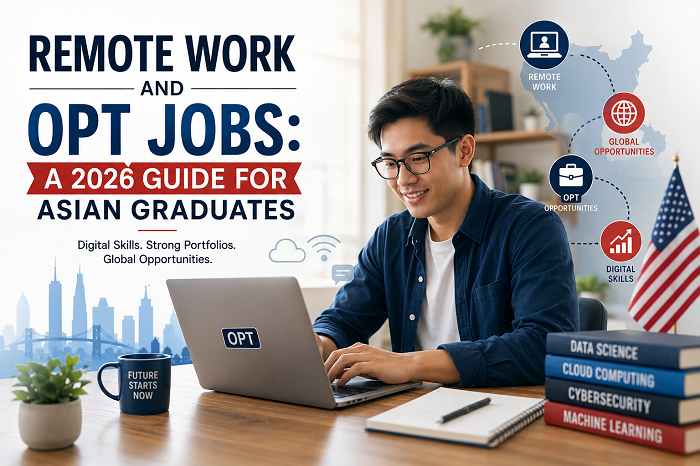
For international students, graduating from a U.S. university is only the beginning of the journey. The next challenge is finding employment through Optional Practical Training (OPT), where competition has become increasingly intense. Employers are no longer satisfied with academic transcripts or lists of technical skills. They want candidates who can demonstrate practical experience, solve real-world problems, and contribute immediately. That’s why building an OPT portfolio has become one of the smartest investments Asian graduates can make before entering the job market.
A strong portfolio gives recruiters something far more valuable than a resume—it provides proof. Whether you’re applying for software engineering, data science, cybersecurity, cloud computing, business analytics, or AI roles, your portfolio demonstrates what you can actually build. In today’s skills-first hiring environment, that evidence often matters more than your university ranking or GPA.
Why Every Student Needs an OPT Portfolio
The hiring landscape has changed dramatically over the past few years. Companies now receive applications from candidates worldwide, especially for remote and hybrid positions. Recruiters frequently rely on Applicant Tracking Systems (ATS) to filter resumes before a human even reviews them. Those who make it through this first stage have only a few seconds to capture attention.
An impressive OPT portfolio immediately separates you from the crowd.
Instead of claiming proficiency in Python, Java, SQL, Data Science, AWS, or machine learning, your portfolio allows employers to verify those skills. They can explore your GitHub repositories, review dashboards you’ve built, examine deployed applications, or read documentation explaining your problem-solving approach.
Employers increasingly prefer candidates who require minimal onboarding. When your portfolio showcases practical projects, you signal that you’re already capable of contributing to production environments rather than simply completing classroom assignments.
Focus on Meaningful Projects
One of the biggest misconceptions among students is that they need dozens of projects to impress recruiters. Quantity rarely wins.
A small collection of carefully developed projects almost always outperforms a GitHub profile filled with unfinished tutorials or copied coursework.
Each project in your OPT portfolio should answer several important questions:
- What problem were you solving?
- Why did the project matter?
- Which technologies did you use?
- What challenges did you overcome?
- What measurable results did you achieve?
For example, instead of uploading another weather application tutorial, build something with practical value. Create a cloud-hosted inventory management system, an AI-powered resume screening tool, a cybersecurity monitoring dashboard, or a business analytics platform using real public datasets.
Projects that solve genuine problems create memorable conversations during interviews.
Build Around Your Career Goals
Your portfolio should tell a consistent professional story.
Recruiters want specialists, not generalists who appear to know a little about everything.
Students pursuing software engineering careers should demonstrate strong backend architecture, APIs, databases, authentication systems, testing frameworks, and deployment pipelines.
Those interested in cloud computing can showcase:
- AWS or Azure deployments
- Docker containers
- Kubernetes clusters
- CI/CD automation
- Infrastructure as Code
- Monitoring dashboards
Data science students should include projects featuring:
- Data cleaning
- Exploratory data analysis
- Interactive dashboards
- Predictive modeling
- Machine learning
- Business recommendations
Cybersecurity students can develop penetration testing labs, vulnerability assessments, SIEM dashboards, security automation scripts, or digital forensic investigations.
When every project aligns with your target role, recruiters quickly understand your expertise.
GitHub Is Your Digital Resume
GitHub has evolved into much more than a code repository.
Many hiring managers visit GitHub before scheduling interviews, making it one of the most important components of your OPT portfolio.
Each repository should include:
- A professional README
- Installation instructions
- Architecture diagrams
- Screenshots
- Live deployment links
- Technologies used
- Future improvements
- License information
Organize your profile by pinning your strongest repositories rather than every project you’ve ever completed.
Remember that recruiters may spend less than a minute reviewing your profile. Make that minute count.
Create a Professional Online Presence
Your portfolio extends beyond GitHub.
Recruiters often search your name online before making hiring decisions.
Consider creating a personal website that includes:
- Professional biography
- Resume download
- Featured projects
- Technical blogs
- Certifications
- Contact information
Update your LinkedIn profile with project highlights, internship experiences, certifications, and measurable achievements.
If you’re involved in data science, Kaggle competitions provide additional credibility. Developers can contribute to open-source projects, while cybersecurity students can participate in Capture the Flag competitions or publish security write-ups.
Every online platform should reinforce the same professional identity.
Remote Work Has Increased Portfolio Expectations
Remote hiring has changed employer expectations.
Since companies cannot easily observe candidates in person, they rely more heavily on portfolios to evaluate technical ability and communication skills.
Recruiters look for evidence that applicants understand collaborative development using tools like Git, GitHub, Jira, Slack, Microsoft Teams, Docker, and cloud-based development environments.
Demonstrating remote collaboration through open-source contributions, group university projects, freelance work, or virtual internships adds significant value to your OPT portfolio.
It shows that you can work effectively across different locations, manage your own time, and communicate clearly without constant supervision.
These are qualities employers increasingly prioritize.
Academic Success Still Supports Career Growth
While employers focus heavily on practical skills, academic performance still matters for international students. Strong grades help maintain eligibility requirements, strengthen internship applications, and demonstrate discipline.
Balancing coursework, internship applications, interview preparation, networking, and portfolio development can become overwhelming during the final year of university.
Many international students rely on learning resources such as Expertsmind.com’s subject expert network to better understand complex engineering, computer science, mathematics, and management subjects. Responsible academic guidance can reduce study pressure, allowing students to dedicate additional time to developing portfolio projects that showcase practical workplace skills.
Employers appreciate candidates who combine academic consistency with hands-on experience.
Networking Makes Your Portfolio More Visible
Even the strongest portfolio won’t help if recruiters never see it.
Successful OPT candidates begin networking six to nine months before graduation.
Attend virtual career fairs, university networking events, technology conferences, alumni webinars, and employer information sessions.
Connect with recruiters on LinkedIn, engage in professional discussions, and follow companies where you’d like to work.
Joining OPT-focused communities also provides valuable insight into sponsorship policies, interview experiences, and current hiring trends.
Networking creates opportunities that online applications alone often cannot.
When recruiters recognize your name before opening your application, your portfolio immediately receives greater attention.
Common Portfolio Mistakes
Many students unknowingly reduce the effectiveness of their portfolios.
Common mistakes include:
- Uploading incomplete projects
- Copying tutorial code without original improvements
- Missing documentation
- Poor README files
- Broken application links
- Generic project descriptions
- Outdated LinkedIn profiles
- Inconsistent branding
- Ignoring ATS-friendly resumes
- Applying without customization
Avoiding these mistakes immediately improves your professional image.
Remember that recruiters evaluate attention to detail just as carefully as technical ability.
Preparing Your Portfolio Before Graduation
The best OPT portfolio is built gradually throughout your degree instead of during the final semester.
Each course project represents an opportunity to create professional work.
After completing an assignment, ask yourself how you can improve it beyond classroom requirements. Add documentation, improve the user interface, deploy it online, automate testing, optimize performance, or integrate additional technologies.
By graduation, you’ll have several polished projects instead of scrambling to create new ones under application deadlines.
Students who continuously improve their portfolio throughout university enter the OPT job market with a significant advantage over those who begin preparing at the last minute.
Final Thoughts
Building an outstanding OPT portfolio is one of the most effective ways Asian graduates can improve their employment prospects in 2026. As employers continue shifting toward skills-based hiring, practical evidence of your abilities carries more weight than ever before.
Focus on creating meaningful projects, maintaining a professional online presence, networking consistently, and aligning every portfolio piece with your desired career path. Combined with strong academic performance and continuous learning, a polished portfolio becomes more than a collection of projects—it becomes your professional story. In a competitive OPT job market, the students who demonstrate real impact rather than simply listing qualifications are the ones most likely to secure interviews, internships, and long-term career opportunities.






















Leave a Reply