

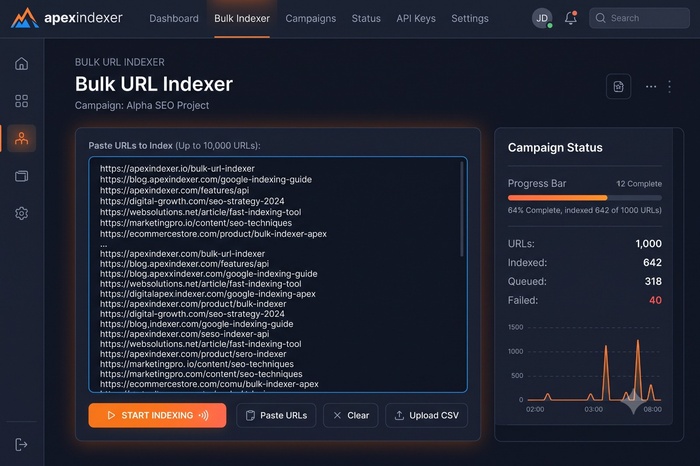
If you’ve published a new webpage but can’t find it in Google search results, you’re not alone. One of the most common SEO problems website owners face is slow or missing indexing. You spend hours creating high-quality content, optimize your page, and hit publish yet Google doesn’t seem to notice it.
This is why Bulk URL Indexer becomes a valuable solution. Instead of waiting days or even weeks for Google to discover your pages naturally, Bulk URL Indexer helps speed up the indexing process by submitting multiple URLs efficiently and improving their chances of being crawled and get indexed.
For this purpose, you’ll learn why your pages are not getting indexed, how to diagnose the problem, and how Bulk URL Indexer can help improve your website’s visibility on search engines.
What actually Google Indexing looks like?
Before understanding the problem, it’s important to know what indexing actually is.
Google indexing is the process where Google’s bots crawl your webpage, analyze its content, and store it in Google’s search database. Only indexed pages are eligible to appear in search results.
If your page isn’t indexed, it simply cannot rank—no matter how good your content or backlinks are.
Using Bulk URL Indexer helps notify search engines about your important URLs, reducing unnecessary delays.
Why Is My Page Not Indexed by Google?
There are several reasons why Google may not be indexing your page.
1. Your Page Is Too New
Google doesn’t instantly discover every newly published page. If your website is new or has low authority, Google may crawl it less frequently.
Using Bulk URL Indexer allows you to submit multiple fresh URLs, helping search engines discover them faster instead of waiting for natural crawls.
2. Your Page Has a “Noindex” Tag
A simple meta tag can completely block indexing.
Example:
<meta name=”robots” content=”noindex”>
If this tag exists, Google will intentionally avoid adding your page to its index.
Always check your page source before assuming there’s an indexing issue.
3. Your Robots.txt File Blocks Crawlers
Your robots.txt file controls which pages search engines can crawl.
If you’ve accidentally blocked important folders or URLs, Google won’t even access your content.
Before using apex indexer the best google indexer, verify that your robots.txt isn’t preventing crawling.
4. Poor Internal Linking
Google discovers pages by following links.
If your page has no internal links pointing to it, Google may never find it.
Create logical internal links from relevant pages, then submit those URLs using Bulk URL Indexer for better crawl efficiency.
5. Low-Quality or Thin Content
Google prefers useful, original, and informative content.
Pages with only a few sentences, copied information, or AI-generated spam often remain unindexed.
Focus on:
- Original information
- Helpful explanations
- User-focused writing
- Proper formatting
- Relevant images
Even when using Bulk URL Indexer, quality content remains essential.
6. Duplicate Content
If several pages contain nearly identical information, Google usually indexes only one version.
Avoid publishing duplicate product descriptions, copied blog posts, or similar landing pages without unique value.
7. Slow Website Performance
A slow-loading website negatively affects crawling.
Improve your website by:
- Compressing images
- Using browser caching
- Reducing unnecessary scripts
- Choosing quality hosting
After performance improvements, use Bulk URL Indexer to resubmit important URLs.
8. Weak Website Authority
New websites with very few backlinks usually receive fewer Google crawls.
Building quality backlinks and regularly using Bulk URL Indexer helps search engines discover your pages more consistently.
How Bulk URL Indexer Helps Speed Up Indexing
Many website owners publish dozens or even hundreds of pages every month.
Submitting each URL manually isn’t practical.
This is where Bulk URL Indexer becomes extremely useful.
Instead of handling URLs one at a time, Bulk URL Indexer lets you submit multiple pages together, making the indexing workflow faster and more efficient.
Benefits include:
- Faster URL discovery
- Bulk submission support
- Better crawl efficiency
- Saves significant time
- Ideal for blogs, ecommerce, and agencies
Although Bulk URL Indexer cannot guarantee Google indexing, it increases the likelihood that Google discovers your pages sooner.
Best Practices Before Using Bulk URL Indexer
Even the best indexing tools work better when your website follows SEO best practices.
Make sure you:
- Publish unique content.
- Optimize title tags.
- Write compelling meta descriptions.
- Build internal links.
- Submit XML sitemaps.
- Fix crawl errors.
- Improve page speed.
- Remove duplicate content.
Then use Bulk URL Indexer to accelerate the discovery process.
How to Check If Your Page Is Indexed
There are several simple methods.
Use Google’s Search Operator
Search:
site:yourdomain.com/page-url
If your page appears, it’s indexed.
If nothing appears, Google hasn’t indexed it yet.
Check Google Search Console
Open the URL Inspection Tool.
It will show whether:
- The page is indexed
- It has crawl issues
- It is blocked
- It is eligible for indexing
If everything looks good, submit it and consider using Bulk URL Indexer for multiple pages.
Common Indexing Mistakes to Avoid
Many website owners unknowingly create indexing problems.
Avoid these mistakes:
- Publishing duplicate pages
- Blocking crawlers accidentally
- Forgetting XML sitemaps
- Using poor internal linking
- Creating thin content
- Ignoring crawl errors
- Expecting instant indexing
Fixing these issues significantly improves your indexing success.
Final Thoughts
If you’re asking, “Why is my page not indexed by Google?”, the answer usually comes down to technical SEO issues, content quality, or slow discovery.
While no tool can force Google to index a page, Bulk URL Indexer provides a practical way to help search engines discover multiple URLs faster. Combined with high-quality content, proper internal linking, optimized site performance, and good SEO practices, Bulk URL Indexer can become an important part of your indexing strategy.
Instead of waiting weeks for Google to find your pages naturally, take a proactive approach. Audit your website, resolve technical issues, publish valuable content, and use Bulk URL Indexer to streamline the indexing process and improve your chances of appearing in search results sooner.
FAQs
1. Why is my page not indexed by Google?
Your page may not be indexed due to crawl issues, a noindex tag, poor content quality, duplicate content, blocked robots.txt settings, or because Google has not discovered the page yet.
2. How can I check if my page is indexed by Google?
Search using site:yourdomain.com/page-url in Google or use the URL Inspection Tool in Google Search Console to verify the indexing status.
3. How long does Google take to index a new page?
Google can index a page within a few hours, but it may also take several days or even weeks depending on your website’s authority, crawl frequency, and content quality.
4. Does Bulk URL Indexer guarantee Google indexing?
No. Bulk URL Indexer cannot guarantee indexing because only Google decides which pages to include. However, it helps search engines discover your URLs faster, improving the chances of quicker indexing.
5. Is Bulk URL Indexer safe to use?
Yes. A reliable Bulk URL Indexer simply helps submit URLs for discovery and does not violate Google’s guidelines when used properly.
6. Why is my page crawled but not indexed?
This usually happens when Google considers the page to have thin, duplicate, or low-value content, or believes another page better satisfies the same search intent.
7. Can poor content prevent Google from indexing my website?
Yes. Google prefers original, helpful, and high-quality content. Thin or duplicate pages are less likely to be indexed.
8. Should I submit every new page to Google?
Submitting important pages through Google Search Console and using Bulk URL Indexer for multiple URLs can help Google discover your content more efficiently.
9. Does an XML sitemap improve indexing?
Yes. An XML sitemap helps search engines find your important pages, making crawling and indexing more efficient.
10. Can robots.txt stop my page from being indexed?
Yes. If your robots.txt file blocks Googlebot from crawling a page, Google may not be able to index it properly.
11. What is the fastest way to get a page indexed?
The fastest approach is to publish high-quality content, create internal links, submit the URL through Google Search Console, maintain an updated XML sitemap, and use Bulk URL Indexer to speed up URL discovery.
12. Why is Google indexing some pages but not others?
Google evaluates every page individually. Factors like content quality, duplicate content, internal linking, crawl budget, and technical SEO all influence whether a page gets indexed.
























Leave a Reply