


The phrase gets thrown around a lot, but most people only have a vague idea of what it actually means to hire dedicated programmers. Some assume it’s just another word for outsourcing. Others think it means hiring a freelancer for a slightly longer project. Neither is quite right, and the difference matters more than it seems once you’re actually trying to build something.
At its core, this hiring model is about bringing a hire dedicated programmers (or a small group of them) onto your project on a dedicated, ongoing basis, someone who works exclusively on your work for the duration of the engagement, rather than juggling five other clients at once. It sounds simple when you put it that way, but the implications, how the relationship works, how billing happens, how much control you retain, are worth unpacking properly.
Understanding the Concept Behind Dedicated Hiring
The word “dedicated” is doing a lot of work in that phrase, and it’s the part most people overlook. It doesn’t just mean a programmer who’s good at their job; it means someone whose working hours, attention, and priorities are reserved specifically for your project during the agreed period.
This is different from a project-based contract, where a developer is hired to complete a specific deliverable and then moves on. With dedicated hiring, you’re essentially renting a slice of someone’s time and expertise on an ongoing basis, much like an employee, except they usually work through a staffing company or development agency rather than being on your direct payroll. That distinction, ongoing commitment versus one-off delivery, is really the heart of what this hiring model is about.
How Hiring Dedicated Programmers Actually Works?
In practice, the process tends to follow a fairly predictable pattern, even though the exact steps vary between providers.
The Hiring and Matching Process
You typically start by describing what you need, the tech stack, the experience level, whether you need a frontend specialist, a backend engineer, or someone full-stack. The agency or platform then shortlists candidates who match that profile, and you usually get to interview them yourself before making a final decision. This is a meaningful difference from random freelance hiring, where you’re often choosing based on a profile and a portfolio alone, with far less visibility into how that person actually works day to day.
How Dedicated Programmers Fit Into Your Team?
Once hired, the hire dedicated programmers usually integrates into your existing workflow. They join your stand-up calls, use your project management tools, and report progress the same way an in-house employee would. Some companies choose to hire dedicated programmers specifically because they want this level of integration without the overhead of formal employment, payroll taxes, benefits, office space, and the long hiring cycles that come with full-time recruitment.
Dedicated Programmers vs Other Hiring Models
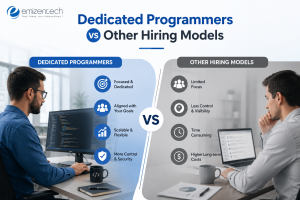
It helps to place this model next to the alternatives, since the differences become much clearer in comparison.
Compared to Freelancers
Freelancers, especially those found on open marketplaces, often work across multiple projects simultaneously. That’s not necessarily a bad thing, plenty of freelancers manage their time well, but it does mean your project is competing for their attention. A hire dedicated programmer, by contrast, is contractually committed to working only on your project during the agreed hours, which tends to produce more consistent availability and fewer scheduling surprises.
Compared to In-House Hiring
In-house hiring gives you the most control, obviously, since the person is your direct employee. But it also comes with the slowest ramp-up time, recruitment, interviews, paperwork, onboarding, and the long-term cost of salary, benefits, and equipment. Choosing to hire dedicated programmers instead often shortens that timeline significantly, since the agency has already handled the vetting and the administrative overhead. You get someone who behaves like an in-house team member, minus the hiring delay and the long-term commitment.
What You Get When You Hire Dedicated Programmers?
Beyond the structural differences, there are a few practical outcomes worth mentioning. Take a small business building a customer support ticketing tool. They might need a backend developer for eight months, not forever, but definitely longer than a quick freelance gig. Hiring someone dedicated for that period means the same person stays with the codebase the entire time, understanding its quirks, its history, and its specific architecture decisions, rather than having different freelancers jump in and out, each needing time to get up to speed.
Continuity like this also reduces a particular kind of risk that’s easy to underestimate, the risk of losing project knowledge. When one developer leaves halfway through a freelance engagement, whoever replaces them often has to relearn the codebase from scratch, which slows everything down. Hire dedicated programmers arrangements are usually structured to minimize this, either through long-term commitments or through replacement guarantees if someone does leave.
When does this hiring model make the Most Sense?
This approach isn’t always the right fit. For a quick, well-defined task, fixing a bug, adding a small feature, a short freelance contract is often more efficient and cheaper. Dedicated hiring tends to make more sense for ongoing development work, products that are still evolving, or situations where you need consistent technical support over months rather than weeks.
It also tends to suit businesses that don’t have the internal bandwidth to manage a full hiring pipeline themselves but still want something closer to an in-house experience than what typical freelance platforms offer. A growing SaaS company adding new features every quarter, for instance, usually benefits more from a stable,hire dedicated programmers team than from constantly re-hiring freelancers for each new feature cycle.
What’s Usually Included in the Rate
The quoted rate typically covers the programmer’s time and, depending on the provider, some level of project management or coordination support. What it usually doesn’t include is your own internal communication overhead, you’ll still need someone on your side, even if it’s just you, to provide direction, review progress, and answer questions as they come up. A common misconception is that dedicated hiring removes the need for any management on your end. It reduces it considerably compared to building an in-house team from scratch, but it doesn’t eliminate it entirely.
This approach isn’t always the right fit. For a quick, well-defined task, fixing a bug, adding a small feature, a short freelance contract is often more efficient and cheaper. Dedicated hiring tends to make more sense for ongoing development work, products that are still evolving, or situations where you need consistent technical support over months rather than weeks.
It also tends to suit businesses that don’t have the internal bandwidth to manage a full hiring pipeline themselves but still want something closer to an in-house experience than what typical freelance platforms offer. A growing SaaS company adding new features every quarter, for instance, usually benefits more from a stable, dedicated team than from constantly re-hiring freelancers for each new feature cycle.
Conclusion
At its simplest, hiring dedicated programmers means getting consistent, focused technical support without committing to the long-term overhead of full-time employment. It sits in a useful middle ground, more reliable and integrated than typical freelance work, but more flexible and faster to set up than traditional hiring. Companies like EmizenTech that work with businesses across different project stages often see how much smoother ongoing development becomes once a team has dedicated programmers who stay with the project long enough to actually understand it, rather than starting fresh with someone new every few weeks.
This matters most when a project isn’t a one-time task but something that keeps evolving, new features, bug fixes, performance improvements, security updates, all of which benefit from continuity rather than a revolving cast of unfamiliar developers. A business that switches hire dedicated developers every few months ends up paying an invisible tax in onboarding time, repeated explanations, and inconsistent coding decisions, even if the hourly rate looks cheaper on paper. Dedicated hiring avoids a lot of that friction simply by keeping the same person, or team, embedded in the project long enough to actually know it well.
That said, this model isn’t a universal fix. It works best when there’s enough ongoing work to justify the commitment, and it’s worth being honest about whether your project genuinely needs that kind of continuity before going down this route. For short, well-defined tasks, a freelancer might still be the simpler choice. But for products meant to grow and change over time, hire dedicated programmers tend to offer a level of stability that’s hard to replicate any other way.
Frequently Asked Questions
Is hire dedicated programmers the same as outsourcing?
Not exactly. Outsourcing can refer to many different arrangements, including project-based contracts. Dedicated hiring specifically means the programmer works exclusively on your project for an agreed period, similar to an in-house role.
How long do dedicated programmer engagements usually last?
It varies widely, but most engagements run for several months to a year or more, since this model is built for ongoing work rather than short, one-off tasks.
Can I interview the programmer before committing?
Yes, in most cases. Reputable agencies allow you to interview shortlisted candidates yourself before finalizing the hire, which gives you more control than typical freelance platforms.
What happens if a hire dedicated programmer leaves mid-project?
Most agencies offer a replacement process to minimize disruption, though the speed and quality of that replacement depend on the provider you choose.
Is this hiring model more expensive than freelancing?
Not necessarily. While hourly rates can be similar or slightly higher, the consistency and reduced management overhead often make it more cost-effective for longer projects compared to repeatedly hiring different freelancers.























Leave a Reply