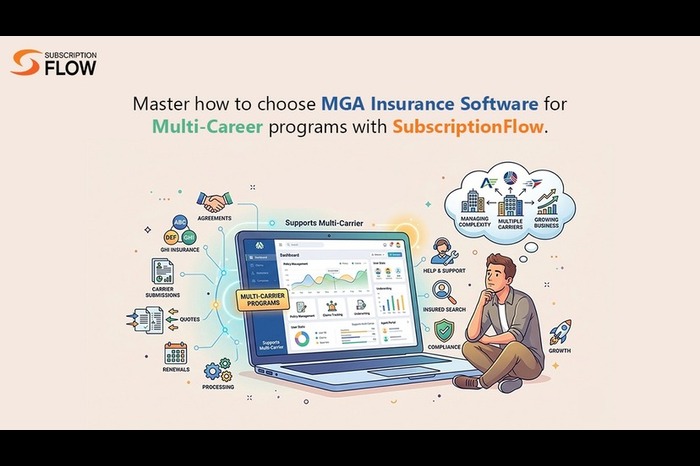
Why Multi-Carrier MGAs Need the Right Technology
Managing General Agents (MGAs) have become an integral part of the modern insurance industry by connecting insurance carriers with retail agents and brokers while providing specialized underwriting expertise. As the insurance market grows more competitive, many MGAs are expanding their business by partnering with multiple carriers instead of relying on a single capacity provider. While this strategy creates more revenue opportunities and broadens product offerings, it also introduces operational complexity that requires the right technology.
Choosing the right MGA Insurance Software for Multi-Carrier Programs is one of the most important decisions an MGA can make. Every carrier has unique underwriting guidelines, rating methodologies, policy documents, commission structures, compliance requirements, and reporting standards. Managing all these differences manually or through disconnected software creates inefficiencies that slow business growth.
Modern MGA Insurance Software for Multi-Carrier Programs provides a centralized platform where underwriting, policy administration, billing, reporting, and carrier management work together. Instead of switching between multiple systems, MGA teams can manage every carrier relationship from one interface while improving accuracy, efficiency, and customer service.
Understanding the Challenges of Multi-Carrier Programs
Running multiple carrier programs is much more challenging than simply offering additional insurance products. Every carrier has its own operational processes that must be followed carefully.
One insurer may allow straight-through underwriting for standard risks, while another requires manual approval whenever specific underwriting conditions are triggered. Rating models also vary significantly. Some carriers rely on ISO-based pricing with customized adjustments, while others use proprietary rating algorithms or external rating engines.
Documentation requirements create another layer of complexity. Each carrier maintains separate policy forms, endorsements, declarations, cancellation notices, and state-specific compliance documents. Using incorrect forms or outdated wording may result in regulatory issues, policy disputes, or dissatisfied customers.
Financial reporting is equally demanding. MGAs are responsible for producing accurate bordereaux reports that summarize premiums, commissions, taxes, claims activity, and policy transactions. Since every carrier often requires different reporting formats, preparing these reports manually becomes increasingly difficult as carrier relationships expand.
This is why MGA Insurance Software for Multi-Carrier Programs has become essential for organizations that want to scale efficiently while maintaining operational consistency.
Essential Features to Look For
When evaluating MGA Insurance Software for Multi-Carrier Programs, organizations should focus on flexibility, automation, and scalability rather than simply comparing feature lists.
A flexible rating engine should allow business users to configure carrier-specific pricing rules, discounts, surcharges, deductibles, and underwriting requirements without relying on software developers whenever changes occur.
Centralized policy administration is equally important. The platform should support quoting, binding, endorsements, renewals, reinstatements, cancellations, and policy servicing across every carrier program from one dashboard. This reduces training requirements while improving operational visibility.
Automated underwriting workflows help eliminate repetitive manual tasks by routing submissions according to predefined carrier rules. Low-risk applications can move through straight-through processing while more complex risks are automatically referred to senior underwriters.
Configurable product management is another essential capability. Since insurance products frequently change, software should allow operations teams to update coverage options, forms, exclusions, and endorsements without expensive customization projects.
Document generation, commission management, premium billing, bordereaux reporting, business intelligence dashboards, and audit trails should also be included within the platform to support day-to-day operations.
Why Integration Capabilities Matter
Insurance organizations depend on multiple technology platforms that must work together efficiently. Customer relationship management software, accounting systems, payment gateways, electronic signature solutions, claims management platforms, and regulatory databases all play important roles.
Modern MGA Insurance Software for Multi-Carrier Programs should offer strong API capabilities that allow seamless integration with both carrier systems and third-party applications. These integrations reduce duplicate data entry, improve reporting accuracy, automate financial reconciliation, and provide real-time visibility across departments.
Strong integration capabilities also make onboarding new carrier partners much easier. Rather than building separate manual processes for every carrier, MGAs can connect systems through standardized interfaces that improve operational efficiency.
Questions to Ask Software Vendors
Software demonstrations often highlight impressive features, but decision-makers should also understand how the platform performs in real-world multi-carrier environments.
Before selecting MGA Insurance Software for Multi-Carrier Programs, ask vendors how many carrier programs the platform currently supports for existing customers. Determine whether internal business users can configure new carrier programs independently or whether every change requires vendor involvement.
Ask how long it typically takes to onboard a new carrier relationship and whether the system supports separate underwriting workflows, commission structures, billing schedules, and reporting templates for different carriers.
It is equally important to discuss security. Vendors should explain their disaster recovery procedures, user permissions, audit logging, encryption standards, and compliance certifications.
Finally, request customer references from MGAs with similar business models. Speaking with existing users often provides valuable insights into implementation experiences and long-term platform performance.
Why Configurability Matters More Than Feature Count
Many insurance software vendors compete by advertising extensive feature lists. However, flexibility usually provides greater long-term value than simply offering hundreds of features.
Insurance carriers regularly update underwriting guidelines, pricing models, commissions, policy forms, and compliance requirements. The best MGA Insurance Software for Multi-Carrier Programs allows operations teams to make these changes through configuration instead of software development.
Configurable systems reduce implementation costs, shorten product launch timelines, and improve organizational agility. Instead of waiting weeks for software updates, MGAs can respond immediately to changing market conditions while continuing to deliver excellent customer service.
Business users gain greater control over workflows while reducing dependency on IT departments and external vendors.
Warning Signs of Poor Software Architecture
Not every insurance platform is designed to support growing MGA operations. Certain limitations indicate that software may struggle as business complexity increases.
Rigid rating engines that require manual calculations create unnecessary administrative work. Separate dashboards for different carrier programs reduce productivity and increase training requirements. Limited workflow customization forces every carrier into identical processes regardless of operational differences.
Weak API support makes integration difficult, while manual bordereaux reporting consumes valuable staff time every reporting cycle. Inflexible commission management often creates accounting challenges whenever compensation agreements differ across carrier programs.
High-quality MGA Insurance Software for Multi-Carrier Programs should eliminate these operational bottlenecks through centralized management, automation, and configurable business rules.
Preparing for the Future
The insurance industry continues evolving through cloud computing, automation, artificial intelligence, predictive analytics, and digital customer experiences. MGAs that invest in scalable technology today will be better positioned to compete tomorrow.
Future-ready MGA Insurance Software for Multi-Carrier Programs will increasingly incorporate AI-powered underwriting recommendations, intelligent document processing, predictive reporting, and real-time carrier integrations. These innovations help organizations reduce operating costs while improving underwriting accuracy and customer satisfaction.
Cloud-native platforms also enable geographically distributed teams to collaborate more effectively while supporting business continuity and remote work environments.
As competition increases, technology will become one of the strongest differentiators for successful MGAs.
Final Thoughts
Selecting the right MGA Insurance Software for Multi-Carrier Programs is a strategic investment that directly affects operational efficiency, underwriting consistency, regulatory compliance, customer satisfaction, and long-term profitability.
Rather than choosing software based solely on the number of available features, MGAs should prioritize configurability, automation, scalability, integration capabilities, reporting flexibility, and user experience. A modern platform should simplify complex carrier operations while allowing organizations to adapt quickly as business requirements evolve.
Organizations that invest in MGA Insurance Software for Multi-Carrier Programs gain the flexibility to onboard new carrier partners faster, streamline policy administration, automate repetitive tasks, improve reporting accuracy, and deliver better service to agents and policyholders. As the insurance industry continues embracing digital transformation, selecting the right technology today creates a strong foundation for sustainable growth and long-term competitive success.